Araucaria angustifolia: The Iconic Paraná Pine Tree
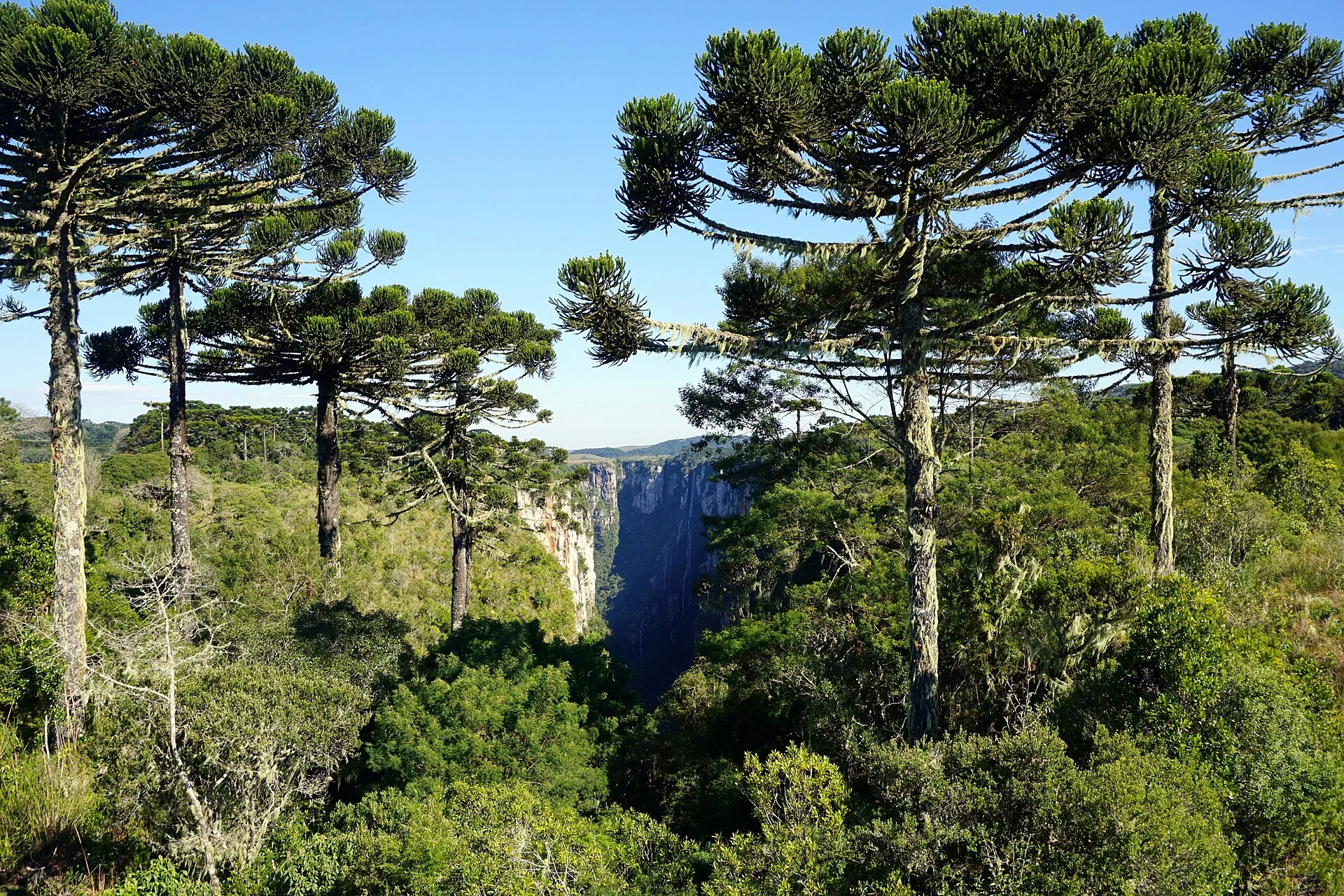
Towering above the misty canopy of the South American moist forests, a giant with a prehistoric candelabra-like silhouette commands the landscape. This magnificent conifer, scientifically known as Araucaria angustifolia, has deep roots dating back to the Triassic period when it flourished across the supercontinent of Gondwana. Today, it stands as an enduring symbol of the southern highlands, though its ancient reign is severely threatened by modern pressures.
Often mischaracterized as a true pine, the Brazilian pine belongs to an entirely different lineage that evolved unique adaptations to its subtropical environment. The monumental architecture of Araucaria angustifolia dominates the skyline, offering crucial shelter and sustenance to specialized wildlife. Its large, nut-like seeds, which take over a year to mature, represent a vital food source that sustains both native animals and indigenous communities through the winter months.
Taxonomy
∟царствоPlantae
∟divisionTracheophytes(Vascular Plants)
∟subdivisionSpermatophytes(Seed plants)
∟superclassGymnospermae(Gymnosperms)
∟divisionPinophyta(Conifers)
∟subclassCupressidae
∟orderAraucariales(Southern pines and monkey-puzzles)
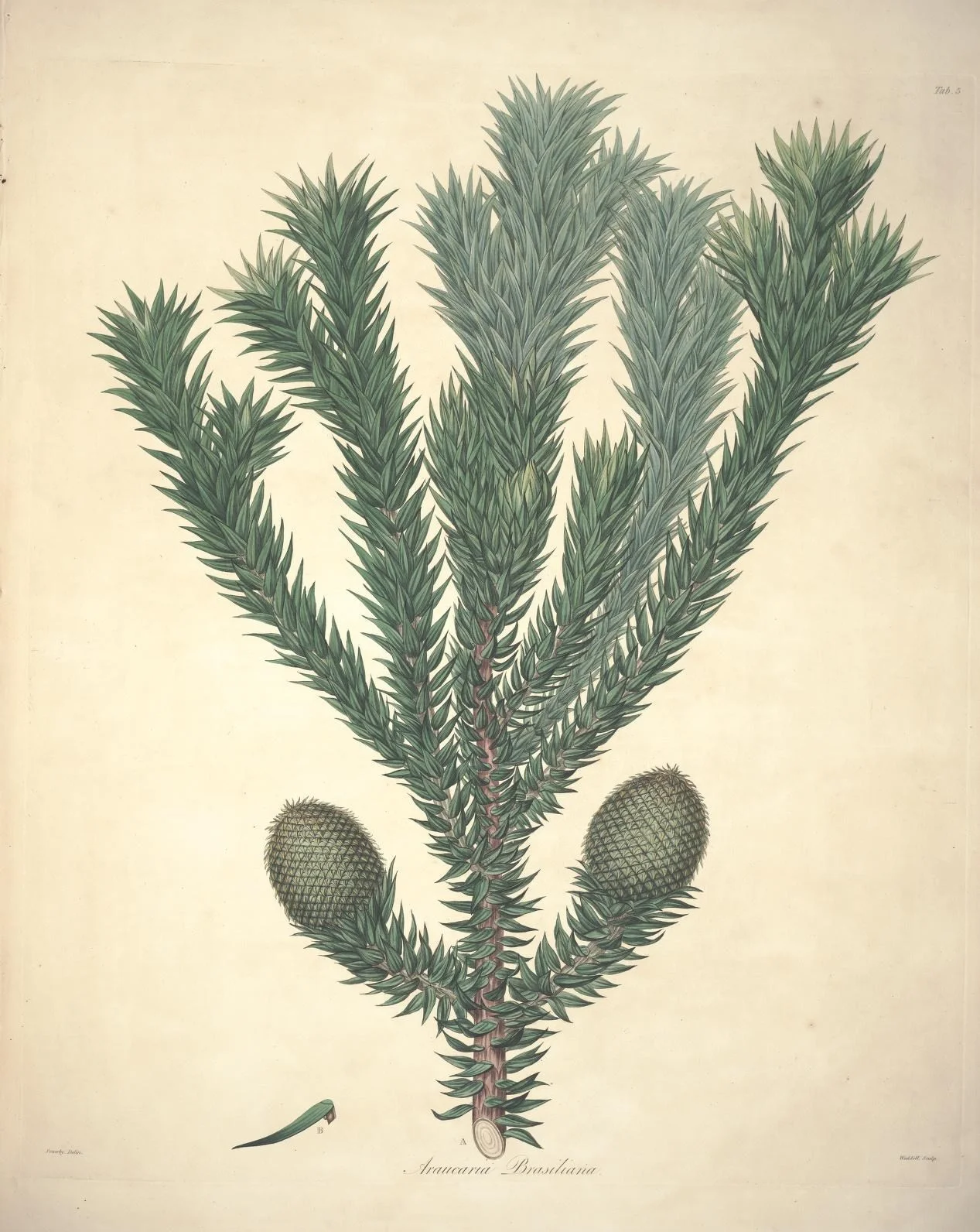
Botanical illustration
Фото: BioDivLibrary / Лицензия: Public Domain Mark
Morphology
This evergreen titan can reach an impressive height of 40 meters, supported by a massive columnar trunk that measures up to one meter in diameter. As Araucaria angustifolia matures, its initial conical shape transforms into a distinct, flat-topped umbrella or candelabra crown. The lower branches are naturally shed in dense forests, leaving a bare trunk covered in unusually thick, resinous bark that provides excellent protection against environmental stress.
The distinctive foliage consists of tough, scale-like, and triangular leaves that are sharply pointed at the tips. These razor-edged needles measure three to six centimeters in length and persist on the tree for over a decade, densely covering the younger branches. The inner bark and the resin produced by the trunk exhibit a striking reddish hue, distinguishing it from closely related South American conifers.
Most individuals are dioecious, meaning male and female cones develop on separate trees. The pollen-producing male cones are elongated and rely entirely on wind for pollination, while the massive, spherical female cones can reach 25 centimeters in diameter. These heavy seed cones take approximately 18 months to ripen and shatter upon maturity to release large, nut-like seeds.
Flowering season
Wind pollination occurs primarily in early spring, with male cones releasing pollen between September and October.
Jan
Feb
Mar
Apr
May
Jun
Jul
Aug
Sep
Oct
Name
Dec
Applications
The highly nutritious seeds of Araucaria angustifolia, locally known as pinhão, are a culinary staple in southern Brazil and are traditionally boiled or roasted as a winter snack. Rich in starch and dietary fiber, they have historically been a crucial food source for indigenous populations like the Kaingang. Today, the harvest remains culturally significant, celebrated at annual regional fairs featuring mulled wine and roasted seeds.
In landscaping, this remarkable conifer is frequently planted as an ornamental tree in subtropical parks and large gardens globally. Its striking, reptilian-like branch structure and symmetrical growth make it a highly prized architectural specimen. Although its use has been heavily restricted due to modern conservation laws, the pale yellow softwood was historically highly valued for joinery, stair treads, and fine furniture.
Interesting facts
Fossil evidence indicates that ancestors of Araucaria angustifolia thrived over 200 million years ago, effectively making it a living fossil from the Jurassic era.
The azure jay (Cyanocorax caeruleus) plays a critical ecological role as the primary seed disperser, caching the nuts for winter and aiding the tree's natural regeneration.
The name of the Brazilian city Curitiba is derived directly from the indigenous Tupi language, translating to "pine nut land" or "forest of curís".
Despite yielding highly sought-after timber that led to massive historical deforestation, a single large female cone can weigh several kilograms and hold up to 150 edible seeds.