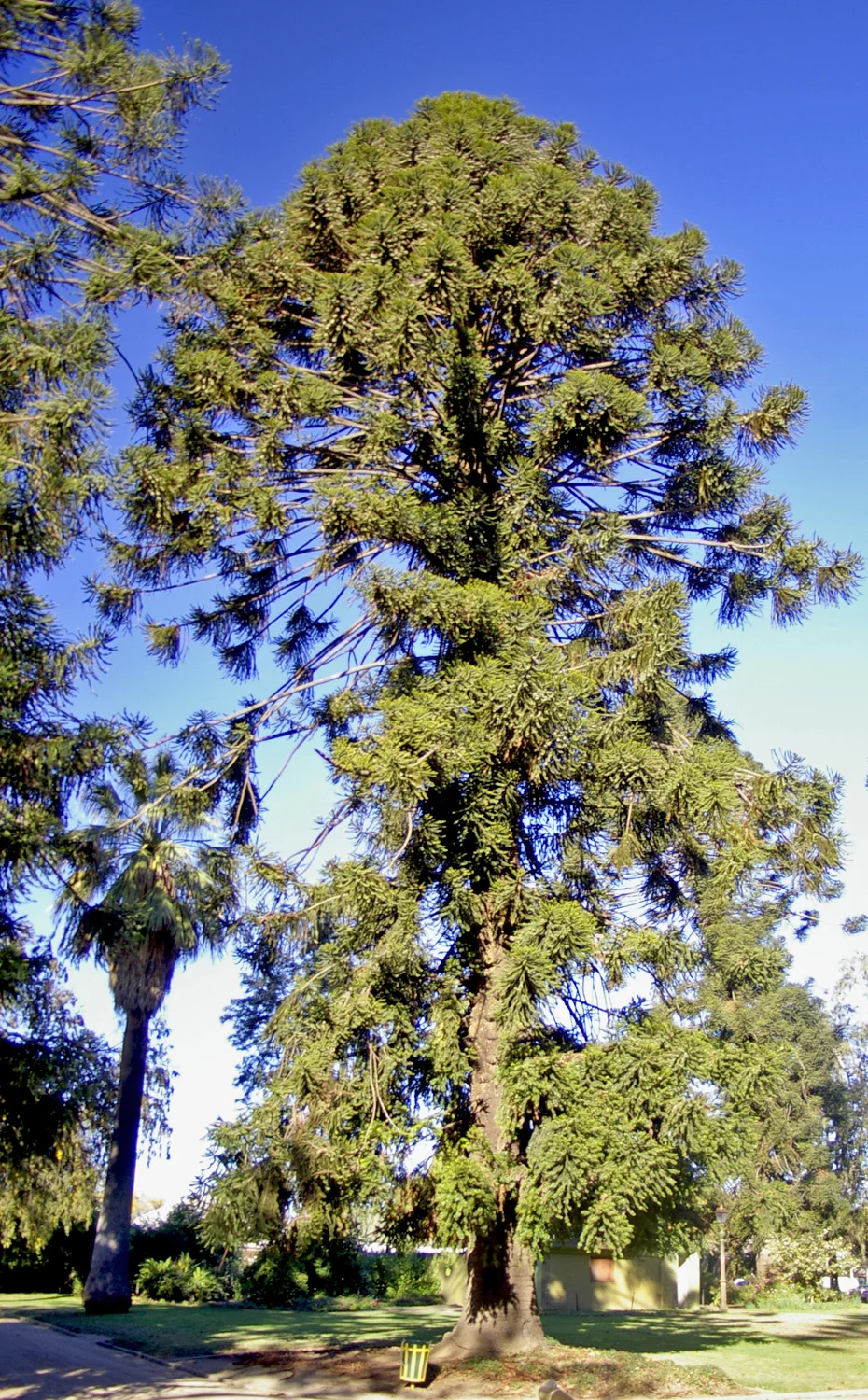
Bunya-bunya
Queensland Pine
False Monkey Puzzle Tree
IUCN: Least Concern
#6F6B45
#526ECA
#A7A37A
#8298C9
#515B80
Plant palette
Araucaria bidwillii: The Majestic Bunya Pine Guide
Towering majestically over the rainforests of Queensland, the ancient Bunya pine stands as a living relic of the Mesozoic era, dropping massive cones that echo a prehistoric past. Araucaria bidwillii commands the landscape with its distinctive dome-shaped canopy and a massive, unbranched trunk. This remarkable conifer has survived for millennia, deeply weaving itself into the ecological and cultural fabric of Australia.
Far from being a standard forest tree, Araucaria bidwillii is famous for its unique cryptogeal germination and incredibly nutritious seeds. The tree holds profound spiritual and social importance for Indigenous Australians, who historically gathered in the thousands for the Bunya festival. Today, it continues to captivate botanists and nature enthusiasts across the globe.
Taxonomy
∟царствоPlantae
∟divisionTracheophytes(Vascular Plants)
∟subdivisionSpermatophytes(Seed plants)
∟superclassGymnospermae(Gymnosperms)
∟divisionPinophyta(Conifers)
∟subclassCupressidae
∟orderAraucariales(Southern pines and monkey-puzzles)
Araucaria bidwillii is a colossal evergreen conifer that can soar to heights of 50 meters, anchored by a thick trunk adorned with dark, flaky bark. The branches are arranged in distinct whorls along the main stem, projecting horizontally to create a unique, symmetrical silhouette. As the tree matures, this initially pyramidal shape gradually softens into a broad, dome-like crown.
The foliage of Araucaria bidwillii displays striking heterophylly, meaning its leaves change significantly with age and light exposure. Juvenile leaves are bright green, narrow, and fiercely sharp, while adult leaves become darker, broader, and more leathery. These mature leaves are arranged radially around the branches, tightly overlapping each other.
As a monoecious species, this conifer bears both male and female reproductive structures on the same plant. The elongated male pollen cones appear at the tips of lower branches, while the gigantic female seed cones develop higher in the canopy. These female cones can weigh up to 10 kilograms and are tightly packed with large, wingless seeds.
Applications
The most celebrated application of Araucaria bidwillii is culinary, centered around its highly nutritious, edible seeds known as Bunya nuts. These large kernels possess a starchy texture and a savory flavor reminiscent of roasted chestnuts or potatoes. Indigenous Australians traditionally consumed them raw, roasted on hot coals, or ground into a paste to make a dense, nourishing bread.
In modern times, the timber of Araucaria bidwillii has garnered significant appreciation in the woodworking industry. Its pale, straight-grained wood is exceptionally resonant, making it a highly sought-after tonewood for the soundboards of premium acoustic guitars. Additionally, the wood is utilized by cabinet makers for fine interior trim and specialty crafts.
From a landscaping perspective, Araucaria bidwillii serves as a dramatic and imposing ornamental specimen tree. It is frequently planted in large botanical gardens and historic estates worldwide to provide architectural interest. However, due to the extreme hazard posed by its falling cones, strategic placement away from pedestrian paths and parking zones is absolutely essential.
Interesting facts
The history and ecology of Araucaria bidwillii are filled with remarkable details that highlight its unique position in the plant kingdom.
The colossal cones of Araucaria bidwillii were the focal point of the Bunya festival, a massive Indigenous Australian gathering where diverse tribes traveled hundreds of kilometers to feast, trade, and settle disputes.
This tree exhibits an unusual cryptogeal seed germination process, where the seed develops an underground tuber from which the aerial shoot may emerge several years later, likely as a survival strategy against harsh climatic conditions.
During the Mesozoic era, ancestors of this ancient conifer were widespread, with structurally similar fossilized cones discovered as far away as South America and Europe.
The massive female cones, which can reach 35 centimeters in diameter and weigh up to 10 kilograms, are capable of causing severe injuries or crushing vehicles when they plummet from the towering canopy.
A famous specimen of Araucaria bidwillii in East Los Angeles, locally known as 'El Pino', gained international fame after being featured prominently in the 1993 film 'Blood In Blood Out'.