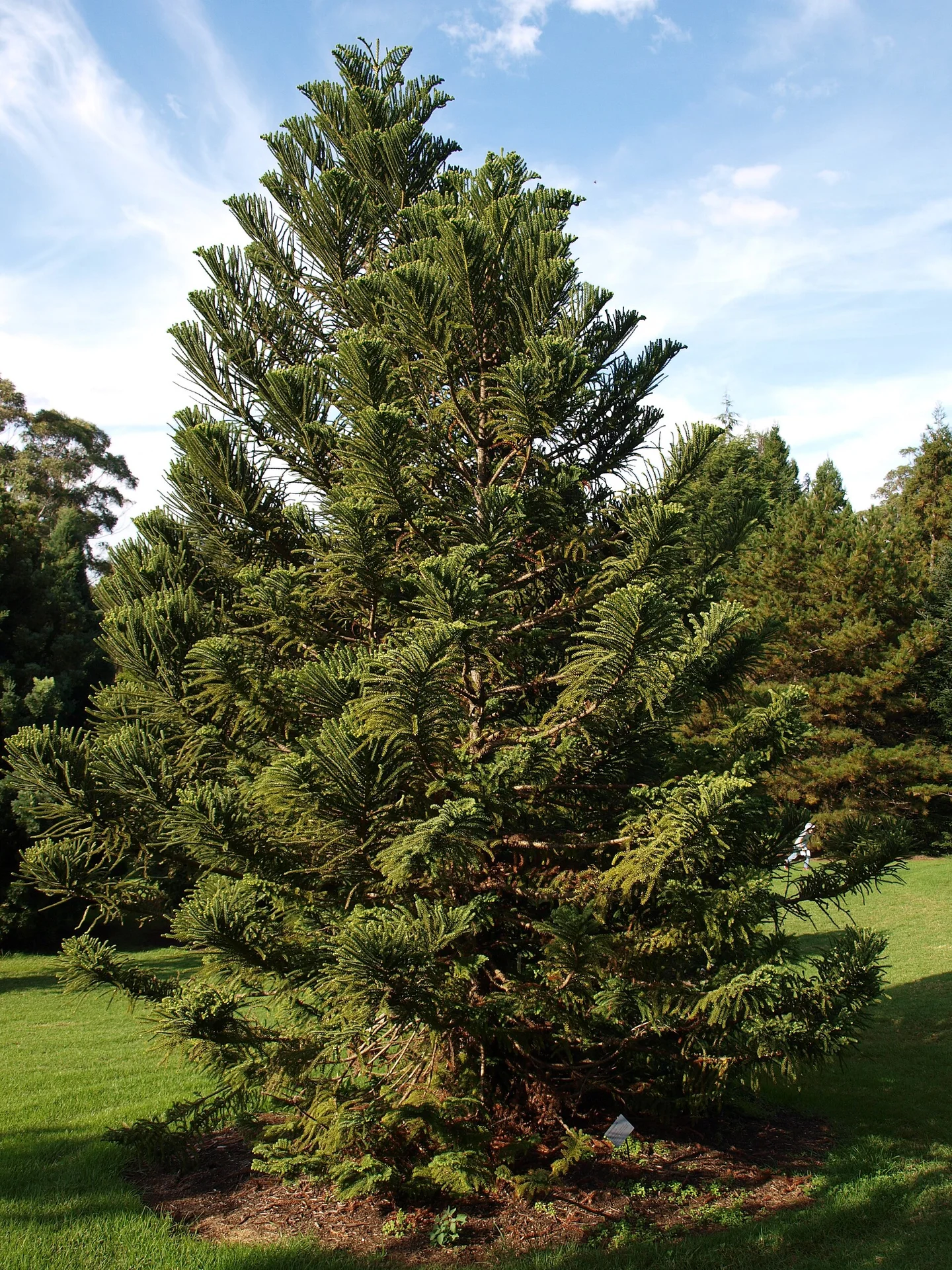
Araucaria biramulata: The Piggyback Tree of New Caledonia
In the dense, humid rainforests of New Caledonia, a peculiar silhouette pierces the canopy, characterized by a mysterious second growth tip that gives it a distinct piggybacking appearance. This is Araucaria biramulata, an impressive and rare conifer that thrives exclusively on the ultrabasic soils of Grande Terre. Reaching heights of up to 30 meters, this ancient tree stands as a living monument to the island's unique and isolated evolutionary history.
As a prominent feature of New Caledonia's rugged landscapes, Araucaria biramulata is uniquely adapted to high-altitude environments, growing at elevations between 190 and 1150 meters. The species plays a significant ecological role in these evergreen mountain forests, enduring substantial rainfall that can reach up to 3000 millimeters annually.
Taxonomy
∟царствоPlantae
∟divisionTracheophytes(Vascular Plants)
∟subdivisionSpermatophytes(Seed plants)
∟superclassGymnospermae(Gymnosperms)
∟divisionPinophyta(Conifers)
∟subclassCupressidae
∟orderAraucariales(Southern pines and monkey-puzzles)
This magnificent evergreen grows as a tall, columnar tree, featuring a grey or brown bark that exfoliates in fine, horizontal strips. The branching is intricate, with the upper canopy often branching multiple times, while the annual shoots measure about 8 to 13 millimeters in thickness.
The foliage of Araucaria biramulata undergoes a distinct transformation as the tree matures. Juvenile leaves are needle-like and sharply pointed with inwardly curved margins, whereas adult leaves develop into spreading, scale-like ovate structures about 7 to 9 millimeters long. These mature leaves are heavily keeled with a prominent midrib, curving sharply at the apex, and feature stomata on both their upper and lower surfaces.
Reproductive structures are separated into distinct male and female cones. The cylindrical male pollen cones reach 6 to 7 centimeters in length, housing microsporophylls with numerous pollen sacs. The more robust female seed cones are roughly spherical, growing 9 to 10 centimeters long, and eventually release triangular seeds equipped with delicate ovate wings for wind dispersal.
Interesting facts
The common name of Araucaria biramulata, the piggyback araucaria, is derived from a highly unusual growth anomaly found in mature specimens. Older trees frequently develop a secondary growth tip halfway up their main trunk, creating a fascinating visual illusion of a smaller tree riding piggyback on the side of a larger one.
This species is a true botanical relic, surviving exclusively on the heavy metal-rich, ultrabasic rocks of Grande Terre. This extreme soil specialization is a hallmark of New Caledonian flora, acting as an evolutionary driver for the island's incredible rate of endemism.
Despite its resilience, the tree faces significant threats in the wild, leading to a fragmented population of less than 10,000 mature individuals.
The northern populations are primarily endangered by open-pit mining operations and related infrastructure development.
In the southern part of its range, including protected areas, the regeneration of the forest is severely compromised by wildfires.
Approximately a quarter of the remaining trees are located within protected conservation zones, such as the Rivière Bleue Provincial Park.