Cook pine
New Caledonia pine
Columnar araucaria
Cook's pine
IUCN: Least Concern
#64A4D4
#8ABCB0
#3873AD
#A6CDC4
#3E7663
Plant palette
Araucaria columnaris: Cook Pine Care, Morphology & Facts
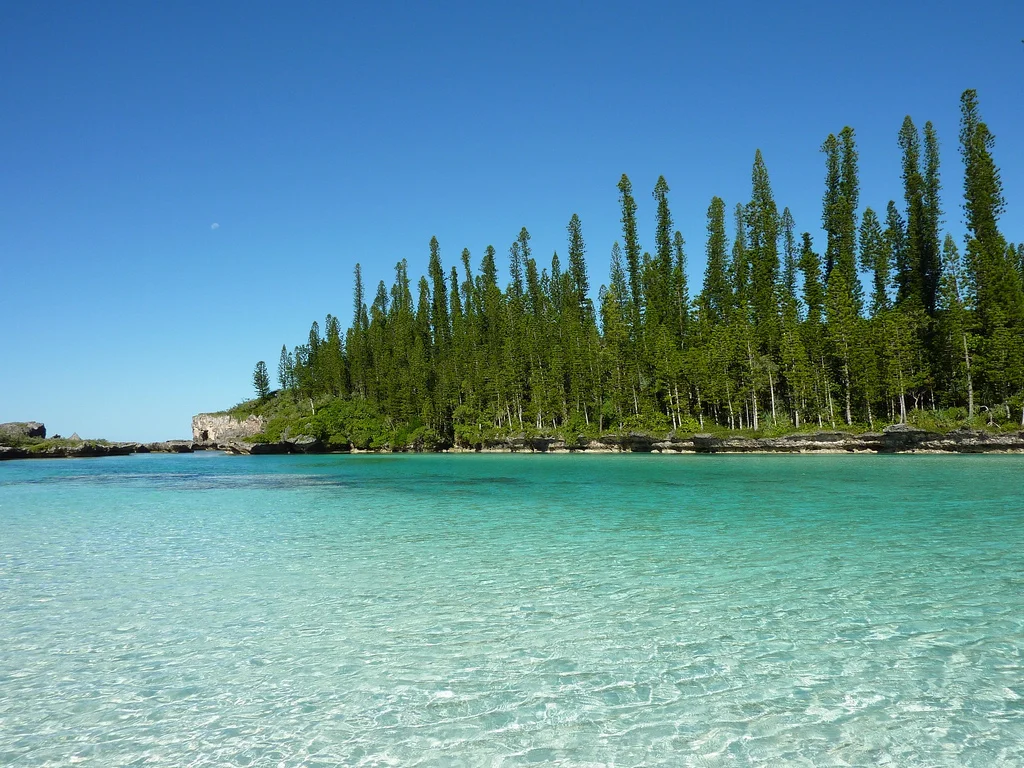
Sailing past the shores of New Caledonia in 1774, Captain James Cook marveled at towering, spire-like silhouettes that he initially mistook for basalt columns. These striking coastal trees were later named Araucaria columnaris to honor their remarkable, pillar-like appearance.
Today, the Cook pine is celebrated globally for a bizarre botanical quirk: when planted outside its native range, the trunk almost universally leans towards the equator. This majestic conifer continues to captivate botanists and landscapers alike with its resilient and unique growth habits.
Taxonomy
∟царствоPlantae
∟divisionTracheophytes(Vascular Plants)
∟subdivisionSpermatophytes(Seed plants)
∟superclassGymnospermae(Gymnosperms)
∟divisionPinophyta(Conifers)
∟subclassCupressidae
∟orderAraucariales(Southern pines and monkey-puzzles)
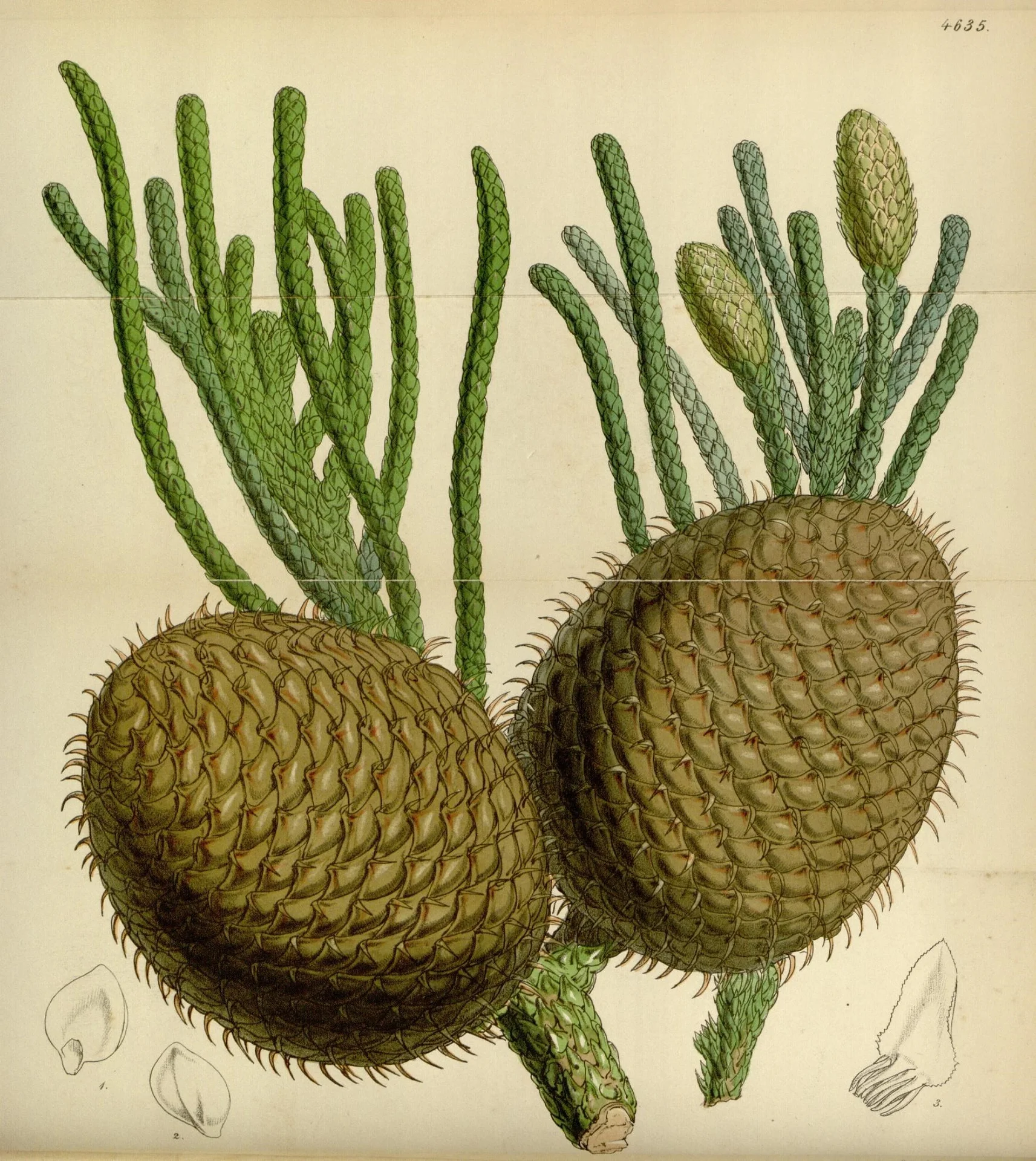
Botanical illustration
Фото: BioDivLibrary / Лицензия: Public Domain Mark
Morphology
The Cook pine is a tall, evergreen conifer that can reach impressive heights of up to 60 meters in its native habitat. It develops a very narrow, spire-like crown and a slender trunk that sheds its rough, resinous bark in thin, papery strips.
Its horizontal branches are arranged in whorls and lined with cord-like branchlets. The foliage displays distinct dimorphism: juvenile leaves are needle-like and incurved, while adult leaves are broader, triangular, and closely overlapping like scales.
As a monoecious species, Araucaria columnaris produces both male and female cones on the same tree. The male pollen cones are small and foxtail-shaped, whereas the female seed cones are large, egg-shaped, and bear winged seeds.
Flowering season
In its native Southern Hemisphere habitat, the cones typically mature and release pollen during the summer months of December and January.
Jan
Feb
Mar
Apr
May
Jun
Jul
Aug
Sep
Oct
Name
Dec
Care parameters
Light
Prefers full sun but can tolerate partial shade, especially when young.
Watering
Requires moderate watering with well-drained soil; established trees are fairly drought-tolerant.
Temperature
Thrives in warm, tropical to subtropical climates and is highly sensitive to frost.
Humidity
Adapts to various humidity levels but benefits greatly from moist, coastal air.
Toxicity
Generally considered non-toxic to humans, dogs, and cats.
Applications
Beyond its native islands, Araucaria columnaris is extensively utilized as a striking ornamental tree in public parks and urban landscapes. It is especially popular in tropical and subtropical regions like Hawaii, California, and coastal Australia.
Historically, the exceptionally straight and tall trunks of the Cook pine were highly valued as timber for constructing ship masts. In New Caledonian tradition, the indigenous Kanak people have long utilized the wood to craft traditional canoes.
Juvenile specimens are also occasionally cultivated in containers as indoor plants or living Christmas trees. In the horticultural trade, they are frequently sold and confused with the closely related Norfolk Island pine.
Interesting facts
One of the most fascinating phenomena surrounding Araucaria columnaris is its documented tendency to lean towards the equator. This unique botanical tropism remains a subject of ongoing scientific research.
Trees planted in the Northern Hemisphere lean south, while those in the Southern Hemisphere predictably lean north.
Research indicates that the degree of the trunk's tilt actually increases the further the tree is planted from the equator.
In Kanak culture, this sacred tree is traditionally planted around the dwellings of chiefs and along paths leading to important village structures.
Captain Cook named the famous Île des Pins (Isle of Pines) after observing the dense forests of these magnificent conifers lining its shores.