Araucaria luxurians: Rare Coast Araucaria of New Caledonia
Clinging to the steep cliffs and humid coastal forests of New Caledonia, Araucaria luxurians exudes a striking red resin when its grey bark peels away. This magnificent columnar conifer, uniquely adapted to the region's heavy ultramafic soils, forms a dense, pyramidal silhouette that dominates the island's skyline.
Endemic to small pockets of Grande Terre and Île Art, the coast araucaria stands as a living testament to the ancient flora of the Pacific. While its lush foliage has made it a cherished ornamental tree locally, strict export laws mean it remains a rare botanical treasure globally, unseen by most outside of specialized collections.
Taxonomy
∟царствоPlantae
∟divisionTracheophytes(Vascular Plants)
∟subdivisionSpermatophytes(Seed plants)
∟superclassGymnospermae(Gymnosperms)
∟divisionPinophyta(Conifers)
∟subclassCupressidae
∟orderAraucariales(Southern pines and monkey-puzzles)
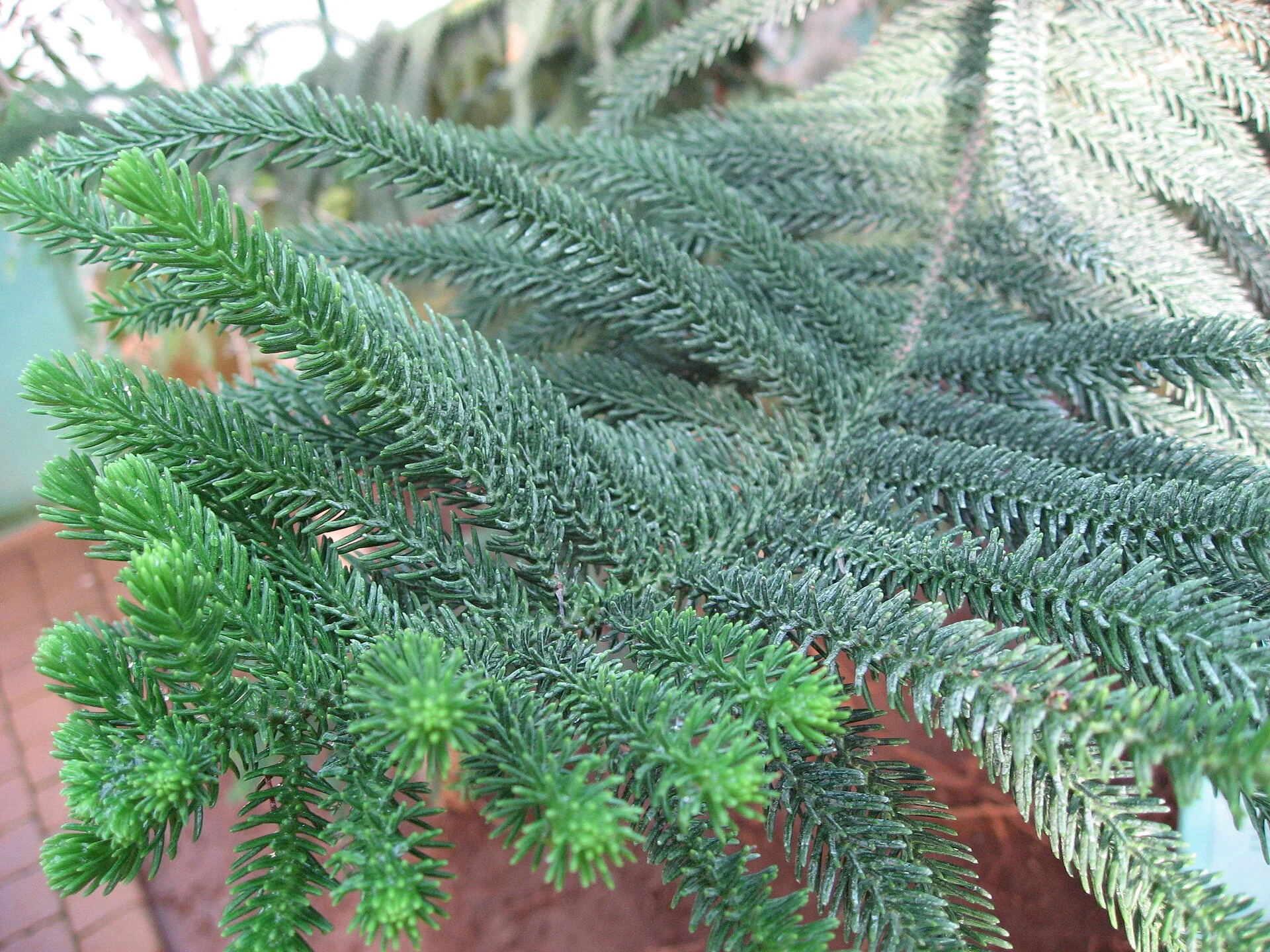
Araucaria luxurians is a towering evergreen tree that can reach staggering heights of up to 40 meters, featuring a thick trunk that grows up to 70 centimeters in diameter. Its dense, rounded crown is supported by branches that elegantly fan out at their tips, while the trunk is enveloped in grey bark that naturally exfoliates in thin strips.
The foliage of this conifer exhibits distinct dimorphism between its developmental stages. Juvenile trees produce scale-like, ovate leaves measuring 6 to 12 millimeters in length, whereas mature specimens develop tightly overlapping, imbricate leaves that are 5 to 7 millimeters long with a prominent midrib.
Its reproductive structures are equally impressive, showcasing sexual dimorphism typical of the genus.
Male cones: Cylindrical and elongated, reaching 12 to 17 centimeters in length, and bearing 12 to 15 pollen sacs per microsporophyll.
Female cones: Globose or spherical, measuring roughly 10 to 12 centimeters in both length and width.
Seeds: Elongated nutlets up to 3.5 centimeters long, equipped with triangular wings to aid in wind dispersal.
Applications
Within its native range in New Caledonia, Araucaria luxurians is highly valued for its aesthetic appeal and lush, verdant foliage. It is frequently cultivated as an ornamental plant in local gardens and urban landscapes.
During the holiday season, its dense, conical shape makes it an immensely popular choice for a living Christmas tree, locally referred to as Sapin de Noël. Due to stringent export restrictions, it is almost entirely absent from international horticulture, restricted only to select botanical gardens dedicated to ex situ conservation.
Interesting facts
The evolutionary lineage of Araucaria luxurians dates back millions of years, making it a true living fossil. The New Caledonian group of Araucaria shared their last common ancestor approximately 7 to 9 million years ago, showcasing the profound isolation of the island's ecosystems.
Some captivating facts about this rare conifer include:
Ultramafic specialist: It thrives almost exclusively on toxic, heavy-metal-rich ultramafic soils, an environment where most other plant life would struggle to survive.
Fragmented populations: The entire global population consists of fewer than 2,500 mature individuals, distributed across highly fragmented subpopulations that rarely exceed 250 trees each.
Red exudate: When its grey, exfoliating bark is damaged or peels naturally, the tree bleeds a distinctive, deep red resin.
Philately: Recognizing its botanical importance and unique beauty, the New Caledonian postal service featured this majestic tree on an official stamp in 2016.