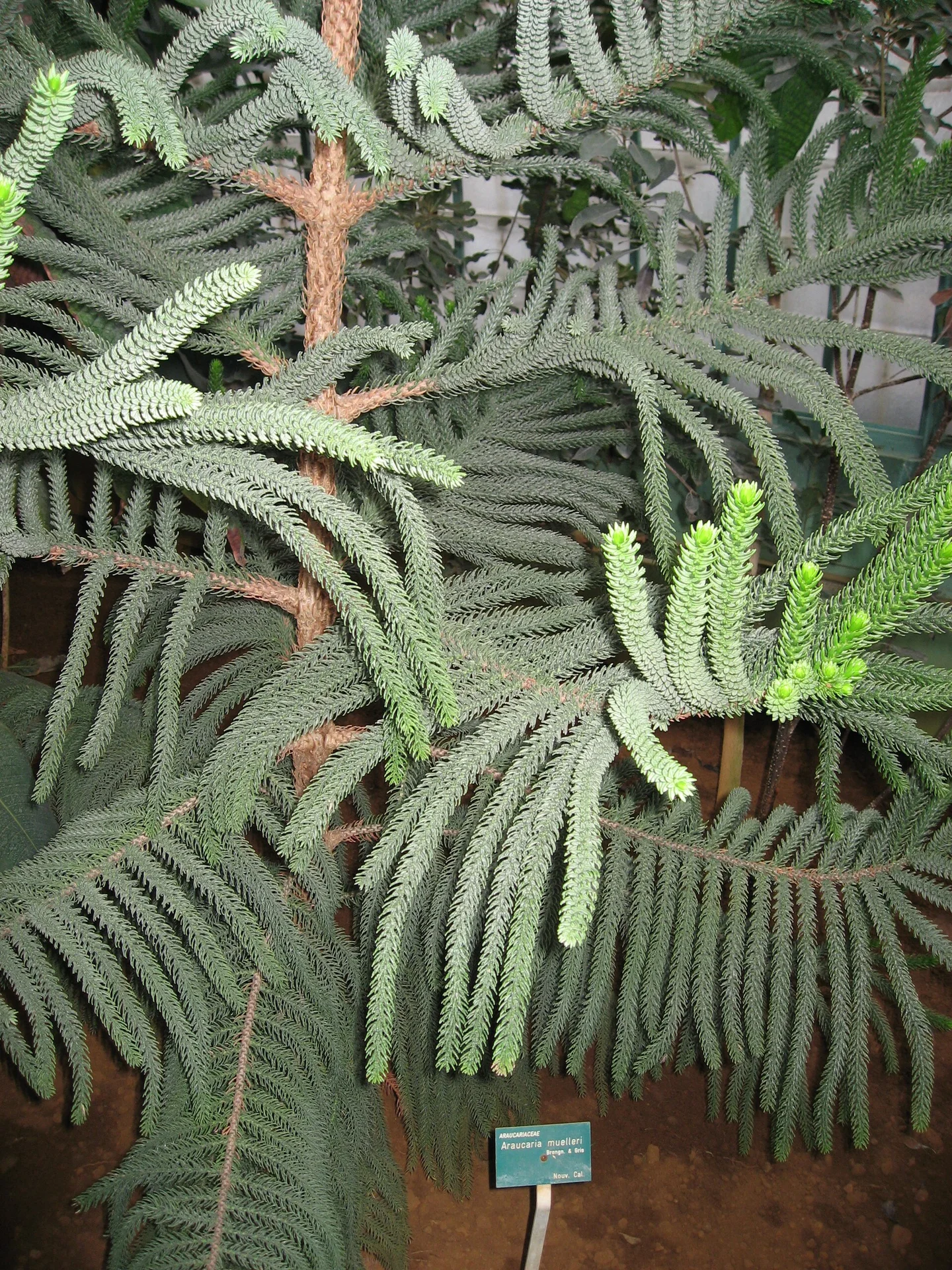
Araucaria muelleri: Characteristics, Habitat and Conservation
Native exclusively to the southern massif and Goro plateau of New Caledonia, Araucaria muelleri stands as a rare and ancient botanical specimen. The tree thrives on ultramafic soils at elevations between 150 and 1000 meters, forming a vital component of the island's unique ecosystem.
Growth and natural regeneration are remarkably slow, making the populations highly sensitive to environmental changes and mining activities. The species honors the botanist Ferdinand von Mueller, reflecting its significance in early botanical explorations.
Taxonomy
∟царствоPlantae
∟divisionTracheophytes(Vascular Plants)
∟subdivisionSpermatophytes(Seed plants)
∟superclassGymnospermae(Gymnosperms)
∟divisionPinophyta(Conifers)
∟subclassCupressidae
∟orderAraucariales(Southern pines and monkey-puzzles)
The tree reaches heights of 10 to 25 meters, developing a distinctive candelabra-shaped crown. Its grey bark naturally exfoliates in thin strips or scaly plates. Juvenile leaves are triangular, slightly flattened, and sharply pointed, measuring 2 to 2.5 centimeters in length.
Adult foliage transitions to scale-like, thick, and incurved leaves up to 3.5 centimeters long and 2 centimeters wide. Male cones are cylindrical, reaching up to 25 centimeters in length, while the robust female cones grow up to 15 centimeters long and bear widely winged seeds.
Interesting facts
The species is highly specialized for serpentine soils, which are notoriously rich in heavy metals like nickel.
Its prehistoric lineage dates back to the Mesozoic era, making it a living fossil deeply intertwined with the geological history of the region.