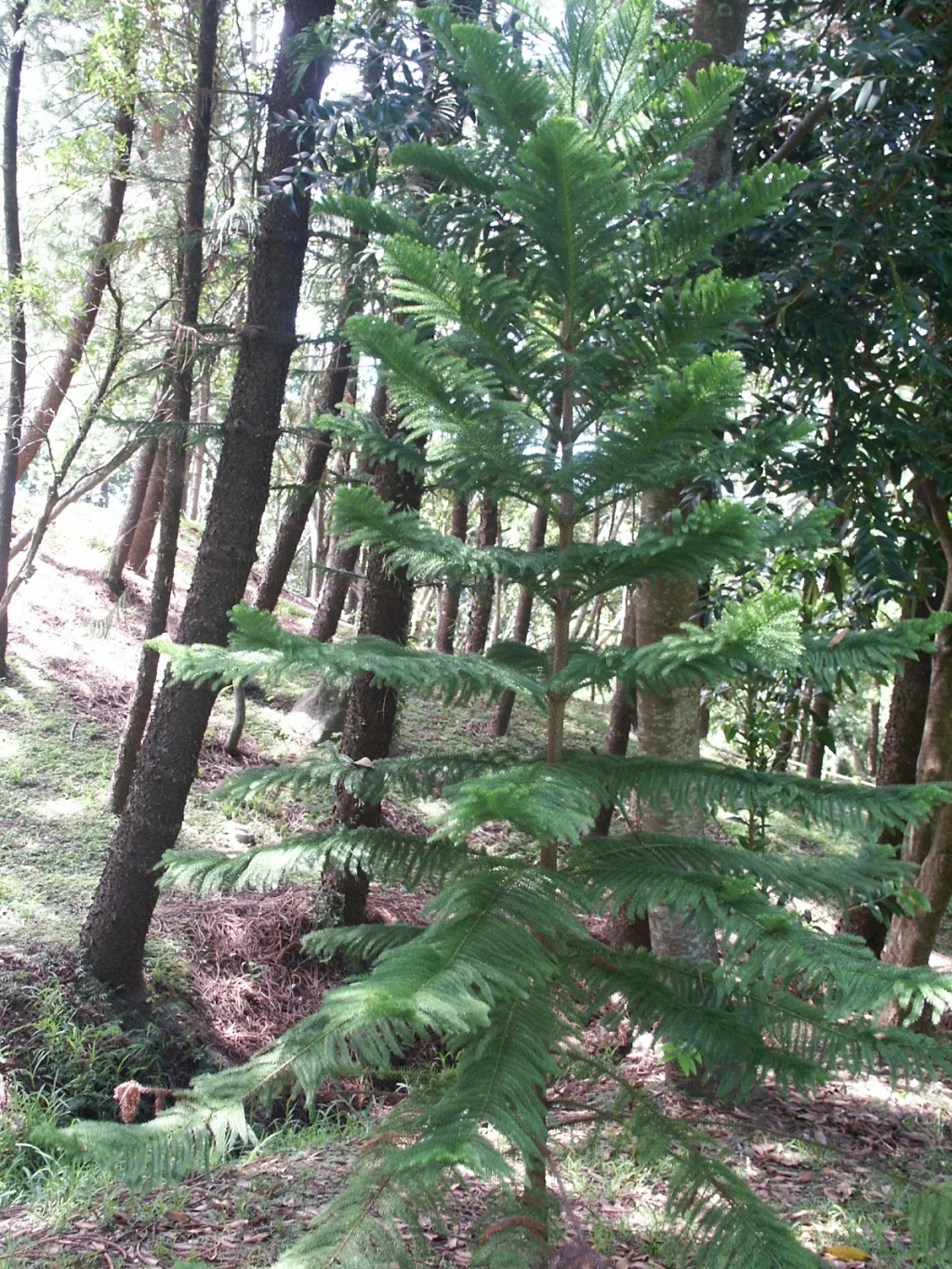
Araucaria nemorosa: The Critically Endangered Boise Araucaria
Restricted to a remarkably small geographic footprint, Araucaria nemorosa is one of the most imperiled gymnosperms on Earth. This rare conifer is exclusively endemic to the southern tip of New Caledonia, with over 90% of the surviving individuals clinging to existence in a few fragmented plots around Port Boisé. Unusually for its genus, it frequently grows as a small understory tree, demonstrating a surprising degree of shade tolerance in dense coastal forests.
The species is strictly confined to elevations below 100 meters, rarely venturing further than two kilometers from the coastline. It flourishes on serpentine soils and rocky terrain with minimal vegetation, relying on the heavy annual rainfall of the region.
Taxonomy
∟царствоPlantae
∟divisionTracheophytes(Vascular Plants)
∟subdivisionSpermatophytes(Seed plants)
∟superclassGymnospermae(Gymnosperms)
∟divisionPinophyta(Conifers)
∟subclassCupressidae
∟orderAraucariales(Southern pines and monkey-puzzles)
Unlike its towering relatives, Araucaria nemorosa typically reaches a modest height of up to 15 meters, though exceptional emergent specimens can rarely attain 30 meters. It develops an oval to conical crown supported by branches that are 8 to 12 millimeters thick. The bark is grey and exfoliates in thin horizontal bands, revealing the trunk beneath.
The foliage is remarkably feathery and less spiky compared to other araucarias. Juvenile leaves are lanceolate, needle-like, and curve inward towards the stem. As the tree transitions to adulthood, the leaves become scale-like, narrow, and imbricate. Adult leaves measure 6 to 10 millimeters in length and feature a straight, acute, and slightly concave apex.
The cylindrical male cones grow to about 8 centimeters long and contain triangular microsporophylls. The ovoid female cones are slightly larger, reaching 11 centimeters in length and up to 9 centimeters in width. They yield relatively large, slightly rectangular seeds equipped with broadly ovate wings.
Applications
In the past, the relatively accessible coastal populations of Araucaria nemorosa were harvested by local communities for timber. This localized extraction contributed to the early decline of the species.
Current conservation protocols strictly prohibit any form of harvesting, as the total global population has dwindled to a critical level, making every individual vital for the species' continuation.
Interesting facts
The specific epithet nemorosa is derived from Latin, translating to "of the woods" or "woody," referencing its typical habitat within coastal thickets and forest understories. The entire global population is estimated to consist of fewer than 5,000 mature individuals.
Recent botanical studies have raised alarms regarding the genetic health of the species. The isolated and small nature of the remaining stands has led to high levels of inbreeding, which in turn causes alarmingly low seed germination rates. Combined with the encroaching threats of mining and urban expansion, the species teeters on the brink of extinction.