Araucaria subulata: The Towering Narrow-Leaf Araucaria
Towering over the dense rainforests of New Caledonia, Araucaria subulata ranks among the tallest endemic conifers on the island, regularly reaching impressive heights of up to 50 meters. Often called the narrow-leaf araucaria, this prominent member of the family Araucariaceae thrives across the central and southern mountainous regions of Grande Terre. It typically grows as a majestic emergent tree in moist environments, frequently situated in deep valleys and steep ravines.
Taxonomy
∟царствоPlantae
∟divisionTracheophytes(Vascular Plants)
∟subdivisionSpermatophytes(Seed plants)
∟superclassGymnospermae(Gymnosperms)
∟divisionPinophyta(Conifers)
∟subclassCupressidae
∟orderAraucariales(Southern pines and monkey-puzzles)
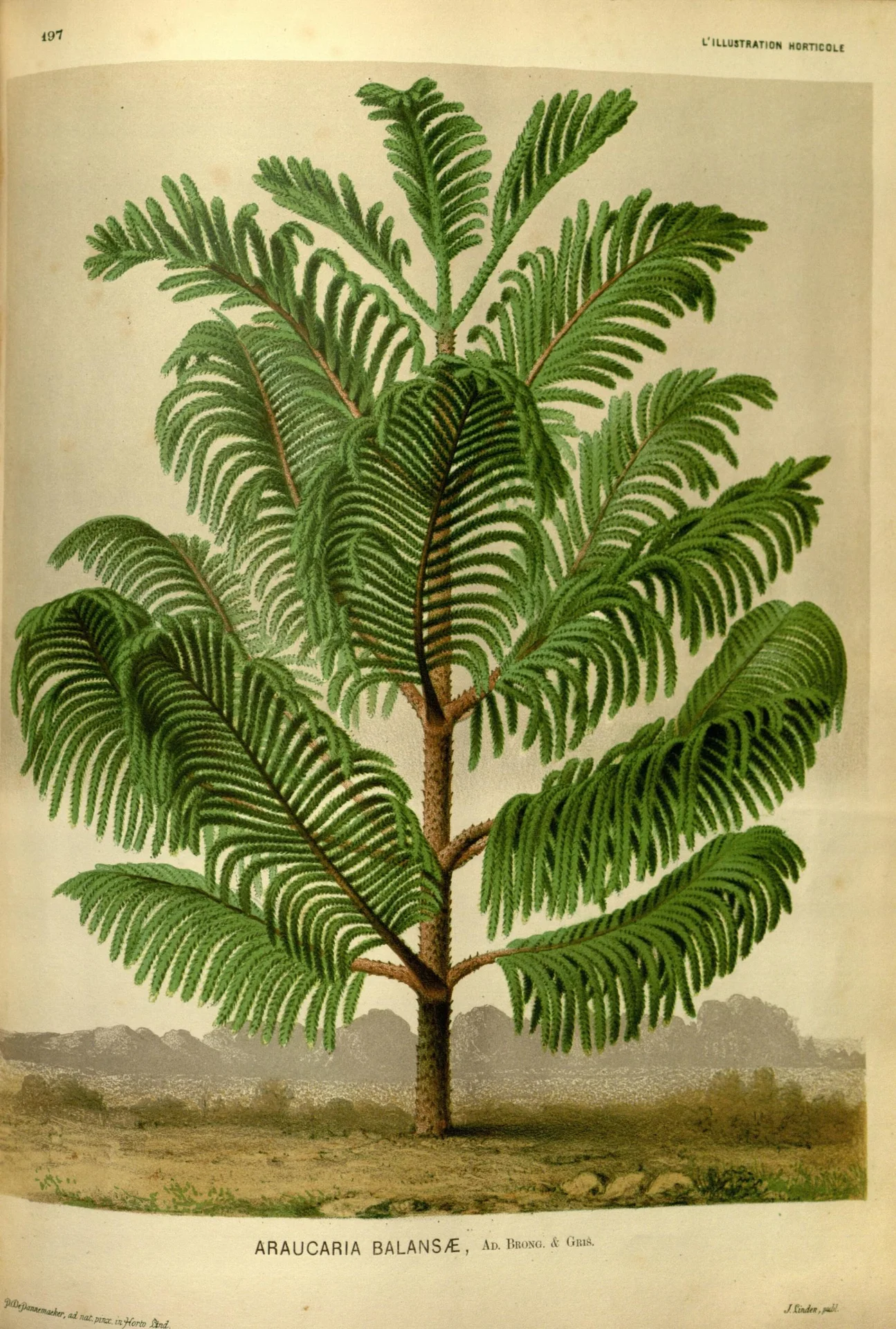
Botanical illustration
Фото: BioDivLibrary / Лицензия: Public Domain Mark
Morphology
The tree exhibits a striking columnar growth habit throughout its lifespan. The gray bark constantly peels off in thin strips, while the branches droop slightly at the sides of the main limbs. Young trees display a symmetrical growth pattern somewhat reminiscent of the closely related Norfolk Island pine.
Juvenile leaves are narrowly lanceolate and sharply curved towards the apex of the shoot. Adult leaves smoothly transition to a scale-like form with a prominent central vein. These mature leaves are tightly packed and incurved at the apex, giving the foliage a highly textured appearance.
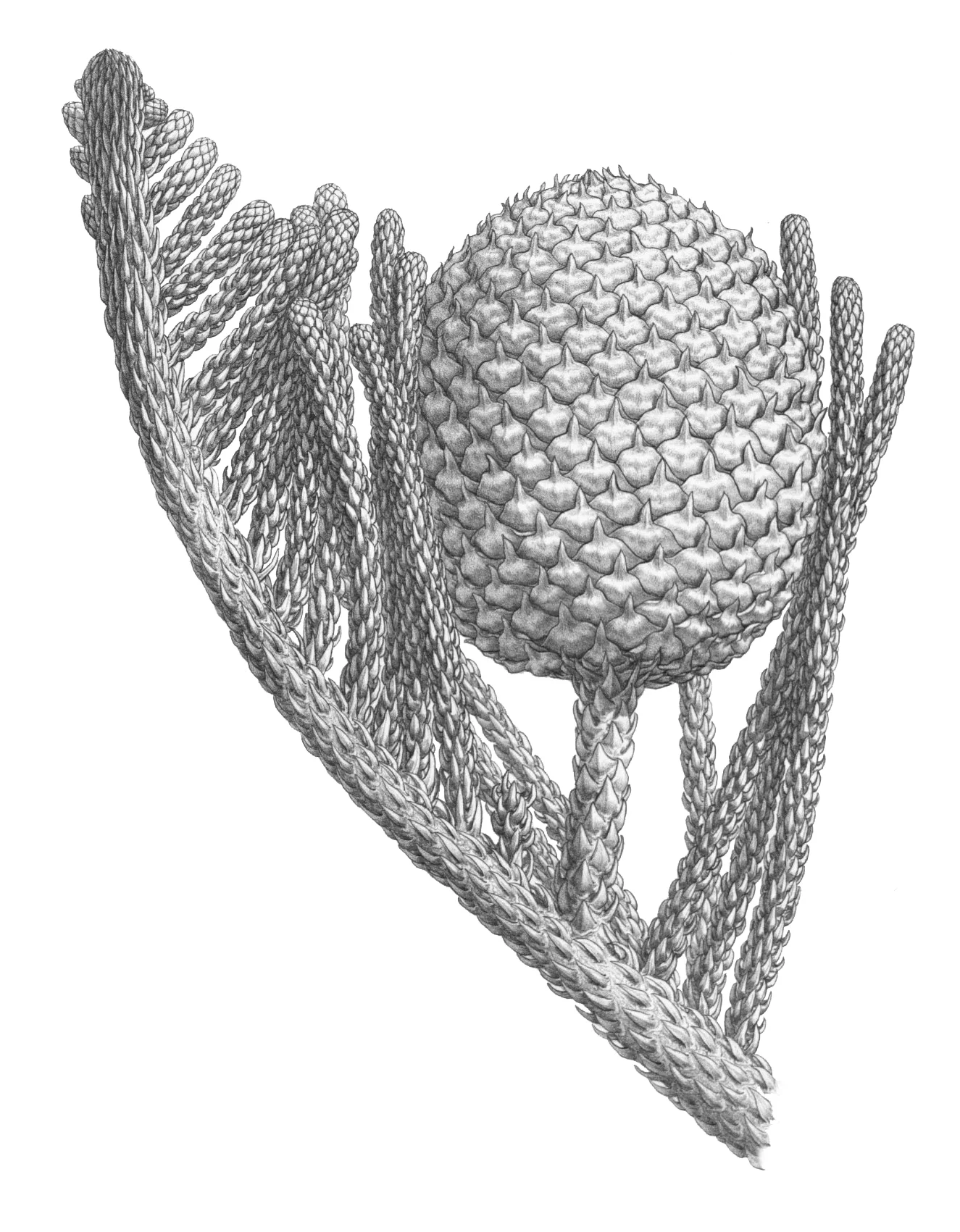
Male cones are cylindrical, growing up to 10 centimeters long. Female cones are considerably more spherical, reaching up to 12 centimeters in length. The reproductive seeds are ovoid nuts with almost rectangular wings, measuring up to 3 centimeters in length.
Interesting facts
The specific botanical epithet subulata translates to "awl-shaped" in Latin, serving as a direct morphological reference to the distinctively narrow, pointed shape of the tree's leaves.
Unlike many other conifers, this specific araucaria is strongly associated with ultramafic soils. While it can occasionally be found at elevations as low as 150 meters, it becomes significantly more dominant at higher altitudes, sometimes reaching up to 1,070 meters in mountainous terrain.
Although it faces ongoing localized threats from habitat fragmentation and increasing wildfire frequencies, its overall populations are currently considered stable. Conservation efforts are greatly aided by the fact that approximately half of the population is securely situated within protected zones such as the Rivière Bleue Provincial Park.