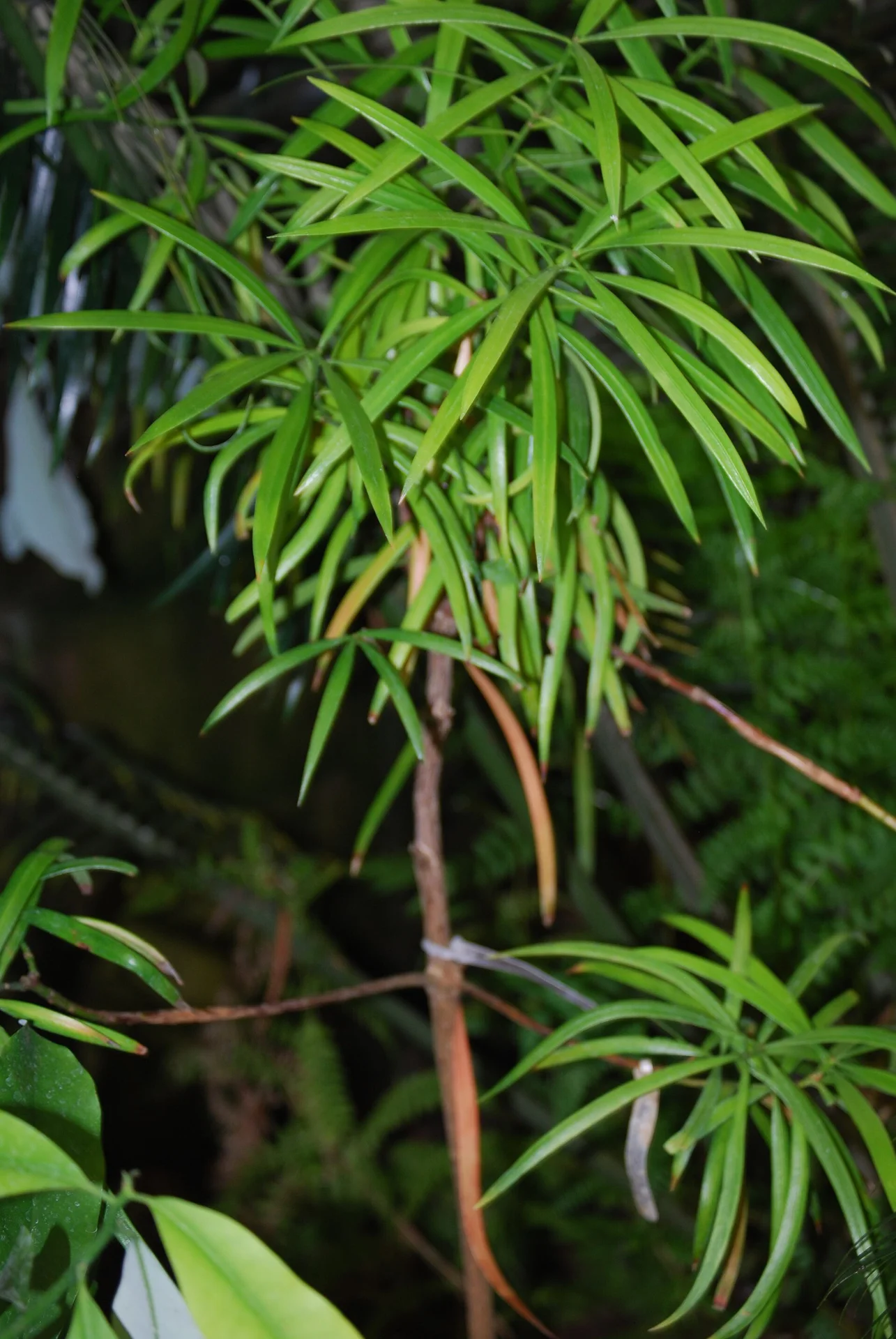
Hidden within the mist-shrouded peaks of New Caledonia lies one of the most enigmatic conifers on Earth, an ancient survivor that tells a story of millions of years of isolation. Inhabiting the dense, high-altitude rainforests, this rare evergreen tree represents a unique branch of the yew family tree.
Known commonly as the New Caledonia yew, it stands as the sole member of its genus, occupying a very limited geographical range. Botanists prize this living relic for its evolutionary significance and its adaptation to the humid tropical highlands of Grande Terre.
This coniferous tree exhibits a range of distinct morphological characteristics that set it apart from its close relatives. It typically grows as a small tree or large shrub, reaching heights of 5 to 20 meters, with exceptionally mature specimens climbing to 25 meters under ideal forest conditions. The trunk is wrapped in dark, reddish-brown bark that is both cracked and fibrous in texture.
The evergreen foliage shows a striking spiral arrangement along the branches. Individual flat, lanceolate leaves measure 8 to 12 centimeters long on mature branches, though they can reach up to 17 centimeters on young plants. Each leaf is deep green on top, with two pale green stomatal bands running along the underside.
As a dioecious species, male and female reproductive structures form on separate plants. The slender male pollen cones measure between 10 and 15 millimeters in length. The female seed cones are drupe-like structures about 20 to 25 millimeters long, featuring a fleshy aril that almost completely envelops the single brown seed, leaving only the very tip exposed.
Interesting facts
This genus holds a unique place in plant geography as the only member of the yew family, Taxaceae, native to the Southern Hemisphere. Its name, which translates to "Southern Yew," reflects this unique geographical placement.
Some intriguing details about this species include:
Monotypic Genus: The genus contains only a single species, making it an irreplaceable part of global biodiversity.
Ancient Island Endemic: It is found nowhere else on Earth except for the mountainous rainforests of New Caledonia.
Late Discovery: The plant was officially described for science relatively late, in 1922, by the British botanist Robert Harold Compton.