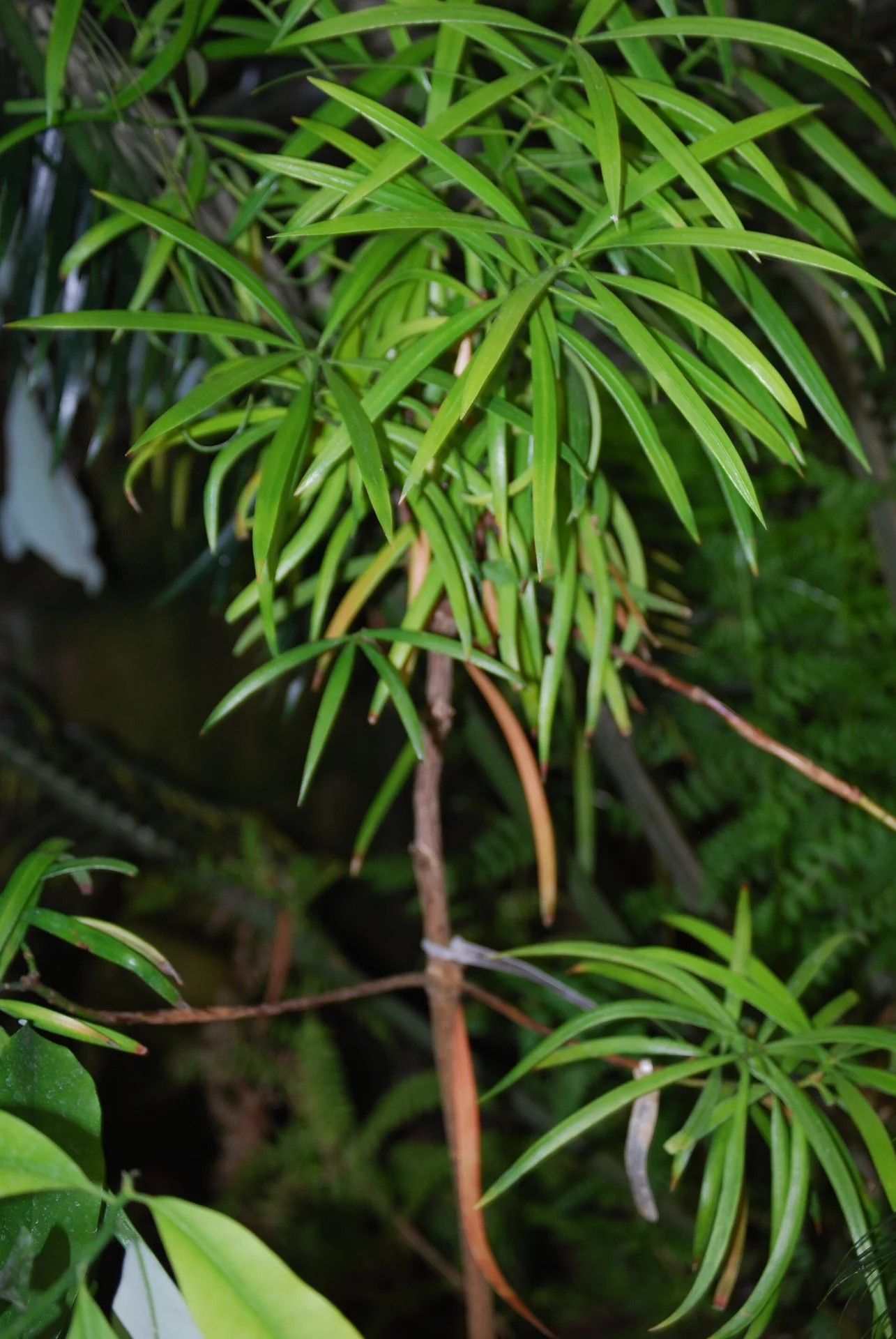
Austrotaxus spicata: The Rare Southern Yew of New Caledonia
High up in the mist-shrouded, acidic serpentine ridges of New Caledonia, a botanical relic of ancient Gondwana quietly thrives in the deep shade of the mountain rainforests. This elusive gymnosperm is Austrotaxus spicata, the only representative of the yew family native to the Southern Hemisphere.
Reaching heights of up to twenty-five meters, this slow-growing conifer stands out with its exceptionally long, glossy dark green needles that spiral gracefully along its reddish-brown branches. While its evolutionary origins remain a subject of intense scientific debate, Austrotaxus spicata continues to play a vital ecological role in its restricted Pacific home.
Austrotaxus spicata is a dioecious, densely branched evergreen conifer growing up to 25 meters tall, though it can sometimes exhibit a bushy shrub-like habit. Its trunk features a fibrous, reddish-brown bark that exfoliates in short bands or scales, revealing dark wood underneath.
The foliage consists of spirally arranged, lanceolate, flat leaves that can reach up to 17 centimeters in length on young plants, shortening to 5–10 centimeters on mature specimens. These glossy dark green needles feature slightly rolled margins, a prominent central furrow on the upper surface, and two pale green stomatal bands on the underside.
The reproductive organs of this dioecious species show significant differences between male and female structures:
Male cones are slender, spike-like catkins measuring 10 to 15 millimeters in length, composed of overlapping scales.
Female cones are borne at the ends of short branches and develop into round, drupe-like seeds about 20 to 30 millimeters long.
Orange arils almost entirely encase the mature seeds, leaving only a tiny opening at the tip for bird dispersal.
Interesting facts
This unique conifer holds several fascinating botanical distinctions that intrigue researchers worldwide:
Southern Hemisphere Outlier:Austrotaxus spicata is the only species in the Taxaceae family native to the Southern Hemisphere, where it evolved in isolation.
Taxonomic Mystery: Due to its unique mix of traits from both the yew (Taxaceae) and podocarp (Podocarpaceae) families, botanists once proposed placing it in its own monotypic family, Austrotaxaceae.
Serpentine Specialist: The species grows almost exclusively in hyper-humid tropical forests on acidic soils derived from serpentinized rocks, requiring annual rainfall exceeding 4,000 millimeters.
Avian Seed Dispersal: The large seeds are surrounded by a fleshy, bright orange aril, which attracts local forest birds that act as the primary seed dispersers.