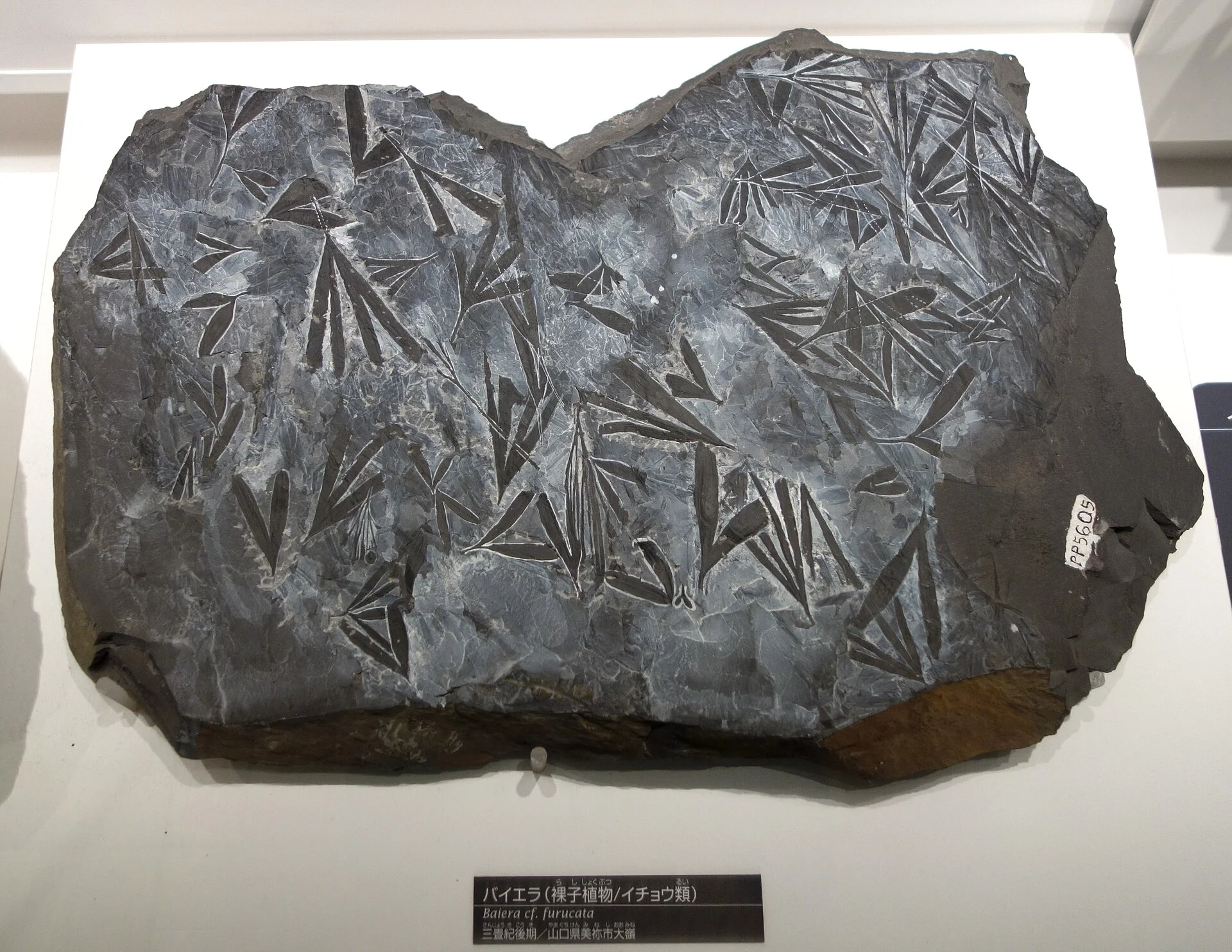
Dating back to the Mesozoic era, Baiera furcata remains a key taxon for understanding ancient gymnosperm diversity. This prehistoric plant was widely distributed across Laurasia, with prominent fossil discoveries in Europe and Asia. The species flourished in warm, humid floodplains, forming a major component of the understory vegetation.
Its distinct foliage is frequently preserved in fine-grained sedimentary rocks. These fossils provide paleobotanists with critical data regarding vegetation shifts during the Triassic and Jurassic periods.
Fossil specimens reveal leaves with a short petiole and a deeply divided, wedge-shaped blade. The lamina is repeatedly bifurcated into narrow, linear segments, each containing parallel veins. This deeply dissected architecture reduced wind resistance and managed water runoff in wet environments.
The epidermal cells show thick cuticles with deeply sunken stomata. This structural adaptation helped the plant regulate gas exchange during seasonal dry spells.
Interesting facts
Fossils of this species are often found in association with coal deposits, suggesting they grew in peat-forming swamps or river deltas. The high level of leaf dissection in Baiera furcata is thought to be an evolutionary response to seasonal temperature fluctuations. Some specimens exhibit exceptionally preserved carbonaceous compressions that allow for chemical analysis of ancient plant waxes.
Geography of distribution
Japan
China
Germany
Sources
Braun, C. F. W. (1843). Beiträge zur Urgeschichte der Pflanzen. In Münster, G. Graf zu, Beiträge zur Petrefactenkunde.
Harris, T. M. (1935). The Fossil Flora of Scoresby Sound, East Greenland. Meddelelser om Grønland.
Seward, A. C. (1919). Fossil Plants: A Text-Book for Students of Botany and Geology. Cambridge University Press.