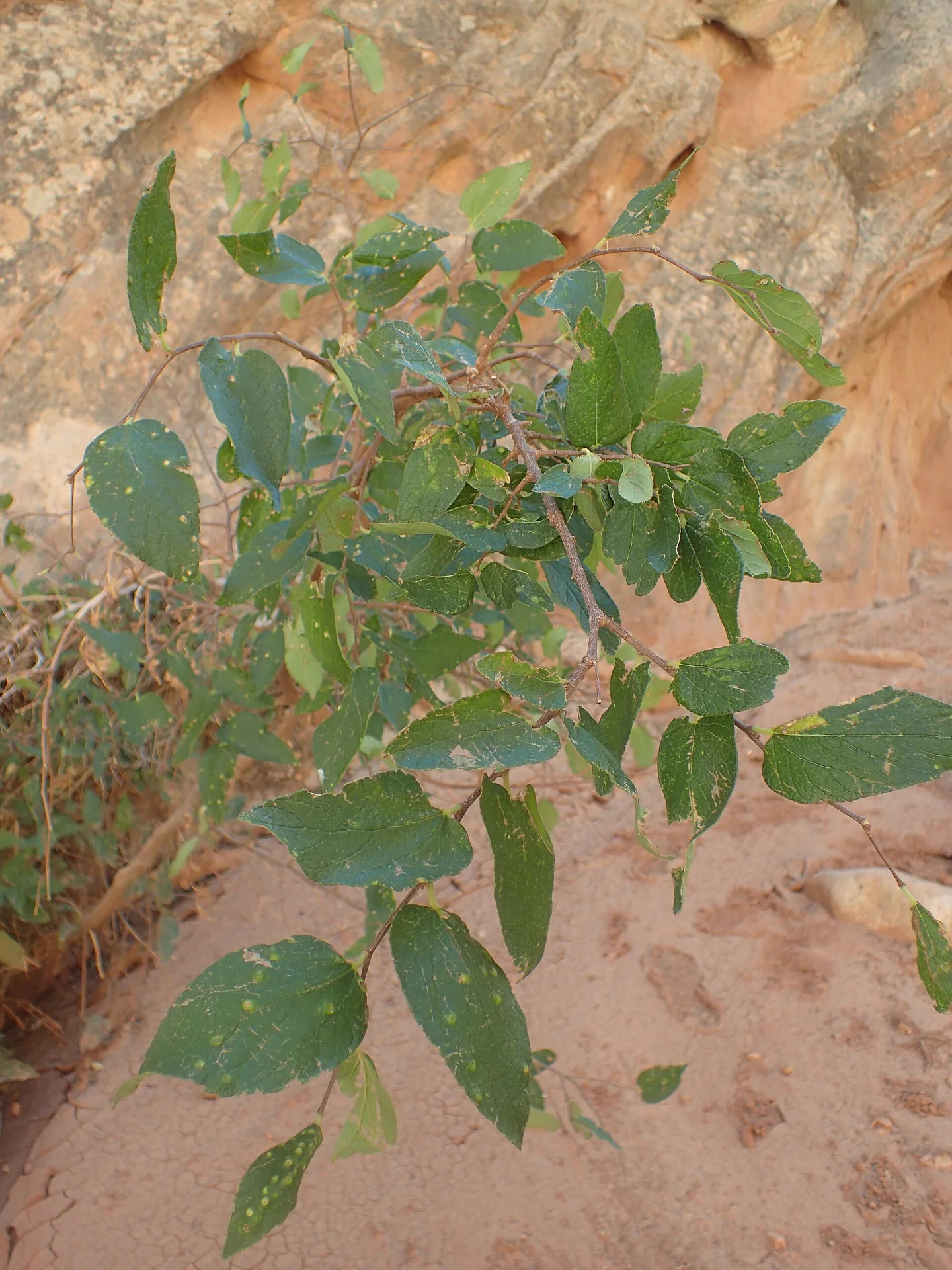
Net-veined sugarberry
(Celtis laevigata var. reticulata)
netleaf hackberry
Celtis laevigata var. reticulata (Netleaf Hackberry): Botanical Profile
Famed for its rugged resilience in arid environments, Celtis laevigata var. reticulata thrives where many other broadleaf trees struggle to survive. Widely known as the netleaf hackberry, this hardy member of the Cannabaceae family is frequently treated by some taxonomic authorities as a distinct species (Celtis reticulata). It is a prominent and recognizable feature in the riparian zones, desert washes, and rocky canyons of the American Southwest and northern Mexico.
This tree is highly valued for its ecological contributions in harsh, dry climates. Its deep and extensive root system allows it to access subterranean water sources, making it an anchor species in desert ecosystems. The netleaf hackberry provides critical shade, sustenance, and structural habitat in geographical regions where dense canopy cover is otherwise sparse.
The tree presents a distinctive rugged appearance, often growing as a small to medium-sized deciduous tree or, in particularly harsh conditions, a large multi-stemmed shrub. The trunk is heavily textured, adorned with thick, corky, wart-like ridges that become increasingly pronounced as the specimen ages. Branching is often irregular and tortuous, creating a broad, asymmetrical, and open crown.
The most diagnostic feature of Celtis laevigata var. reticulata is its remarkable foliage. The leaves are thick, leathery, and prominently reticulate, meaning they display a conspicuous, net-like pattern of raised veins on the underside. The upper leaf surface is typically scabrous, feeling rough to the touch similar to fine sandpaper. In autumn, the tree produces small, spherical drupes that transition from green to a dark orange-red or reddish-brown.
Flowering season
Spring
Jan
Feb
Mar
Apr
May
Jun
Jul
Aug
Sep
Oct
Name
Dec
Applications
The netleaf hackberry has profound ecological importance, serving as a primary food source for a vast array of wildlife. Birds, including quail and cedar waxwings, aggressively consume the sugary drupes. It is also a critical larval host plant for several specialized butterfly species, notably the Hackberry Emperor (Asterocampa celtis).
Historically, indigenous peoples of the American Southwest utilized the sweet, date-like fruits as a dependable food source, grinding them into a paste or eating them raw. The dense, hard wood was occasionally utilized for tool handles, fencing, and high-heat firewood, though its irregular growth habit limits its use in modern commercial carpentry.
Interesting facts
The specific epithet reticulata directly refers to the prominently netted or 'reticulate' venation clearly visible on the underside of the leaves.
Fossil records indicate that trees closely resembling the modern netleaf hackberry have existed in North America for millions of years, adapting over immense time scales to the gradual drying of the continent's interior.
Due to the unusually high calcium carbonate content in the fruit pits, hackberry seeds are highly resistant to decay and are often found exceptionally well-preserved in ancient archaeological sites.