
Tournefort's hackberry typical
Celtis tournefortii subsp. tournefortii
Celtis tournefortii subsp. tournefortii is the autonymic subspecies of the Oriental hackberry, a hardy deciduous …
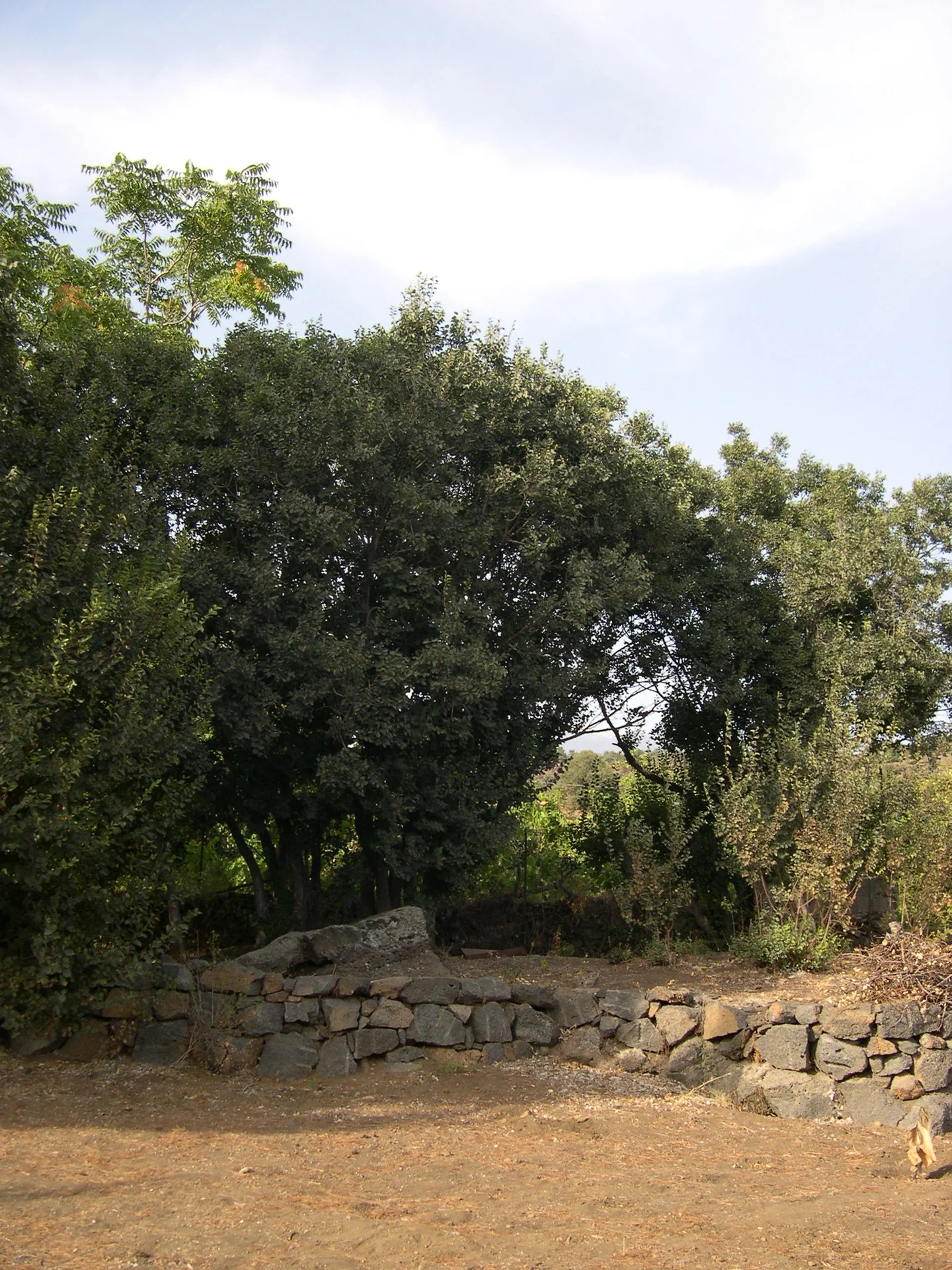
Originating from the southwestern slopes of Mount Etna and other Sicilian mountain ranges, this deciduous tree represents an endemic subspecies of Tournefort's hackberry. It primarily grows at elevations ranging between 500 and 900 meters above sea level.
This taxon holds a protected status within the Etna Regional Park due to its restricted distribution and ecological vulnerability. It typically inhabits rocky terrains, screes, and volcanic soils.
This woody plant develops a cespitose growth habit, forming either a large shrub or a small tree that reaches up to 6 or 8 meters in height. The branches are dense, bearing sturdy and compact wood.
The leaves display a characteristic heart-shaped (cordate) base with weakly crenate edges. The fruit is a globose drupe that ripens from yellow-orange to a dark, almost black hue in early autumn.
Spring
The dense, hard wood of the Etna hackberry has traditionally been valued for creating high-strength wooden implements and tools. The sweet, aromatic fruits are edible and consumed locally when fully ripe.
Ecologically, it serves as a critical food source for migratory and native birds, which help disperse the seeds. It also helps prevent erosion on steep volcanic slopes.
Taxon Synonyms: Celtis asperrima, Celtis tournefortii var. aetnensis, Celtis tournefortii subsp. asperrima, Celtis betulina
Celtis tournefortii subsp. tournefortii
Celtis tournefortii subsp. tournefortii is the autonymic subspecies of the Oriental hackberry, a hardy deciduous …

Picrasma
A genus of deciduous trees and shrubs known for their extremely bitter bark and medicinal …

Araucaria humboldtensis
A small, critically endangered coniferous tree native strictly to the high-altitude mountain peaks of southern …

Araucaria sect. Araucaria
Araucaria sect. Araucaria is a botanical section of evergreen conifers native to South America. It …