Celtis tournefortii (Oriental Hackberry): Care, Uses & Morphology
Widespread across Southeastern Europe and the Mediterranean, Celtis tournefortii thrives as a resilient deciduous tree or large shrub in the family Cannabaceae. It was scientifically named in honor of the renowned French botanist Joseph Pitton de Tournefort. The species naturally occurs over a fragmented geographical range extending into Western Asia and the Caucasus.
This hardy plant typically inhabits maquis and dry forest ecosystems, flourishing on open plains and rocky slopes. It demonstrates significant drought tolerance and adapts to various soil types, though it remains sensitive to waterlogging and severe frosts.
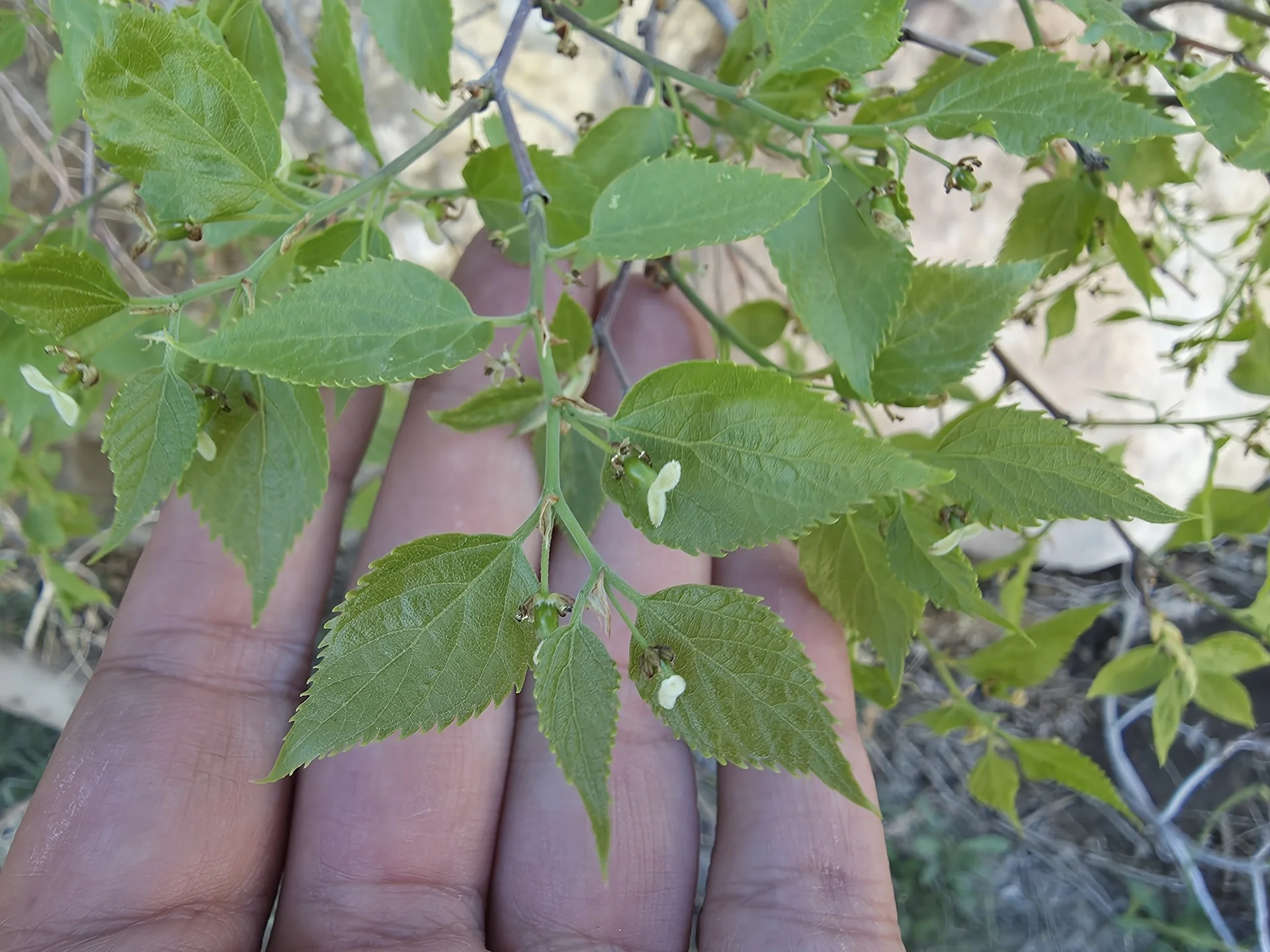
The plant typically grows as a large shrub or small tree, reaching a maximum height of up to 6 meters. Young branches are distinctively pubescent, exhibiting a light brown or yellowish coloration. The foliage consists of ovate leaves measuring 3 to 7 centimeters in length, featuring a pointed apex and a rounded or weakly cordate base.
The leaf margins are serrated predominantly above the middle section. The upper leaf surface displays a bluish-green to grey-green hue and can vary from completely glabrous to noticeably hairy. The spherical fruits grow on pedicels about 1 centimeter long, reaching 8 millimeters in diameter, and ripen to a vibrant yellow-orange color in early autumn.
Applications
The fruits of the Oriental hackberry are fully edible and possess a pleasant, distinctive flavor. In Sicily, these small drupes are traditionally harvested to prepare specialized jams and marmalades. They are also commonly consumed fresh in Turkey and other parts of its native range.
In traditional medicine, extracts from the leaves and twigs are utilized for their astringent and soothing properties. Phytochemical analyses have revealed the presence of tannins, saponins, flavonoids, betulin, and gallic acid. Research indicates that the plant's extracts exhibit notable antibacterial, antifungal, and antioxidant activities.
Interesting facts
The species exhibits a highly fragmented and patchy distribution throughout its range, often forming relict micro-forests on volcanic or limestone substrates, such as on the slopes of Mount Etna. The Sicilian subspecies, Celtis tournefortii subsp. aetnensis, is specifically adapted to the volcanic soils of the region and is highly protected.