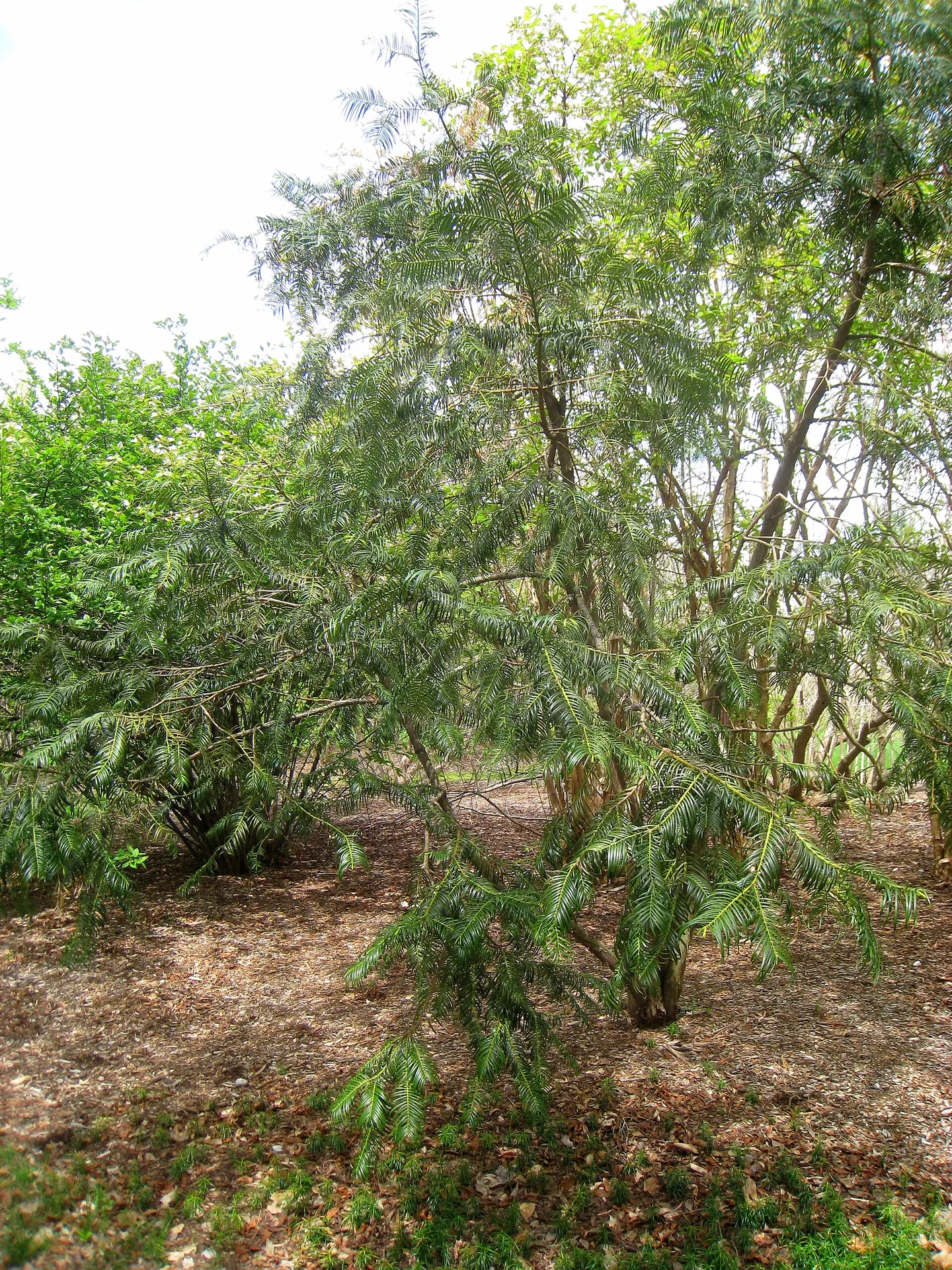
Chinese plum-yew
Fortune's plum-yew
Chinese cowtail pine
Fortune's Yew Plum
IUCN: Least Concern
#696943
#A1A37B
#F4F5EE
#848F5B
#363416
Plant palette
Chinese Plum-Yew (Cephalotaxus fortunei) | Encyclopedia
Scaling the misty slopes of central and southern China reveals the elegant, sweeping branches of Fortune's plum-yew, a conifer that has fascinated botanists since the mid-19th century. Named after the legendary Scottish plant hunter Robert Fortune, who first sent specimens to Europe in 1848, this species brings a distinct primeval grace to temperate collections.
Unlike typical narrow-needled conifers, its foliage catches the eye with unusually long, flat, and remarkably soft needles that drape gracefully from its stems. Beyond its ornamental appeal, the species holds a significant place in traditional pharmacology and modern oncology research due to the potent compounds hidden within its bark.
Cephalotaxus fortunei typically grows as a multi-stemmed shrub or a small tree, reaching heights of up to 20 meters with a trunk diameter of around 20 centimeters. The trunk is cloaked in a distinctive reddish-brown bark that peels in long, irregular shreds, revealing purplish undertones beneath. Its young branches are slightly pendulous, and the new ribbed shoots remain green for three years before maturing.
The foliage is particularly striking, boasting the longest leaves within the genus Cephalotaxus. Key characteristics of these needles include:
Dimensions: Measuring between 3.5 and 12.5 centimeters in length and 3.2 to 5 millimeters in width.
Texture and Color: Soft, flexible, and leathery to the touch, with a glossy, dark yellowish-green upper surface.
Underside: Features two distinct, broad, pale-grey stomatal bands, each containing 13 to 24 rows of stomata.
Shape: Linear-lanceolate and often slightly falcate (sickle-like), tapering to a sharp, fine point at the apex.
As a dioecious species, male and female reproductive structures appear on separate trees. Matured seeds are enclosed in a fleshy, berry-like aril that transitions from green or yellow to a deep purple upon ripening between June and October.
Flowering season
Pollination occurs from April to May, with seeds ripening from June to October.
Jan
Feb
Mar
Apr
May
Jun
Jul
Aug
Sep
Oct
Name
Dec
Applications
Due to its elegant drooping habit and unusually long needles, Cephalotaxus fortunei has been cultivated as a choice ornamental specimen in Western gardens and arboretums since 1848. It is highly valued in landscape design for shady borders and woodland gardens where its deep green texture provides year-round interest.
In traditional Chinese practice and regional economy, the plant serves practical purposes:
Traditional Lamp Oil: A rich oil extracted from the fleshy aril surrounding the seeds has historically been used as fuel for lamps.
Oncology and Medicine: The leaves and bark are a natural source of complex alkaloids, which are harvested and processed for use in modern cancer therapies, particularly in treating certain forms of leukemia.
Interesting facts
The naming of Cephalotaxus fortunei honors the famous 19th-century Scottish botanist Robert Fortune, who introduced numerous Chinese plants to the West. Although its fleshy, plum-like purple fruits look like those of flowering plants, the species is a gymsomperm and is closely related to true yews.
Its ecological adaptability and local folklore include several fascinating points:
Extreme Elevation Range: The species grows at altitudes ranging from 200 meters in low woodlands up to 3,700 meters in alpine areas.
Understory Survivor: It is remarkably shade-tolerant, thriving beneath the dense canopy of conifers like fir and spruce, alongside rhododendrons.
Ancient Lineage: Often referred to as a relic lineage, members of the family Cephalotaxaceae represent an ancient evolutionary branch of conifers.