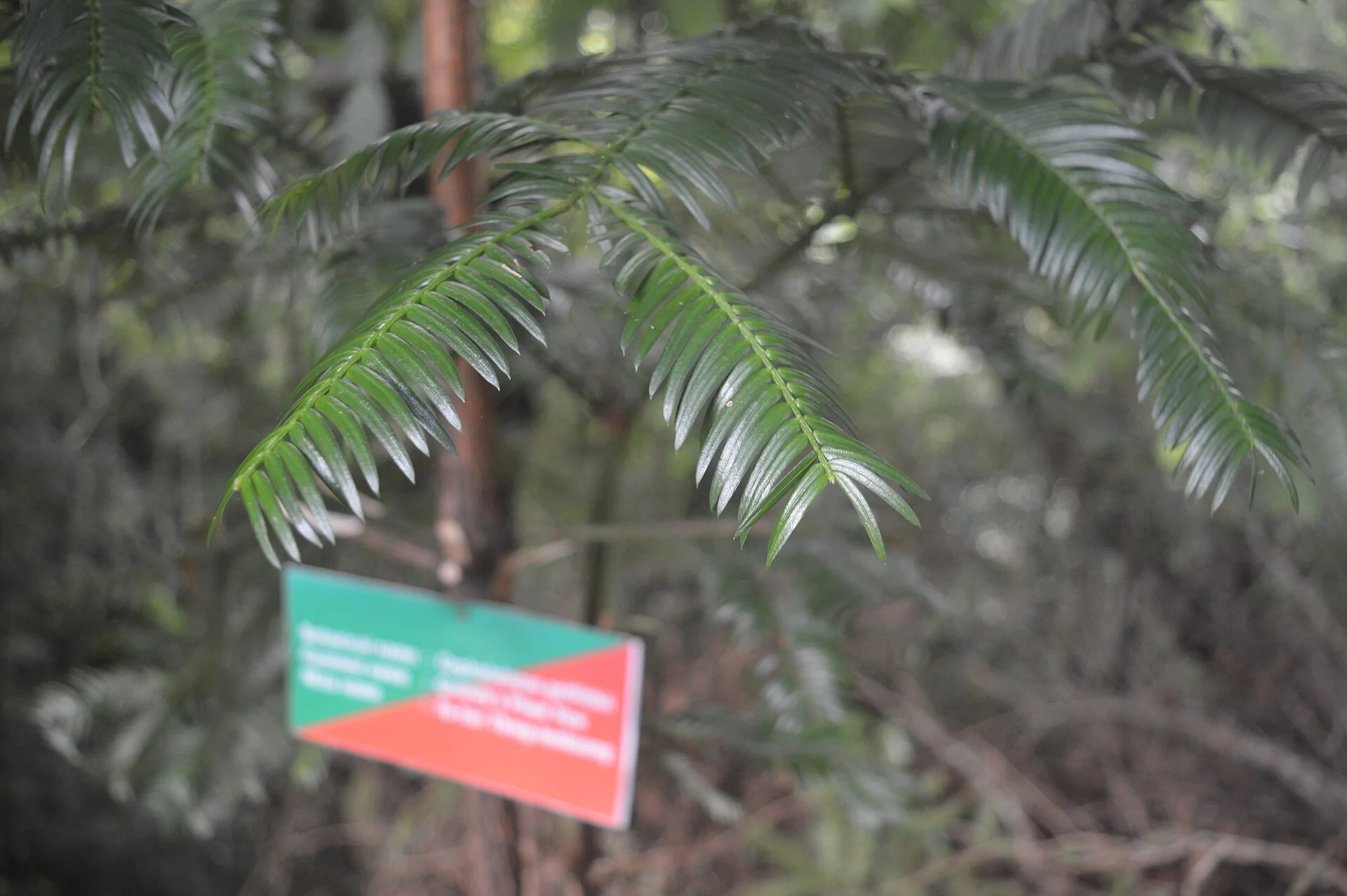
Griffith's plum yew (Cephalotaxus griffithii)
Cephalotaxus griffithii - Griffith's Plum Yew Guide & Botany
Belonging to the ancient lineage of conifers, Cephalotaxus griffithii attracts botanical interest due to its limited distribution and distinct foliage. This evergreen tree is primarily native to the montane forests of northeastern India, northern Myanmar, and western Sichuan in China. The species honors the 19th-century British botanist and explorer William Griffith, who contributed extensively to Asian botany.
Typically found in moist, shaded environments, it often grows alongside other evergreen broad-leaved trees. The tree is closely related to Cephalotaxus mannii and Cephalotaxus harringtonia, leading to some ongoing taxonomic discussions regarding its classification.
Taxonomy
- β ΡΠ°ΡΡΡΠ²ΠΎ Plantae
- β division Tracheophytes
- β subdivision Spermatophytes (Seed plants)
- β superclass Gymnospermae
- β division Pinophyta
- β subclass Cupressidae
- β order Cupressales (Cypresses and junipers)
- β family Cephalotaxaceae (Plum-yews family)
- β genus Cephalotaxus (Plum yew)
- β species Cephalotaxus griffithii (Griffith's plum yew)
Morphology
The structural characteristics of Cephalotaxus griffithii reflect its adaptation to humid montane climates. It grows as an evergreen tree reaching heights of up to 20 meters, with a trunk diameter ranging from 0.5 to 1.1 meters. The light brown to reddish-brown bark typically flakes off in irregular thin strips.
Key morphological features include:
- Foliage: The needles are linear to linear-lanceolate, measuring 5 to 7.5 centimeters in length and approximately 3 millimeters in width. They are glossy dark green on the upper surface, while the underside features 19 to 26 distinct white or bluish-white stomatal bands.
- Male Cones: These pale yellow, globose structures are 4 to 4.5 millimeters in diameter, arranged in clusters of six to eight.
- Female Cones and Seeds: The seeds are enclosed in a fleshy, green aril that matures to a bright red color. Mature seeds are obovate-elliptic, reaching 2.2 to 2.8 centimeters in length.
Flowering season
November to March
Applications
The wood of Cephalotaxus griffithii has historically been utilized for local construction and fuel. Additionally, the species contains unique alkaloids, which are studied for their potential medicinal properties. These chemical compounds show promise in pharmacological research, particularly in the development of antileukemia treatments.
Interesting facts
This conifer has several fascinating botanical and historical details:
- Taxonomic Debate: Many botanists consider this species to be a synonym of Cephalotaxus mannii or Cephalotaxus harringtonia because of their extremely similar physical traits.
- High-Altitude Habitat: In India, it thrives in remote areas such as the Mishmi Hills, growing at elevations of around 1,830 meters.
- Slow Regeneration: The species suffers from a very slow natural regeneration rate, making its populations highly sensitive to environmental disturbances.
Geography of distribution
- India
- Myanmar
- China
Sources
- Hooker, J.D. (1888). Flora of British India, Vol. 5.
- The Gymnosperm Database (conifers.org).
- Flora of China, Vol. 4.
- World Checklist of Selected Plant Families (WCSP) / POWO.