Harrington's plum-yew
Harrington plum-yew
Japanese plum-yew
Korean plum yew
cowtail pine
Harrington's cephalotaxus
IUCN: Least Concern
#536E48
#8BA785
#1F3216
#344F24
#5A6741
Plant palette
Cephalotaxus harringtonia: Japanese Plum Yew Care & Info
Deep within the misty, shaded ravines of Japan's Honshu island, the ancient needles of the plum yew catch the filtered mountain light. This elegant evergreen conifer, long treasured in East Asian temple grounds, has graced European gardens since its introduction in the early nineteenth century.
Named in honor of the Earl of Harrington who first cultivated it in Europe, Cephalotaxus harringtonia offers a unique architectural presence. Its sweeping, dove-wing-like foliage provides a lush, dark green texture that thrives where other conifers struggle.
In modern landscapes, this resilient species is highly valued for its exceptional tolerance to deep shade and urban conditions. Beyond its ornamental appeal, the plant has also attracted scientific interest due to the therapeutic compounds found within its delicate needles.
Cephalotaxus harringtonia is a slow-growing evergreen shrub or small tree that typically reaches heights of 6 to 10 meters, featuring a broad, rounded crown and peeling greyish-brown bark. The young shoots remain green for up to three years before maturing into a reddish-brown hue.
The foliage is characterized by several distinct features:
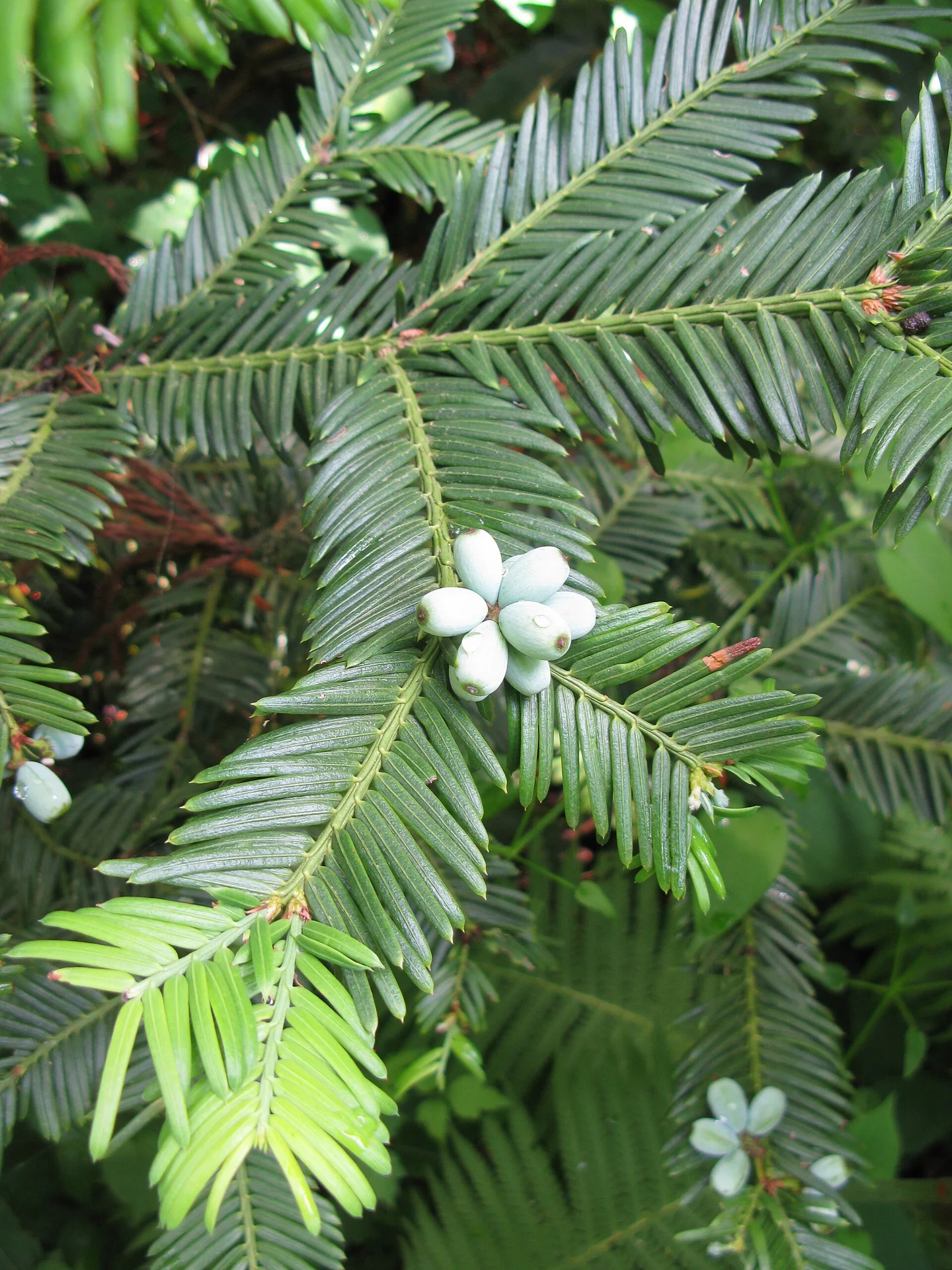
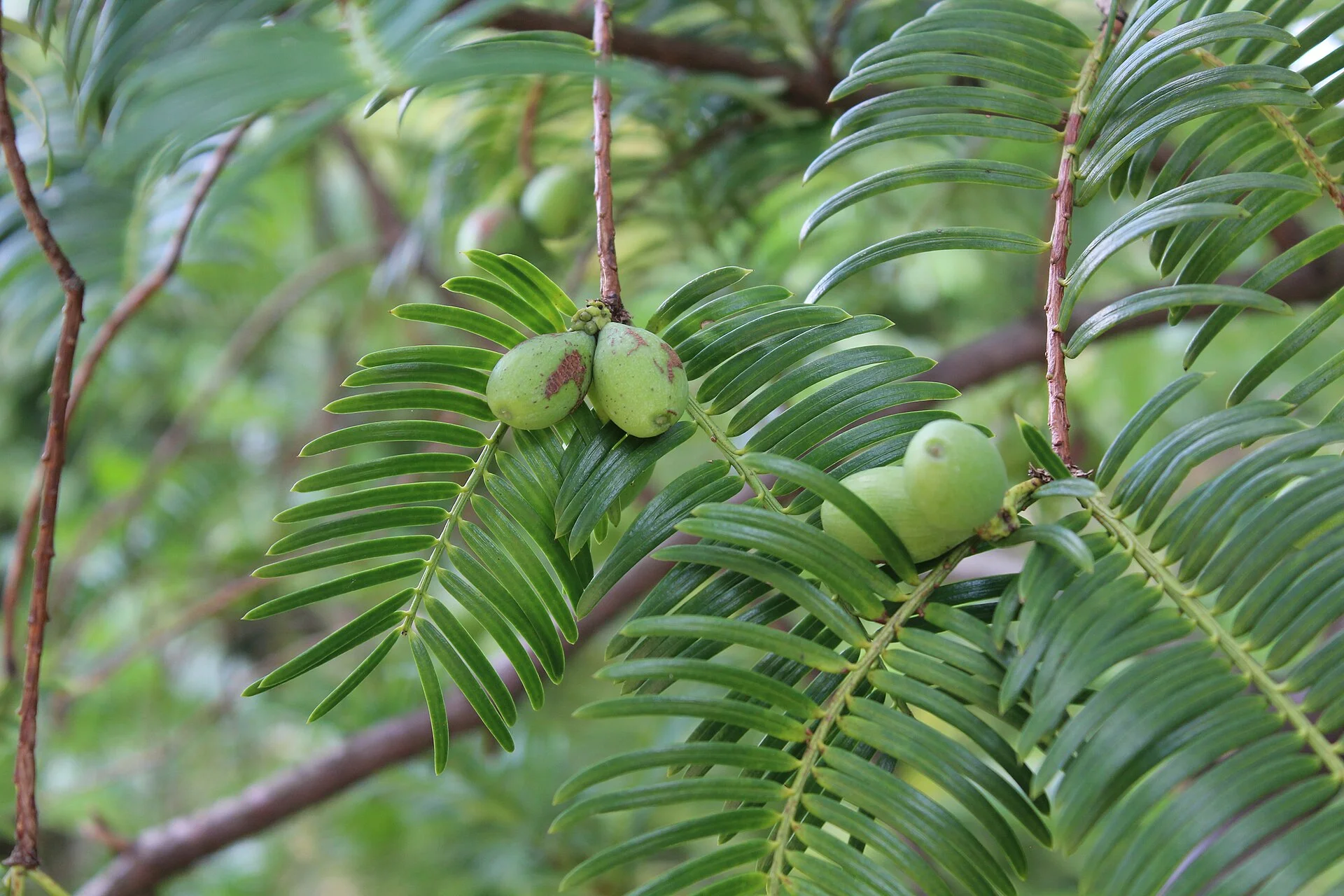
Arrangement: The linear, leathery needles are arranged in two ranks, curving upwards to form a narrow V-shape.
Dimensions: Each needle measures approximately 3 to 5 centimeters long and about 3 millimeters wide.
Coloration: The upper surface is a glossy dark green, while the underside features two prominent, silvery-white stomatal bands.
As a dioecious species, male plants produce globular, cream-colored pollen cones on short stalks, while female plants bear pairs of knob-like cones. The resulting plum-like seeds are surrounded by a fleshy green aril that ripens to a deep brown, measuring approximately 2.5 centimeters in length.
Flowering season
Pollen release and cone development occur in spring, typically from March to May.
Jan
Feb
Mar
Apr
May
Jun
Jul
Aug
Sep
Oct
Name
Dec
Care parameters
Light
Thrives in partial to full shade, but can adapt to sunny spots if the soil remains consistently moist.
Watering
Requires moderate but regular watering; the soil should be kept moist but well-drained to prevent root rot.
Temperature
Hardy down to USDA zone 6; prefers protection from harsh, drying winter winds and tolerates summer heat well.
Humidity
Prefers cool, humid environments but adapts well to average garden humidity if sheltered from dry drafts.
Toxicity
The foliage and seeds contain toxic alkaloids such as cephalotaxine, making them harmful if ingested by humans or pets.
Applications
Cephalotaxus harringtonia is highly esteemed in horticulture as an ornamental plant for shady borders, woodland gardens, and foundation plantings. Because it tolerates shearing exceptionally well, it is frequently used to create dense, slow-growing hedges or formal structures.
In Japan, the sweet, fleshy aril surrounding the seed is historically consumed as a local delicacy, although the bitter seed itself is non-edible. Additionally, the fine-grained, hard yellow wood was traditionally utilized for crafting bows and delicate wooden utensils.
In the field of medicine, the plant has gained significant importance:
Omacetaxine: An alkaloid derived from the leaves of this species is used in the formulation of modern anti-leukemia drugs.
Traditional Uses: The seed oil was historically pressed and used as a clean-burning fuel for temple lamps in Japan.
Interesting facts
The species was introduced to European horticulture in 1829 and was named in honor of Charles Stanhope, the 4th Earl of Harrington, who was among the first to cultivate it at Elvaston. In Japanese folklore, the tree is known as Inugaya, meaning 'dog yew', reflecting its resemblance to the true yew but noting its bitter, inedible seeds.
Fascinating historical and biological aspects of this plant include:
Ancient Maritime Craft: In Japan, the resilient wood was used to craft oars for traditional dugout canoes during the late Jomon period.
Lamp Oil Tradition: The seeds contain a high oil content of up to 62 percent, which was historically favored for temple lightings because it burns without freezing in winter.
Anticancer Compounds: The discovery of homoharringtonine in its foliage has made it a vital natural source for chronic myeloid leukemia treatments.
Varieties and cultivars
Several popular cultivars have been selected for garden use, offering diverse growth habits:
'Fastigiata': A striking columnar form selected in Japan in 1861, growing up to 6 meters tall with erect branches and spirally arranged, dark green needles.
'Nana': A low-growing, prostrate variety that rarely exceeds 1 meter in height, often rooting where branches touch the soil.
'Prostrata': A wide-spreading, mound-forming cultivar that reaches about 60 centimeters in height and spreads over a meter wide.
'Korean Gold': A selection featuring bright golden-yellow new foliage that contrasts beautifully with the older, dark green needles.
Unlock lush evergreen foliage with our guide to Japanese plum yew care. Discover ideal upright Cephalotaxus harringtonia growing conditions, pruning, and soil needs.
Discover ideal Japanese plum yew sun requirements. Learn whether sun or full shade yields richer foliage and how to prevent heat stress in your garden.
Discover how an upright Japanese plum yew hedge creates a dense, deer-resistant privacy wall in deep shade. Step-by-step planting, pruning, and Cephalotaxus harringtonia care.
Discover how to grow Cephalotaxus harringtonia Fastigiata in Australia. Master shade tolerance, soil setup, watering, and heat protection for thriving Japanese plum yews.
Discover how to successfully cultivate a japanese plum yew in container setups. Essential potting mix recipes, shade tips, and winter protection strategies.
Expert guide to successful Japanese plum yew propagation. Discover step-by-step techniques for stem cuttings, rooting hormone selection, and seed stratification.
Master growing japanese plum yew in texas heat and clay soils. Expert tips on shade placement, drip irrigation, cultivars, and deer-resistant landscaping.
Discover whether Japanese plum yew is invasive in home gardens and wild forests. Uncover growth habits, seed dispersal risks, and eco-friendly landscape care tips.
Discover how and when to prune Japanese plum yew for health and dense growth. Master seasonal plum yew pruning techniques, hedge maintenance, and elegant topiary design.
Determine precise Japanese plum yew spacing for groundcovers and hedges. Expert layout recommendations for Cephalotaxus harringtonia prostrata spacing and cultivars.
Master Japanese plum yew winter resilience across USDA Zones 5-9. Learn Cephalotaxus harringtonia cold tolerance, winter burn prevention, and microclimate protection.
Learn whether Japanese plum yew fruit is edible, how to safely harvest sweet Cephalotaxus arils, and how to avoid toxic seeds with expert foraging tips.
Choosing between japanese plum yew podocarpus macrophyllus or buddhist pine? Compare cephalotaxus vs podocarpus for hardiness, shade, and deer resistance.
Transform dense shade into a lush evergreen carpet with plum yew ground cover. Explore prostrate cultivars, spacing rules, and low-maintenance care tips.
Deciding between Japanese plum yew vs Hicks yew? Compare deer resistance, shade tolerance, growth habits, and hardiness zones to choose the right evergreen.
Discover if Japanese plum yew is toxic to dogs, key symptoms of Cephalotaxus poisoning, critical differences from true yews, and emergency pet safety steps.
Deciding between plum yew vs japanese yew? Compare needle size, fruit morphology, heat tolerance, deer resistance, and toxicity in this ultimate guide.