Deep within the mist-shrouded subtropical forests of the eastern Himalayas and Southern China, an ancient conifer quietly thrives on steep limestone cliffs and ravines. This is the home of Cephalotaxus mannii, a remarkable tree whose evolutionary lineage stretches back millions of years.
Adorned with glossy, dark green needle-like leaves and fleshy red seed cones, it stands as a unique botanical treasure of Southeast Asia's montane ecosystems. However, this wild gymnosperm now faces a silent struggle for survival in its fragmented native habitats.
Cephalotaxus mannii grows as an evergreen tree, typically reaching heights of 20 to 30 meters, with some exceptional specimens in untouched forests reported up to 50 meters. The trunk, which can measure between 0.5 and 1.1 meters in diameter, is covered in a flaking, light brown to reddish-brown bark.
Its distinct foliage and reproductive structures exhibit the following characteristics:
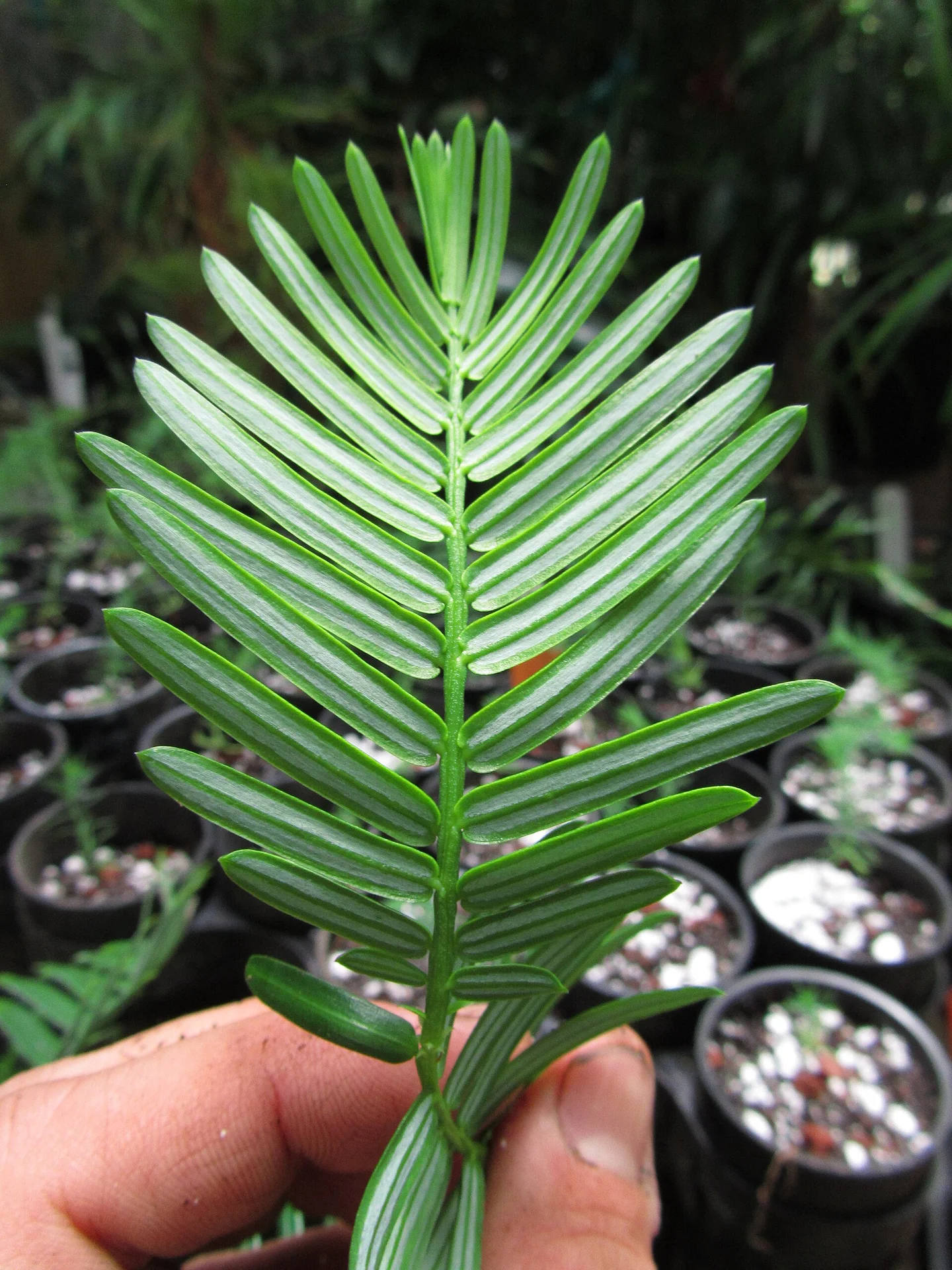
Needles: The leaves are linear to linear-lanceolate, measuring 1.5 to 4 centimeters in length and 2.5 to 4 millimeters in width. They feature a glossy, dark olive-green upper surface and two prominent white or bluish-white stomatal bands underneath, containing 19 to 26 lines.
Pollen Cones: Male cones are globose, pale yellow, and about 4 to 4.5 millimeters in diameter. They cluster in groups of six to eight on short stalks.
Seed Cones: Female cones occur singly or in clusters of up to three. They develop a fleshy, berry-like aril that is initially green, turning bright red upon ripening, surrounding an obovoid seed.
Flowering season
Flowering and pollination occur from November to March, followed by seed maturation between August and October.
Jan
Feb
Mar
Apr
May
Jun
Jul
Aug
Sep
Oct
Name
Dec
Applications
The high-quality wood of Cephalotaxus mannii is highly valued for its fine texture, hardness, and exceptional flexibility. It is resistant to insect damage and warping, making it a preferred material for crafting premium furniture, tool handles, and artistic wood carvings.
In addition to timber, the species has significant medicinal and industrial uses:
Medicine: The bark and seeds contain bioactive alkaloids that have been researched and utilized in treatments for leukemia and lymphoma.
Seed Oil: An oil extracted from the seeds is traditionally used as a binder in paints and local artistic applications.
Interesting facts
Cephalotaxus mannii exhibits fascinating ecological adaptability, growing on both acidic silicate rocks and alkaline karst limestone formations. On limestone soils, it forms complex communities alongside specialized conifers like the Siam wood and Fujian cypress.
Some intriguing facts about this ancient tree include:
Taxonomic Synonyms: Depending on the botanical authority, the Indian populations are sometimes classified as Cephalotaxus griffithii, while the Hainan island populations are referred to as Cephalotaxus hainanensis.
Conservation Challenges: The wild population in China is estimated to be fewer than 15,500 trees, making every remaining mature specimen critical for the preservation of the gene pool.
Altitude Range: This species is typically restricted to mountainous subtropical zones, thriving at elevations between 500 and 2,000 meters above sea level.