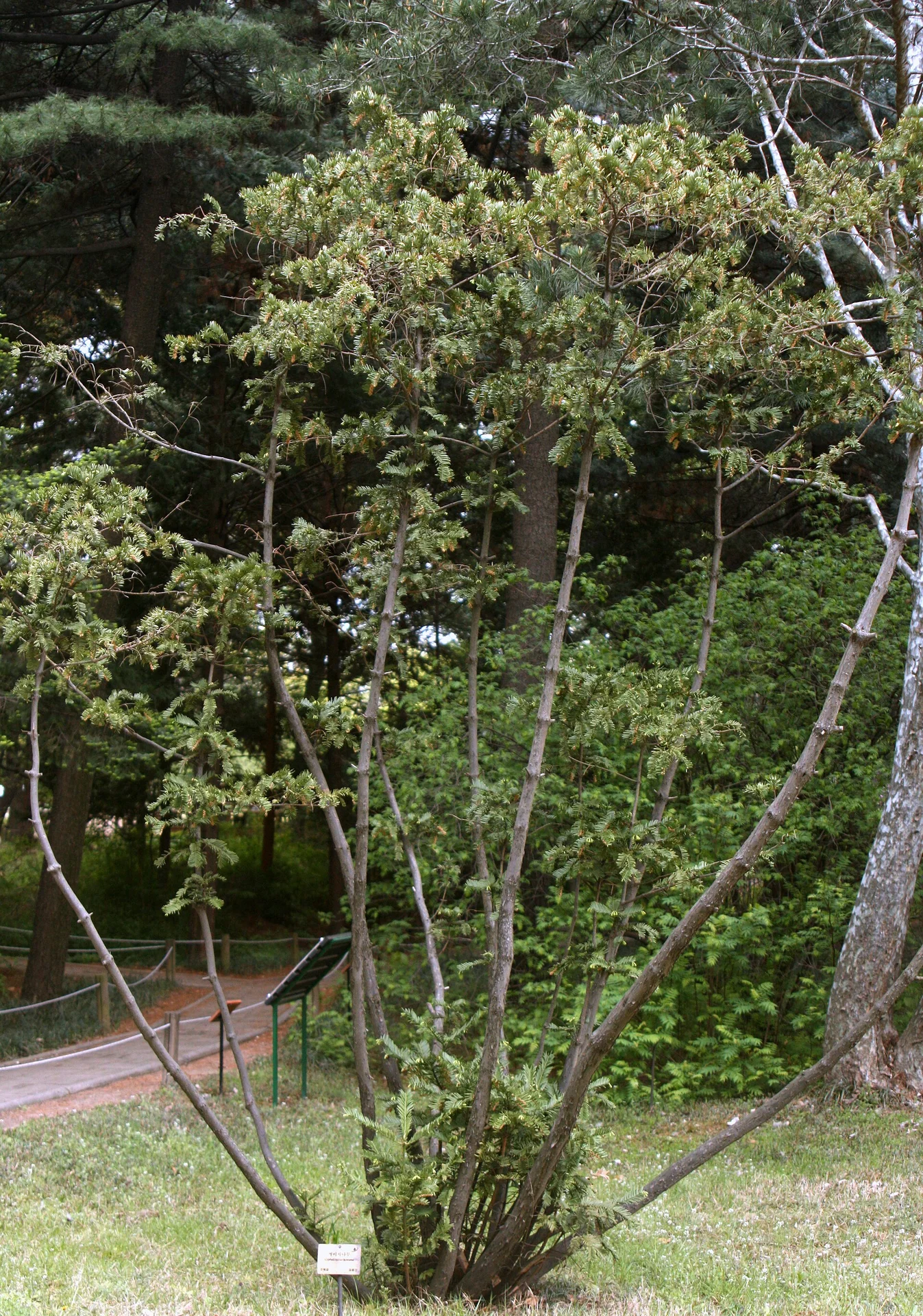
Cephalotaxus koreana (Korean Plum Yew): Guide, Facts, and Range
Cephalotaxus koreana grows in the moist, shaded forest understories and valleys across the Korean Peninsula, Japan, and northeastern China. Commonly known as the Korean plum yew, it is highly valued for both its ecological significance and ornamental appeal. The plant thrives under the canopy of larger deciduous trees, where it forms dense, slow-growing stands.
Botanists frequently debate its taxonomic status, with some classifying it as a distinct species and others treating it as a variety of the Japanese plum yew. It remains a cherished component of East Asian temperate forests.
The Korean plum yew grows as an upright, slow-growing evergreen shrub, typically reaching a height of 1 to 3 meters. It is characterized by a multi-stemmed, heavily branched habit that creates a rounded shape.
Key morphological features include the following structures:
Needles: The linear leaves are dark green and glossy on top, measuring 3 to 5 centimeters long and about 4 millimeters wide. They end in sharp points and feature two distinct white stomatal bands on their undersides.
Pollen cones: The male flowers appear in April, measuring about 5 millimeters in length and clustered in groups of 20 to 30 on a single stalk.
Fruit-like seeds: The female cones develop into fleshy, globose arils that ripen to a vibrant red color in late summer or autumn and are edible.
Flowering season
Spring
Jan
Feb
Mar
Apr
May
Jun
Jul
Aug
Sep
Oct
Name
Dec
Applications
The fleshy red arils of the plant are edible and consumed locally for their sweet flavor. Additionally, the seed kernels contain oils that have historical uses in lighting lamps and manufacturing traditional paints.
Modern research focuses on the chemical compounds found within its tissues:
Bioactive compounds: The plant contains catechin-7-O-glucoside and various cephalotaxine alkaloids.
Pharmacological potential: These chemical constituents are studied for their potential antitumor and anti-inflammatory activities.
Horticulture: Its extreme shade tolerance and attractive red winter seeds make it a popular choice for shade gardens.
Interesting facts
A notable specimen of this species located in Hwaseong, South Korea, is designated as a Natural Monument for its exceptional age and size. This highlights the plant's cultural and historical importance in the region.
The seeds require a long dormancy period, often taking over a year to germinate under natural conditions. This slow reproduction rate makes the species sensitive to habitat fragmentation and deforestation.