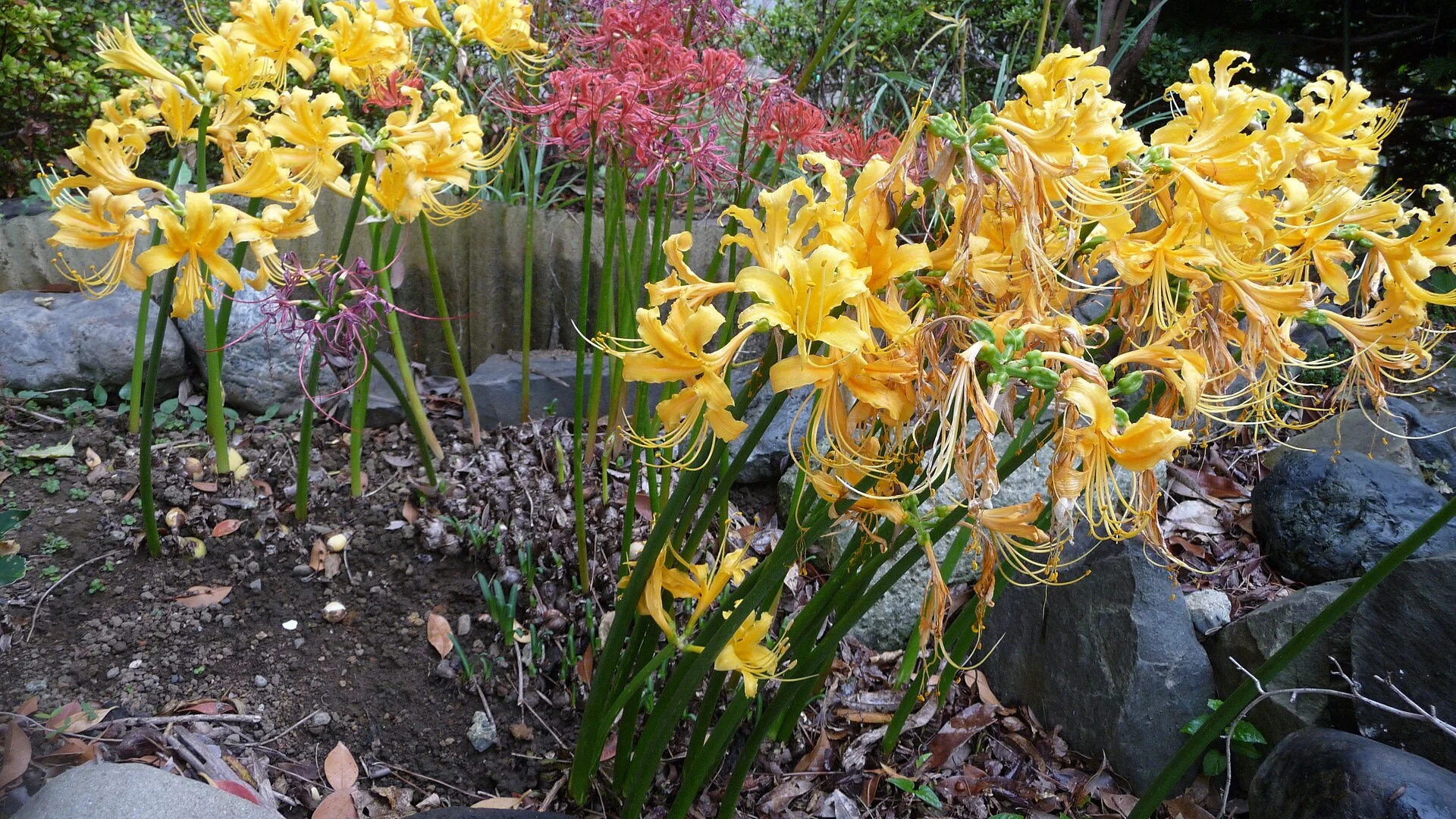
golden spider-lily
golden hurricane-lily
golden-lily
#6A6246
#BEA763
#2D2D1D
#635359
#23272E
Plant palette
Lycoris aurea - Golden Spider Lily Species Guide
Admired for its brilliant golden-yellow blossoms, Lycoris aurea illuminates shady slopes and gardens across East and Southeast Asia. This robust, bulbous perennial is celebrated for its sudden, dramatic late-summer flowering display.
The species is widely distributed from southern Japan to Indochina, thriving in humid, subtropical climates. Its striking appearance has earned it a prominent place in regional folklore and horticulture.
The large, ovoid bulbs of Lycoris aurea produce fleshy, strap-like, glaucous leaves in autumn that persist through winter before dying back in spring. In late summer, stout flowering scapes rise up to 60 centimeters high, bearing umbels of four to ten trumpet-shaped flowers.
The golden tepals are strongly recurved with wavy margins, surrounding exceptionally long, upward-curved stamens. The seed capsule is subglobose and contains a few large black seeds.
Flowering season
Late summer to early autumn
Jan
Feb
Mar
Apr
May
Jun
Jul
Aug
Sep
Oct
Name
Dec
Applications
This species is highly valued as an ornamental plant in warm-temperate and subtropical regions for its vibrant yellow flowers. The toxic bulbs are harvested for the extraction of lycorine and other alkaloids, which have significant applications in modern pharmacology.
Additionally, the starch extracted from the bulbs is processed for industrial purposes after removing the toxic compounds.
Interesting facts
In Mandarin Chinese, Lycoris aurea is known as hu di xiao, which translates to 'suddenly the earth smiles,' perfectly describing its rapid, unexpected bloom. The plant is highly toxic due to the presence of lycorine, protecting it from herbivores but requiring careful handling by humans.
It exists in two chromosomal races with diploid numbers of 14 and 16, which is of great interest to cytogeneticists.