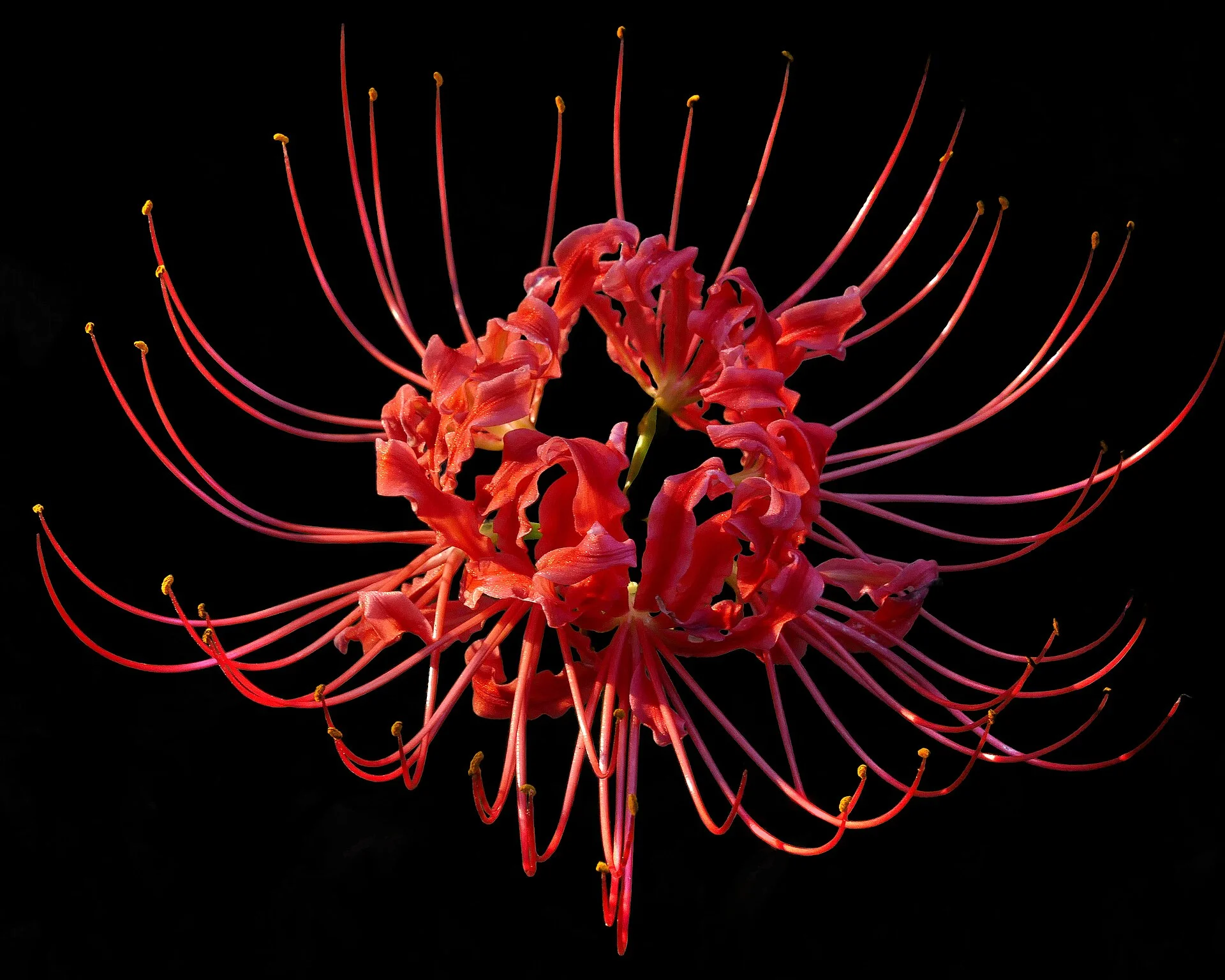
Red magic lily
Corpse flower
Equinox flower
Hurricane lily
Resurrection lily
#0B0201
#280A0F
#000300
#841923
#000104
Plant palette
Lycoris radiata: Complete Guide to the Red Spider Lily
Coinciding with the arrival of autumn rains, brilliant crimson blooms suddenly rise from bare soil to paint East Asian landscapes in fiery red. This striking visual phenomenon belongs to Lycoris radiata, a bulbous perennial that is deeply embedded in the folklore and seasonal rhythms of China, Japan, and Korea.
Known under many names such as the red spider lily or equinox flower, it exhibits a unique growth cycle where flowers and leaves never coexist. The brilliant red blossoms appear in late summer on naked stalks, while the narrow green leaves emerge only after the flowers have faded to persist through the winter.
Lycoris radiata is a bulbous perennial herb characterized by its distinct separation of flowering and vegetative phases. The underground bulb is ovoid to globose, measuring several centimeters in diameter, and is covered by dark-colored outer scales.
During the flowering season, the plant produces the following structures:
Flower Scape: A solid, leafless stalk rising 30 to 70 centimeters from the ground, topped by a cluster of showy blossoms.
Inflorescence: An umbel consisting of 4 to 7 irregular, bright-red flowers, which are subtended by two lanceolate bracts.
Perianth: Composed of six narrow, wavy-edged segments that curve backwards, creating a delicate, open crown.
Stamens: Six exceptionally long, red filaments that project far beyond the petals, resembling spider legs.
The vegetative structures develop after the flowering phase is complete. In autumn, parallel-sided leaves emerge, measuring 15 centimeters long and 0.5 to 1 centimeter wide with a prominent pale green midrib. The fruit, produced only by diploid varieties, is a three-valved capsule containing black, spherical seeds.
Flowering season
Late summer to early autumn, typically from August to September.
Jan
Feb
Mar
Apr
May
Jun
Jul
Aug
Sep
Oct
Name
Dec
Applications
Historically, the applications of Lycoris radiata span agricultural protection, traditional medicine, and modern pharmacology. The highly toxic bulbs have been utilized for centuries in rural areas to protect crops and burial grounds.
Key uses of the plant include:
Pest Control: Bulbs are planted along the borders of rice paddies and gardens, where their toxicity deters moles, mice, and other pests.
Pharmacological Extraction: The plant contains galantamine, an alkaloid approved for treating Alzheimer's disease, and is cultivated commercially in China for this compound.
Ornamental Value: Due to their striking appearance, these lilies are popular in autumn gardens, temple grounds, and landscapes across East Asia and the southern United States.
Famine Food: In times of severe famine, the starch-rich bulbs were processed through extensive washing to remove water-soluble toxins for emergency consumption.
Interesting facts
The unique lifecycle and striking appearance of Lycoris radiata have inspired numerous legends and cultural beliefs throughout East Asia. In Japan, the flower is known as higanbana, associating it with the autumnal equinox and the transition to the afterlife.
Several fascinating myths and historical facts surround the species:
The Legend of Manju and Saka: Shinto myth tells of two elven guardians cursed by the sun goddess Amaterasu to never meet, causing the flowers to bloom only after the leaves wither.
Sangsahwa in Korea: Translated as the "flower of unrealized love," it represents eternal separation due to the physical impossibility of its leaves and flowers appearing together.
Historical Introduction to the US: The species was first brought to America in 1854 by Captain William Roberts, who returned from Japan with only three bulbs that successfully naturalized in North Carolina.
Hurricane Lily: In the southern United States, it is widely referred to as the hurricane lily because its sudden flowering period coincides with the peak of the Atlantic hurricane season.