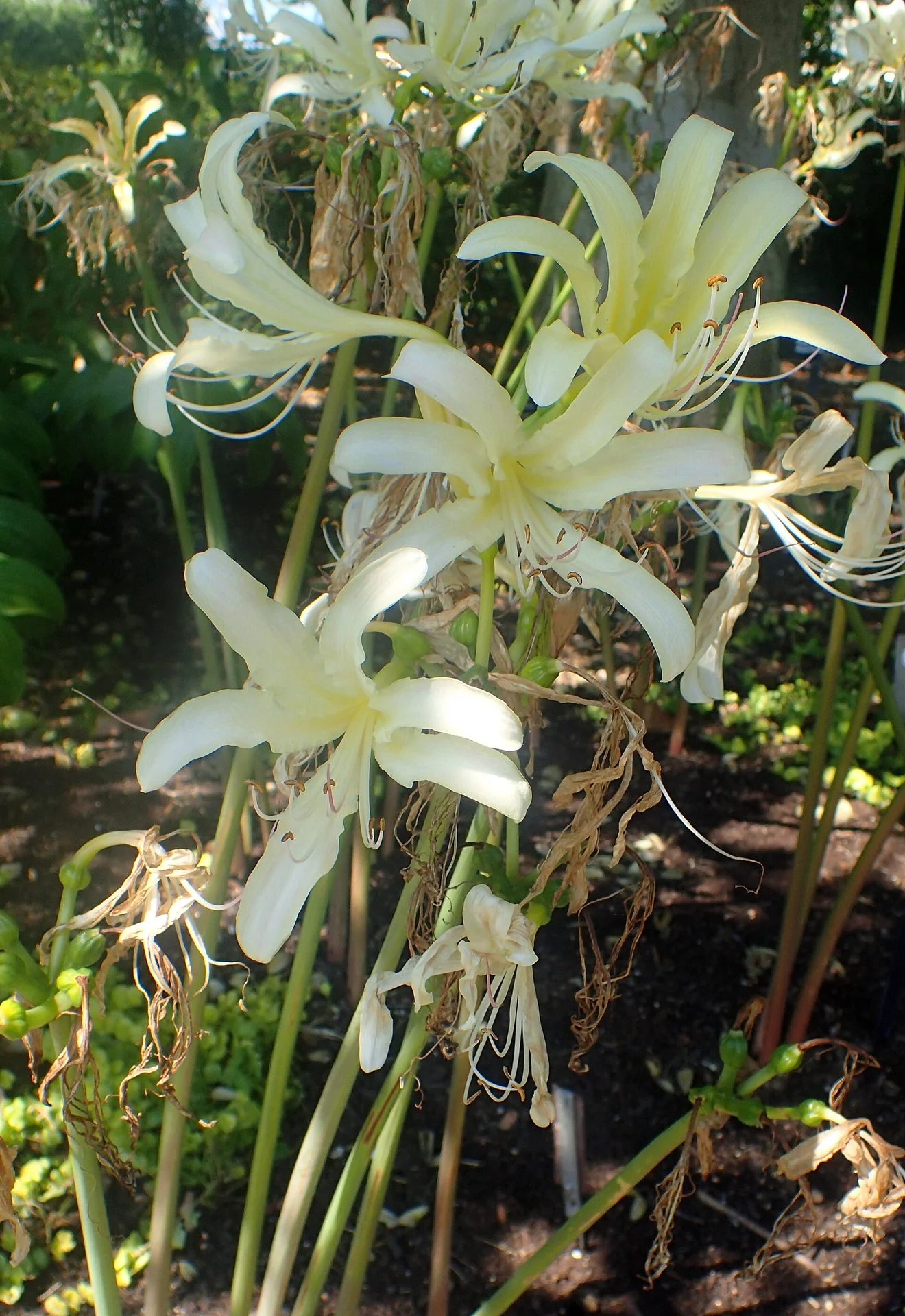
Caldwell's Spider Lily (Lycoris caldwellii)

Caldwell's surprise lily Short-stamened spider lily
#666644
#272614
#A6AA85
#172612
#474B24

Lycoris caldwellii - Pale Yellow Surprise Lily Guide

Growing naturally in the shady, moist hillsides of southeastern China, Lycoris caldwellii captivates botanists with its rare pale yellow blooms. This herbaceous perennial belongs to the Amaryllidaceae family and stands out due to its unique genetic history. As a sterile triploid, it is believed to have originated as a natural hybrid between Lycoris chinensis and Lycoris sprengeri.

The species is primarily native to provinces such as Jiangsu, Jiangxi, and Zhejiang, where it thrives in moist, shaded environments. Because it does not produce viable seeds, the plant relies entirely on vegetative propagation through its underground bulbs to survive and spread.

Taxonomy

  • царство Plantae
  • division Tracheophytes (Vascular Plants)
  • subdivision Spermatophytes (Seed plants)
  • Angiosperms
  • monocots
  • order Asparagales
  • family Amaryllidaceae (Amaryllis family)
  • subfamily Amaryllidoideae
  • tribe Lycorideae
  • genus Lycoris (Spider Lily)
  • species Lycoris caldwellii (Caldwell's Spider Lily)

Living Pulse

Morphology

The structural characteristics of this species reflect its hybrid lineage, presenting a blend of features from its parent plants. Key morphological traits include:

  • Bulbs: Underground ovoid bulbs that serve as the primary means of vegetative reproduction and nutrient storage.
  • Leaves: Long, strap-like green leaves that emerge during the spring and wither before the onset of the flowering season.
  • Flowers: Pale yellow or cream-colored, funnel-shaped blossoms arranged in terminal umbels on erect, leafless stalks.
  • Stamens: Notably short stamens that barely protrude from the perianth, which is a key distinguishing feature of this taxon.

Flowering season

Late summer, typically in August

Jan
Feb
Mar
Apr
May
Jun
Jul
Aug
Sep
Oct
Name
Dec

Applications

Due to its rarity and sterile nature, the plant is not widely utilized in commercial horticulture or agriculture. However, it holds significant value in botanical research:

  • Evolutionary Studies: It serves as a vital model for studying natural hybridization and polyploidy in the genus Lycoris.
  • Phytochemical Potential: Like many members of the Amaryllidaceae family, it is investigated for bioactive alkaloids, though it is not commercially harvested.

Interesting facts

The evolutionary pathway of this plant showcases the complexity of natural hybridization in the wild. Some fascinating aspects of its biology include:

  • Sterile Genome: Being a triploid organism, it cannot undergo normal meiosis, rendering it completely sterile and unable to produce seeds.
  • Late Blooming: The flowers emerge suddenly in late summer on bare stems, earning it and its relatives the common association with surprise lilies.
  • Taxonomic History: It was first scientifically described in 1957 by the American botanist Hamilton Paul Traub.

Geography of distribution

  • China

Sources

  • POWO (2026). "Lycoris caldwellii". Plants of the World Online. Facilitated by the Royal Botanic Gardens, Kew.
  • IPNI (2026). "Lycoris caldwellii". International Plant Names Index.
  • Tropicos (2026). "Lycoris caldwellii". Missouri Botanical Garden.

Technical Information

External Databases: GBIF, POWO, Tropicos

See also

Orange Spider Lily

Orange Spider Lily

Lycoris sanguinea

An orange-flowered deciduous perennial native to East Asia, famous for its toxic bulbs and synchronized …