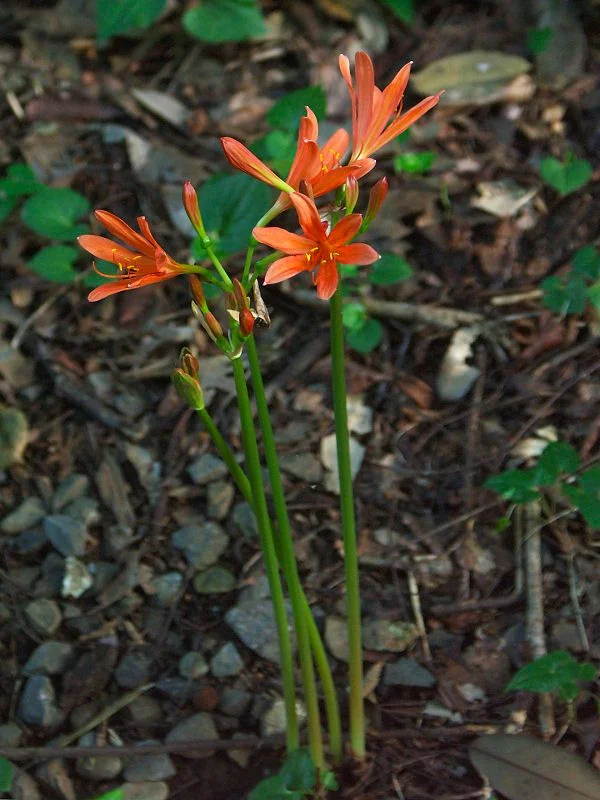
Orange Spider Lily (Lycoris sanguinea)

Orange-flowered surprise lily Kitsune-no-kamisori Fox's razor Spider-lily
#2E2A20
#635543
#213321
#435E45
#26522C

Lycoris sanguinea - Orange-Flowered Surprise Lily & Fox's Razor

Renowned for its striking orange blooms that emerge on bare stems in mid-summer, Lycoris sanguinea brings a dramatic touch to East Asian forests. This bulbous perennial belongs to the Amaryllidaceae family and is native to Japan and the Korean Peninsula. In its native habitats, it is commonly known as Kitsune-no-kamisori, which translates to 'fox's razor' due to the shape and sharp appearance of its spring foliage.

The species grows naturally in bright forest floors and edges, showcasing a highly synchronized life cycle. It produces strap-shaped leaves in early spring that completely wither away before the flower stalks rise in August, ensuring that foliage and flowers are never present at the same time.

Taxonomy

  • царство Plantae
  • division Tracheophytes (Vascular Plants)
  • subdivision Spermatophytes (Seed plants)
  • Angiosperms
  • monocots
  • order Asparagales
  • family Amaryllidaceae (Amaryllis family)
  • subfamily Amaryllidoideae
  • tribe Lycorideae
  • genus Lycoris (Spider Lily)
  • species Lycoris sanguinea (Orange Spider Lily)

Living Pulse

Morphology

The growth patterns and structure of this species distinguish it from other members of the genus. Its physical description includes the following characteristics:

  • Bulbs: Underground globose bulbs containing high concentrations of protective alkaloids.
  • Leaves: Narrowly linear, measuring approximately 5 to 6 millimeters in width, appearing in early spring and dying back before summer.
  • Stems: Erect, leafless flowering scapes that reach a height of 30 to 50 centimeters.
  • Flowers: Orange to reddish-orange trumpet-shaped blooms, arranged in terminal umbels of 3 to 5 flowers with recurved tepals and flat margins.
  • Reproductive Organs: Stamens that are roughly equal in length to the perianth, unlike the long, protruding stamens of closely related species.

Flowering season

Late summer, typically mid-August

Jan
Feb
Mar
Apr
May
Jun
Jul
Aug
Sep
Oct
Name
Dec

Applications

While its high toxicity limits culinary or general agricultural uses, this plant has several specialized applications:

  • Ornamental Gardening: It is cultivated in temperate regions for its vibrant summer flowers and dramatic, leaf-free blooming habit.
  • Medical Research: The bulbs contain valuable alkaloids such as lycorine and galanthamine, which are studied for potential pharmaceutical applications.
  • Traditional Medicine: Historically, external preparations were used in traditional practices, though internal consumption is strictly avoided due to severe toxicity.

Interesting facts

The combination of toxic properties and striking appearance has given this plant a unique place in regional folklore and botany. Some notable aspects include:

  • Fox's Razor: The common Japanese name, Kitsune-no-kamisori, reflects both the blade-like appearance of the leaves and the legendary shape-shifting foxes associated with mysterious events.
  • Natural Pest Repellent: Because of the toxic alkaloid lycorine present throughout the plant, herbivores and common garden pests completely avoid it.
  • Intraspecific Variations: The species includes distinct varieties such as var. kiushiana, which features larger flowers, and the rare var. koreana, which is critically endangered.

Geography of distribution

  • Japan
  • South Korea

Natural varieties

Sources

  • POWO (2026). "Lycoris sanguinea". Plants of the World Online. Facilitated by the Royal Botanic Gardens, Kew.
  • GBIF (2026). "Lycoris sanguinea". Global Biodiversity Information Facility.
  • IPNI (2026). "Lycoris sanguinea". International Plant Names Index.

Technical Information

External Databases: GBIF, POWO, Tropicos
See also