
Red spider lily
Lycoris radiata
Lycoris radiata, commonly known as the red spider lily, is a bulbous perennial famous for …
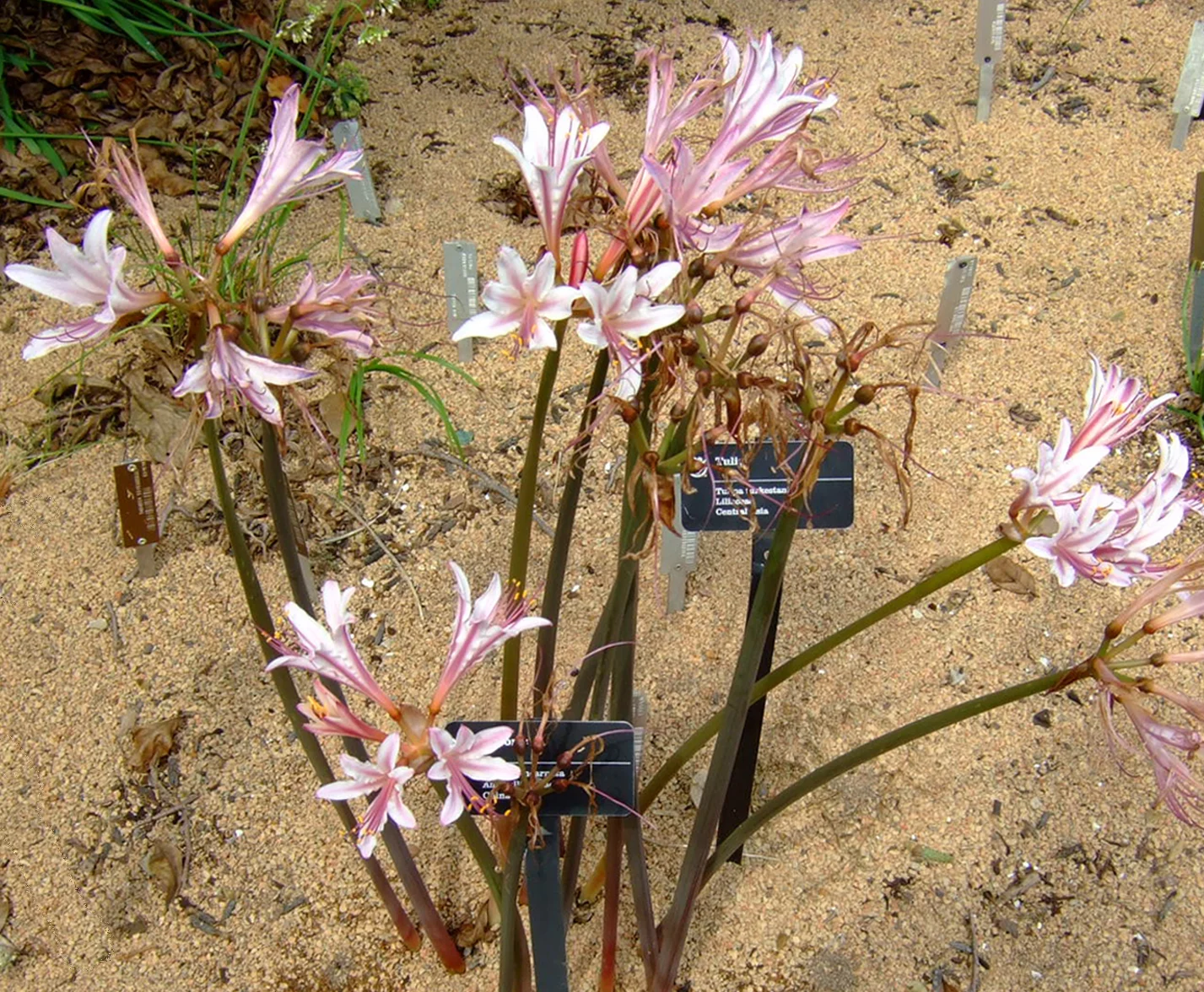
Discovered in the moist mountain valleys of Hubei and Yunnan provinces, Lycoris incarnata captivates observers with its fragrant, peppermint-striped flowers.
This plant is a naturally occurring hybrid, believed to have originated from a cross involving Lycoris sprengeri. It belongs to the family Amaryllidaceae and is noted for being entirely sterile.
The bulbs are ovoid to subglobose, reaching about 3 to 5 centimeters in diameter.
Leaves are linear, strap-like, and appear in early spring, dying back completely before the mid-summer heat.
The flowering stems produce clusters of 4 to 6 funnel-shaped, pale pink or white flowers. Each tepal features a distinct rose-red or purple stripe running down the center, and the petals are slightly reflexed with wavy margins.
Mid to late summer
The plant is grown as an ornamental specialty in botanical gardens and collector collections due to its distinct coloration.
Its bulbs contain various alkaloids, typical of the family Amaryllidaceae, which are analyzed for potential medicinal properties.
As a sterile hybrid, this plant possesses several interesting biological attributes:
Lycoris radiata
Lycoris radiata, commonly known as the red spider lily, is a bulbous perennial famous for …

Lycoris squamigera
Lycoris squamigera, also known as the resurrection lily or surprise lily, is a bulbous herbaceous …

Lycoris sanguinea
An orange-flowered deciduous perennial native to East Asia, famous for its toxic bulbs and synchronized …

Lycoris caldwellii
A rare sterile triploid perennial from China, prized for its pale yellow late-summer blooms.