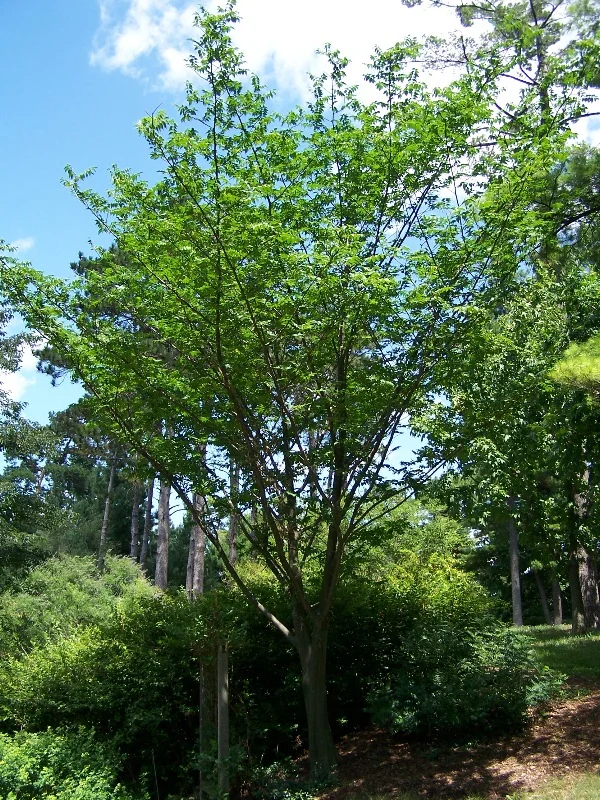
Bitterwood
Shurni
Nigaki
Indian quassia
Quassia wood
#172812
#4E6C45
#88A98C
#B5DDF4
#232812
Plant palette
Picrasma quassioides (Bitterwood): Guide to Nigaki and Shurni
Renowned for its intensely bitter bark, Picrasma quassioides grows natively across the temperate zones of East Asia, spanning from the Himalayas to Japan and Korea.
This deciduous woody plant occurs in mountainous woodlands, valleys, and forest margins. It is highly valued in regional traditions for its medicinal bark and ornamental qualities.
This deciduous shrub or small tree reaches heights of 10 to 15 meters, occasionally reaching up to 20 meters, with a trunk diameter up to 50 centimeters. The outer bark is smooth and dark grey-brown, while the young twigs exhibit conspicuous white lenticels.
Its pinnate foliage ranges from 15 to 40 centimeters in length, bearing 7 to 15 leaflets with coarsely and irregularly serrated margins. During mid to late spring, it produces small green to yellow-green flowers arranged in loose cymes, which eventually develop into small, globose red to black drupes.
Flowering season
Mid to late spring
Jan
Feb
Mar
Apr
May
Jun
Jul
Aug
Sep
Oct
Name
Dec
Applications
The bark and wood are widely utilized in traditional East Asian medicine as a bitter stomachic, digestive aid, and antibacterial treatment. In organic farming, water extracts from the wood serve as an effective, biodegradable natural insecticide.
Cultivated gardens in Europe and North America occasionally feature this species as an ornamental tree. It is highly appreciated for its stunning, vibrant orange and red foliage during the autumn season.
Interesting facts
In the indigenous Ainu culture of Hokkaido, this plant is referred to as "the tree that kills deer," likely because deer avoid feeding on its extremely bitter leaves. The yellow heartwood has a distinct grain and is used in traditional Japanese Hakone wood mosaic crafts.
However, the wood cannot be used to manufacture eating utensils or bowls. Even after drying, the bitter compounds easily leach out when in contact with liquids, spoiling the taste of food.