Variety
Bloodberry (Rivina humilis)
Pigeonberry
Rougeplant
Coral-Berry
Baby Pepper
#1F3B0E
#2A320B
#31511C
#636C30
#426031
Rivina humilis (Pigeonberry): Characteristics and Uses
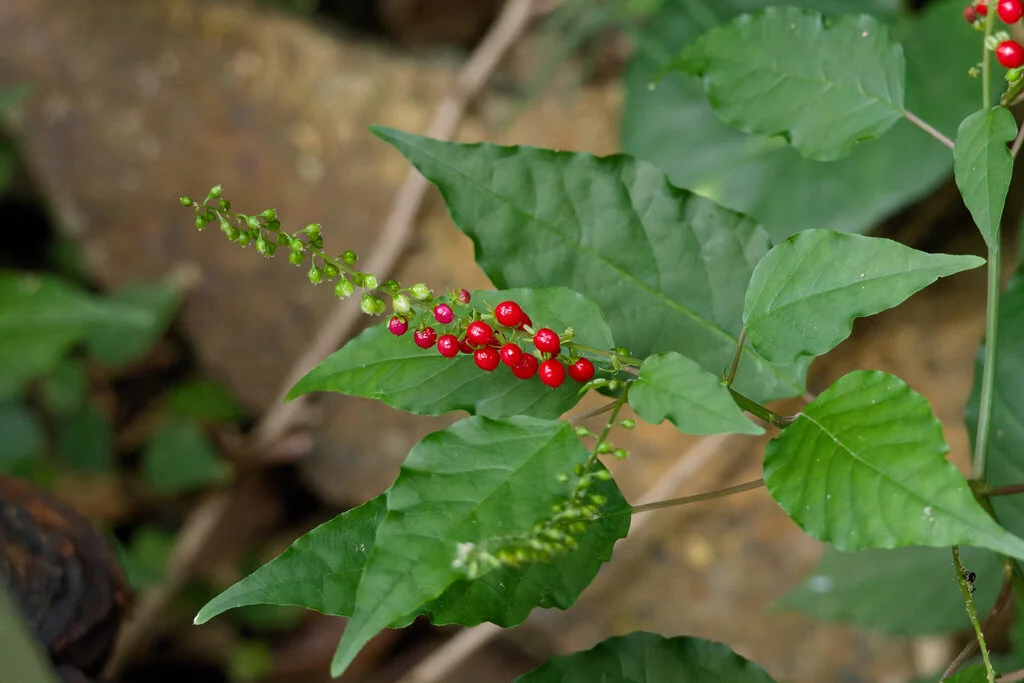
Vibrant clusters of glossy, bright red berries are the unmistakable signature of Rivina humilis, a resilient species that thrives in the dappled shade of forest understories. Native to the southern United States, the Caribbean, and vast expanses of Central and South America, this evergreen perennial brings a distinct visual appeal to habitats ranging from coastal shell middens to dense thickets. Commonly known by evocative names such as pigeonberry or rougeplant, it features a sprawling, vine-like habit that gracefully navigates the lower canopies of its environment.
Historically placed in the pokeweed family (Phytolaccaceae) but more recently classified under Petiveriaceae, this highly adaptable species has successfully spread far beyond its native range. Its remarkable environmental tolerance has allowed it to naturalize in diverse tropical and subtropical regions globally, spanning from Pacific islands to Australia and parts of Asia. While admired for its ornamental qualities, it is equally noted for its ruggedness, easily tolerating salt spray and flourishing in fully shaded areas where many other plants struggle.
Taxonomy
- ∟ царство Plantae
- ∟ division Tracheophytes (Vascular Plants)
- ∟ subdivision Spermatophytes (Seed plants)
- ∟ Angiosperms
- ∟ mesangiosperms (Core angiosperms)
- ∟ eudicots
- ∟ Superasterids
- ∟ order Caryophyllales
- ∟ family Petiveriaceae
- ∟ genus Rivina (Bloodberry genus)
- ∟ species Rivina humilis (Bloodberry)
Botanical illustration
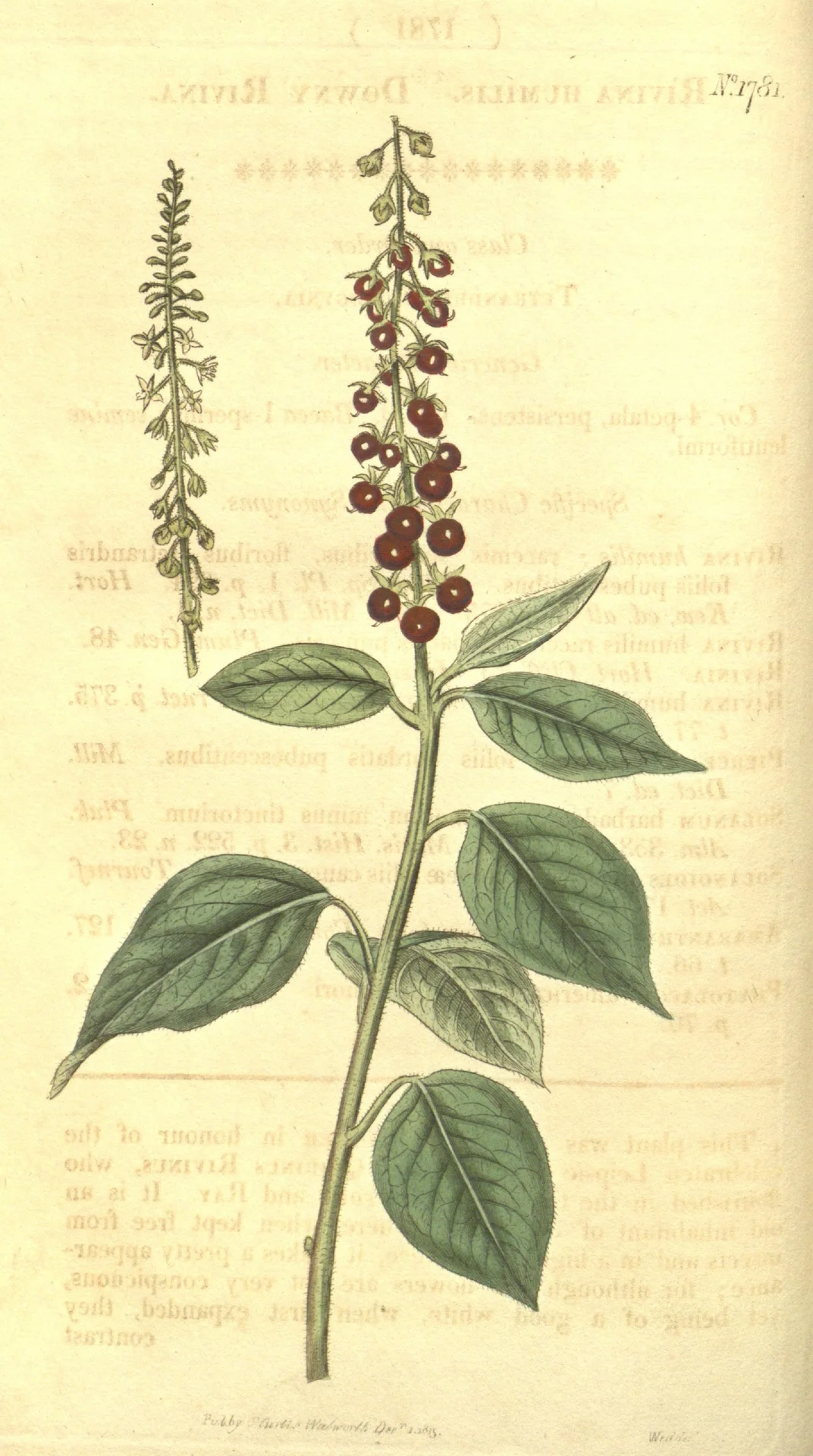
Botanical illustration
Morphology
Rivina humilis grows as an erect, sometimes vine-like herbaceous perennial or subshrub, typically reaching heights between 0.4 and 2 meters. The ribbed stems can become slightly woody near the base and bear alternately arranged foliage. Its evergreen leaves are broadly ovate to lanceolate, measuring up to 15 centimeters in length and 9 centimeters in width, supported by petioles that vary from 1 to 11 centimeters long.
The plant produces fine, hairy, indeterminate racemes ranging from 4 to 15 centimeters in length. The small, radially symmetrical flowers lack true petals; instead, they feature four petaloid sepals that measure 1.5 to 3.5 millimeters long. These sepals undergo a subtle color transition from green or white to pink or purplish as the flower matures, containing four short stamens and a single superior carpel.
The most striking morphological feature is its fruit, a small, thinly fleshy berry measuring 2.5 to 5 millimeters in diameter. These glossy berries ripen to a vivid bright red or orange and contain a single lens-shaped, bristly black seed. The continuous production of both the delicate flowers and the bead-like fruits often results in them appearing simultaneously on the same raceme.
Flowering season
In tropical and subtropical climates, this species is capable of blooming and producing fruit continuously throughout the entire year.
Jan
Feb
Mar
Apr
May
Jun
Jul
Aug
Sep
Oct
Name
Dec
Applications
Throughout history, the vibrant berries of Rivina humilis have been highly valued for their intense pigments. The primary pigment responsible for this striking coloration is rivianin, a compound chemically similar to the betanin found in beetroots. Because of this rich color, the plant has been utilized in several traditional ways:
- As a natural red dye for textiles and fabrics in traditional crafts.
- As a makeshift ink for writing and artistic endeavors.
- As a coloring agent for beverages and sweets in some South American cultures.
In contemporary landscaping, the species is occasionally cultivated as an ornamental groundcover in warm climates. Its exceptional shade tolerance makes it a strategic choice for woodland gardens, while its resistance to saline soils suits coastal environments. However, due to its vigorous seed production, it is considered an invasive weed in several regions outside its native habitat.
Interesting facts
The specific epithet humilis translates to "dwarfish" or "lowly" in Latin, reflecting the plant's relatively short stature within the Petiveriaceae family. The genus name itself serves as a tribute to Augustus Quirinus Rivinus, a prominent 17th-century German botanist. He pioneered early botanical classification systems based on floral morphology rather than growth habits.
In its native ecosystems, Rivina humilis plays a crucial role in supporting local fauna and interacting with its environment. Some notable ecological relationships include:
- Serving as a specific host plant for caterpillars of Goodson's greenstreak butterfly (Cyanophrys goodsoni).
- Providing a favored food source for various bird species, which subsequently aid in the widespread dispersal of its seeds.
- Forming dense thickets in disturbed areas, showcasing its ability to thrive in challenging conditions.
This avian-assisted dispersal has been a critical factor in the plant's successful naturalization across global tropical zones. However, this has also led to its aggressive spread and invasive status in vulnerable island ecosystems.
Geography of distribution
- United States
- Mexico
- Brazil
- Colombia
- Argentina
- Australia
Natural varieties
Variety
Bracteate bloodberry
A distinct botanical variety of the widespread pigeonberry plant known for its specific floral structures.
Sources
See also

Brazilian rougeplant
Rivina brasiliensis
A species of flowering plant in the family Phytolaccaceae, noted for its exceptionally wide distribution …

Bitterwood Tree
Picrasma
A genus of deciduous trees and shrubs known for their extremely bitter bark and medicinal …
Read more →
480

Humboldt Araucaria Pine
Araucaria humboldtensis
A small, critically endangered coniferous tree native strictly to the high-altitude mountain peaks of southern …
Read more →
126

True Araucarias
Araucaria sect. Araucaria
Araucaria sect. Araucaria is a botanical section of evergreen conifers native to South America. It …
Read more →
124