Bitter wood
Lokhandi
Karinjotta
Manunggal
Nipa
Kaduhonge
Gucchakaranjah
Samadera indica: Botanical Guide, Uses and Native Habitat
Growing in the wet tropical regions from West Africa to the Pacific islands, Samadera indica forms a notable part of coastal and riverine ecosystems.
This evergreen plant, frequently referred to as the Niepa bark tree or bitter wood, has long been utilized in traditional medicine across various Asian and African countries. It thrives in low-altitude environments, including tidal swamps and evergreen forests, playing a significant role in local folklore and ecological systems.
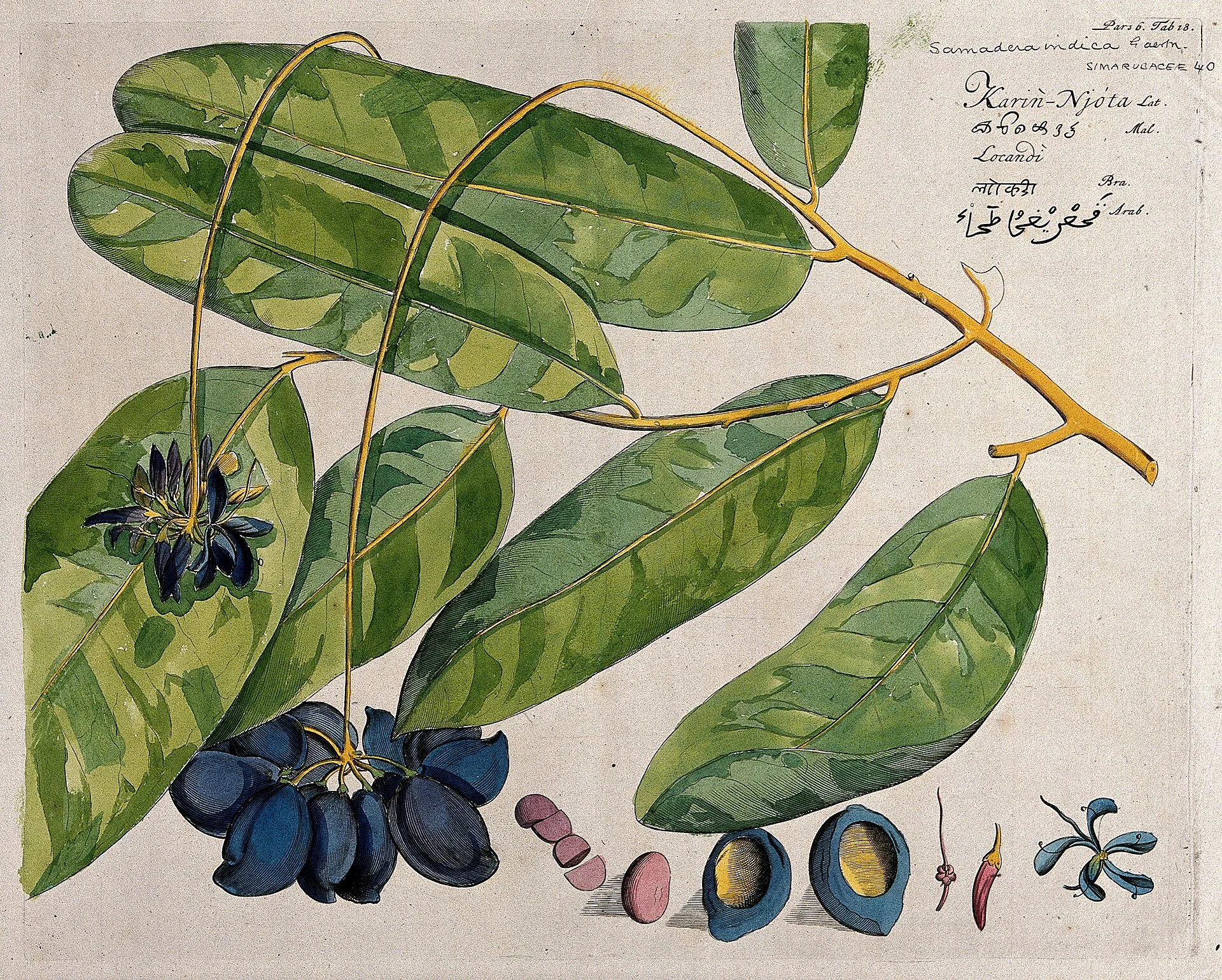
Samadera indica displays a distinct vegetative structure, growing as an evergreen shrub or tree that reaches heights between 10 and 20 meters. Its pale yellow bark is characterized by transverse cracks, featuring small pores and lacking distinct heartwood.
The simple, lustrous leaves are elliptic, ovate, or obovate, measuring 5 to 25 centimeters in length and 2 to 8.5 centimeters in width. They are arranged on stout, often curved petioles and exhibit a densely reticulate venation with glandular structures on the underside.
The inflorescences are umbelliform, bearing 20 or more bisexual flowers with four petals that range in color from white and pale yellow to light purple. The resulting fruits consist of flattened, woody drupes grouped in whorls, each containing a single large brown seed with a thin outer coat.
Flowering season
Flowers all year round
Jan
Feb
Mar
Apr
May
Jun
Jul
Aug
Sep
Oct
Name
Dec
Applications
Historically, the leaves, bark, and seeds of Samadera indica have been harvested for diverse medicinal applications in traditional Asian and African practices. In Ayurvedic medicine, it is known as Guchakaranja and is prescribed to treat conditions such as rheumatism, fevers, and skin eruptions.
Beyond pharmacology, the plant serves as a natural insecticide, with leaf infusions frequently applied to control termite infestations. Leaf extracts have also demonstrated efficacy in reducing the reproductive capacity and egg hatchability of key mosquito species.
The light, soft wood is used locally for crafting small implements like knife handles. Additionally, the species is cultivated as an ornamental plant in parks and gardens due to its attractive foliage and unique fruit structures.
Interesting facts
The bitter properties of Samadera indica are attributed to a specialized glucoside called samaderin, which is present throughout the plant tissues. This bitterness has made the plant a staple in regional folk remedies for centuries.
The species possesses buoyant, woody fruits that are capable of floating long distances on water. This evolutionary adaptation explains how the plant successfully colonized diverse coastlines and islands across the Indian and Pacific Oceans.
Taxonomic research in 2007 utilizing DNA sequencing resolved a long-standing debate by separating the genus Samadera from Quassia. This genetic analysis confirmed their distinct lineages, leading to the formal resurrection of the species' original name.
Geography of distribution
Tanzania
Madagascar
India
Sri Lanka
Myanmar
Vietnam
Indonesia
Philippines
Papua New Guinea
Singapore
Sources
Gaertner, J. (1791). De Fructibus et Seminibus Plantarum, 2: 352.
Govaerts, R. et al. (2022). Plants of the World Online (POWO). Royal Botanic Gardens, Kew.
Hassler, M. (2022). World Plants: Synonymic Checklists of the Vascular Plants of the World.