Torreya nucifera (Kaya): The Golden Wood Conifer of Japan
Amidst the steep, misty shale slopes of Mount Takao near Tokyo, the ancient coniferous whispers of the forest are defined by a tree of remarkable cultural depth. Torreya nucifera, revered in Japan as kaya, stands as a slow-growing testament to the rich temperate woodlands of East Asia.
The tree is celebrated for its warm, golden wood that produces a distinct, resonant sound when game stones are placed upon it. Beyond the game boards, its resinous foliage and oil-rich seeds have deeply integrated into local culinary history and Buddhist spiritual practices.
In the wild, Torreya nucifera persists in broad-leafed and coniferous forest strands. While past logging has made mature specimens rare, efforts in Japan and South Korea protect this venerable species from further decline.
Torreya nucifera is a slow-growing evergreen tree that typically attains a height of 15 to 25 meters, with a trunk diameter reaching up to 1.5 meters. The bark is greyish-brown to reddish-brown, peeling in thin, vertical strips as the tree matures, while young shoots remain smooth and green.
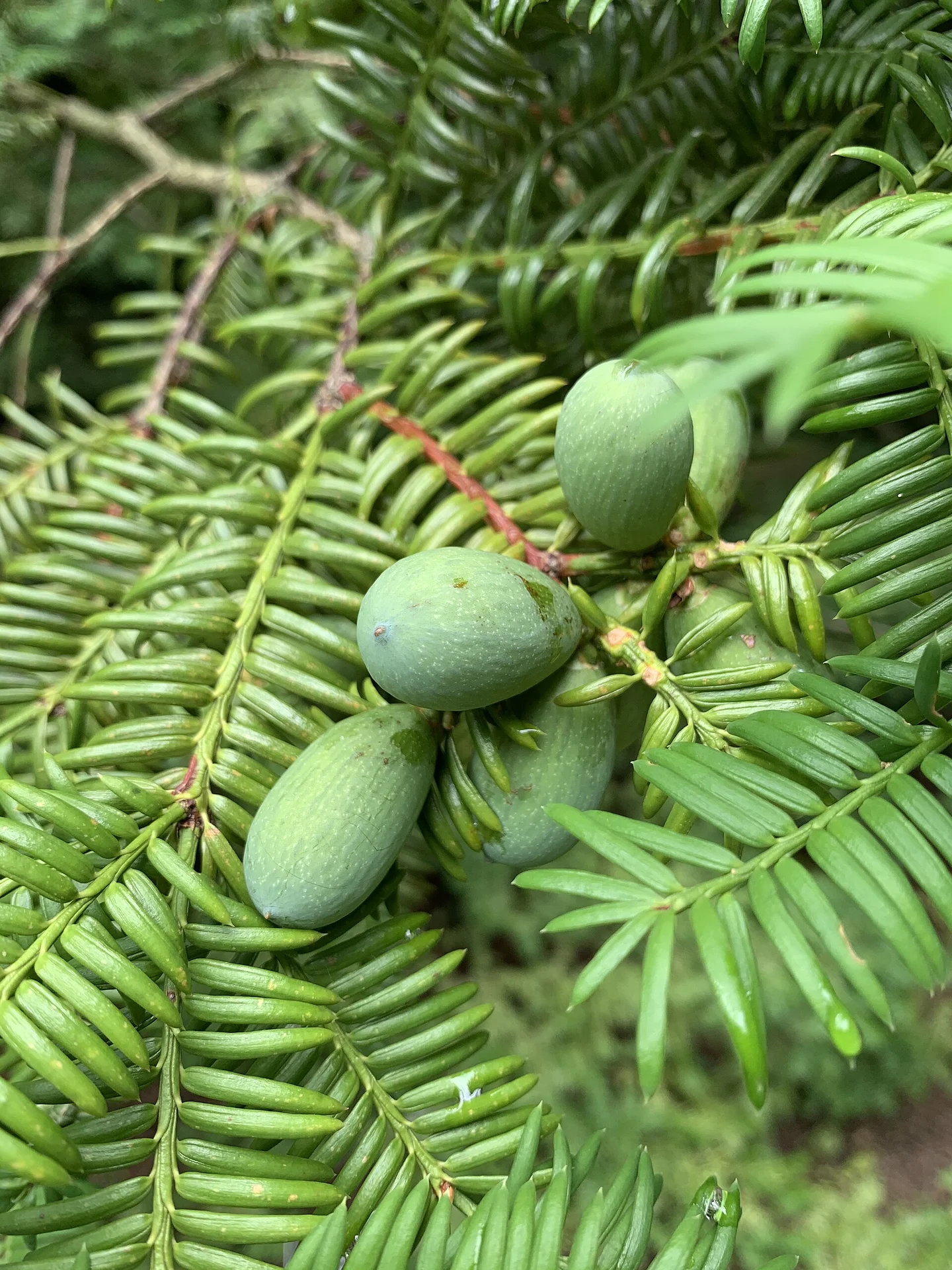
The stiff, needle-like leaves are spirally arranged but twist at the base to form two flat, horizontal rows. Each needle is 2 to 3 centimeters long, ending in a sharply spined tip, with a glossy dark-green upper surface and two whitish stomatal bands underneath.
This conifer exhibits subdioecious reproduction, meaning individual trees primarily bear cones of one sex but may produce some of the other. The reproductive organs and seeds show distinct features:
Male Cones: These are globular structures measuring 5 to 6 millimeters in diameter, arranged in double rows on the underside of young shoots.
Female Cones: They are borne in clusters of three to eight, maturing over 18 to 20 months into a single seed enveloped by a fleshy, green-to-purple aril.
Seeds: The mature seeds are oblong and red-brown, measuring approximately 2 to 3.5 centimeters in length.
Flowering season
Spring, typically during April and May.
Jan
Feb
Mar
Apr
May
Jun
Jul
Aug
Sep
Oct
Name
Dec
Applications
The wood of Torreya nucifera is highly prized for crafting traditional Go and Shogi boards. Its beautiful golden-yellow hue, fine grain, and resonant acoustic quality—creating a clear click when a stone is played—make it the ultimate material for high-end boards, which can cost tens of thousands of dollars.
Beyond game boards, the plant serves various culinary, medicinal, and cultural functions:
Edible Seeds: Known as a savory snack similar to almonds, the oil-rich seeds are eaten roasted or pressed for high-quality cooking oil.
Traditional Medicine: The seeds have a long history in East Asian medicine as a treatment for intestinal parasites, and modern research shows potential for compounds acting as protease inhibitors.
Spiritual Practices: In Shingon esoteric Buddhism, the leaves represent flowers in rituals, and the extracted oil is burned in lamps during intensive meditation practices.
Interesting facts
At Nagoya Castle, a historic Torreya nucifera tree over 600 years old stands as a symbol of resilience, having survived the devastating air raids of 1945. Feudal lord Tokugawa Yoshinao reportedly decorated his dinner tray with nuts from this tree for good fortune before going into battle.
The species holds deep cultural significance and exhibits unique characteristics across its native range:
Sumo Purification: Torreya seeds are buried in the center of the Sumo ring (dohyo) along with salt, rice, and chestnut to purify the ground and appease the spirits.
Ancient Giants: The largest specimen in Japan, located at Manzhoji Temple in Fukushima, boasts a trunk circumference of 8.7 meters and is estimated to be hundreds of years old.
Protected Forests: South Korea preserves several ancient groves as national monuments, including the famous natural Torreya forest on Jeju Island.