stinking-cedar
Florida nutmeg
gopher wood
stinking cedar
IUCN: В опасности
#262105
#716F2F
#545212
#908E4B
#A9A570
Plant palette
Florida Torreya (Torreya taxifolia) - Species Overview
Along the shaded limestone bluffs of the Apalachicola River, a pungent, resinous scent rises from the rare subcanopy of northern Florida. This distinctive aroma belongs to Torreya taxifolia, a critically endangered conifer that has survived since the glacial epochs of the Pleistocene.
Commonly known as the Florida torreya or stinking-cedar, this species was discovered in 1833 by the botanist Hardy Bryan Croom. Today, it stands as one of the rarest conifers in the world, with its remaining wild population decimated by fungal pathogens and habitat changes.
Preserving this ancient evolutionary relic has sparked passionate debates about climate change adaptation and assisted migration. Dedicated researchers and volunteers are actively planting seeds further north in the Appalachian Mountains to establish new populations.
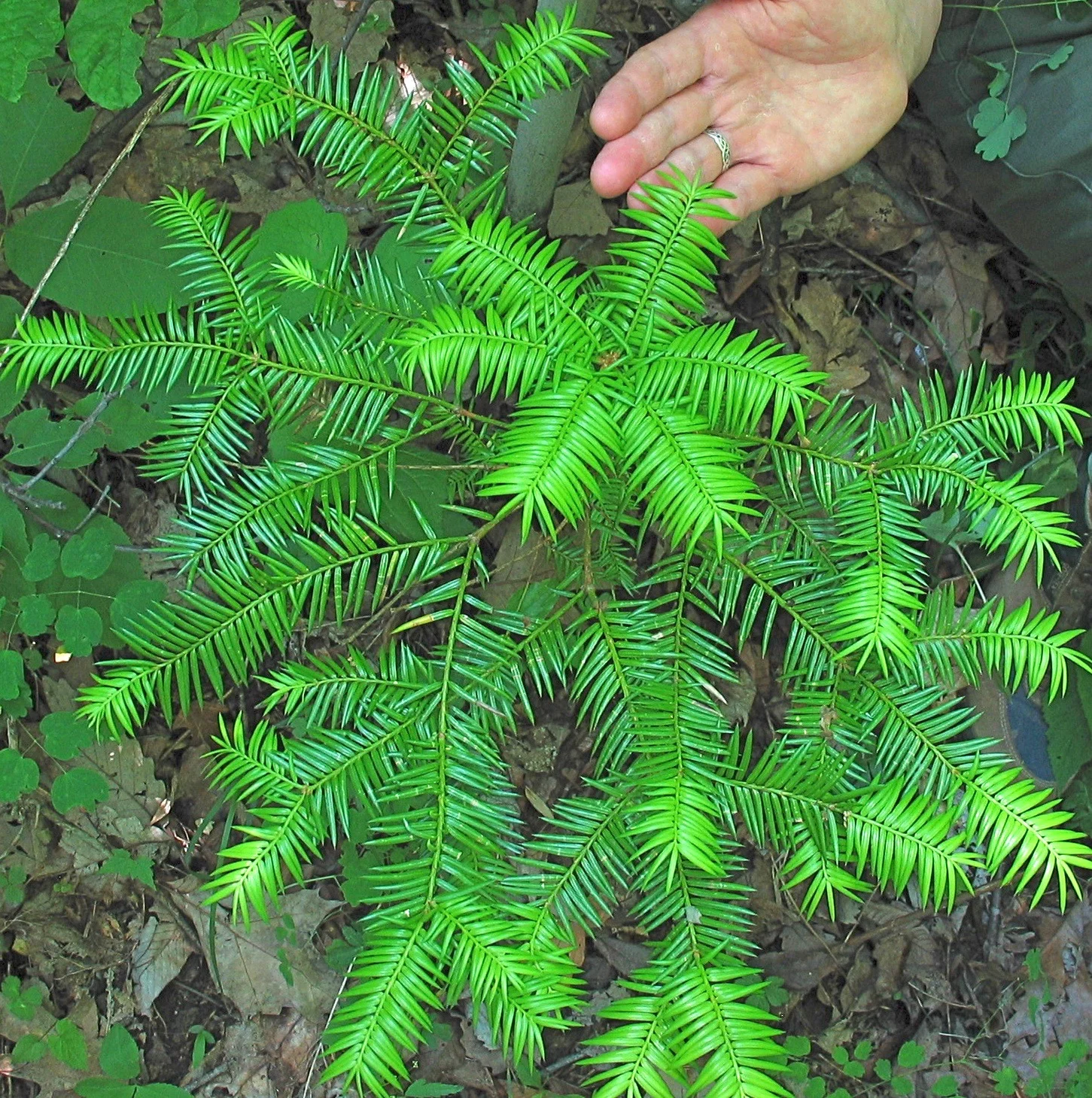
Torreya taxifolia is an evergreen coniferous tree that historically reached heights of 18 meters with a trunk diameter of up to 80 centimeters. Modern wild specimens, however, rarely exceed 3 meters due to the devastating impact of stem cankers. The tree features an open, conical crown with whorled, spreading, or slightly drooping branches.
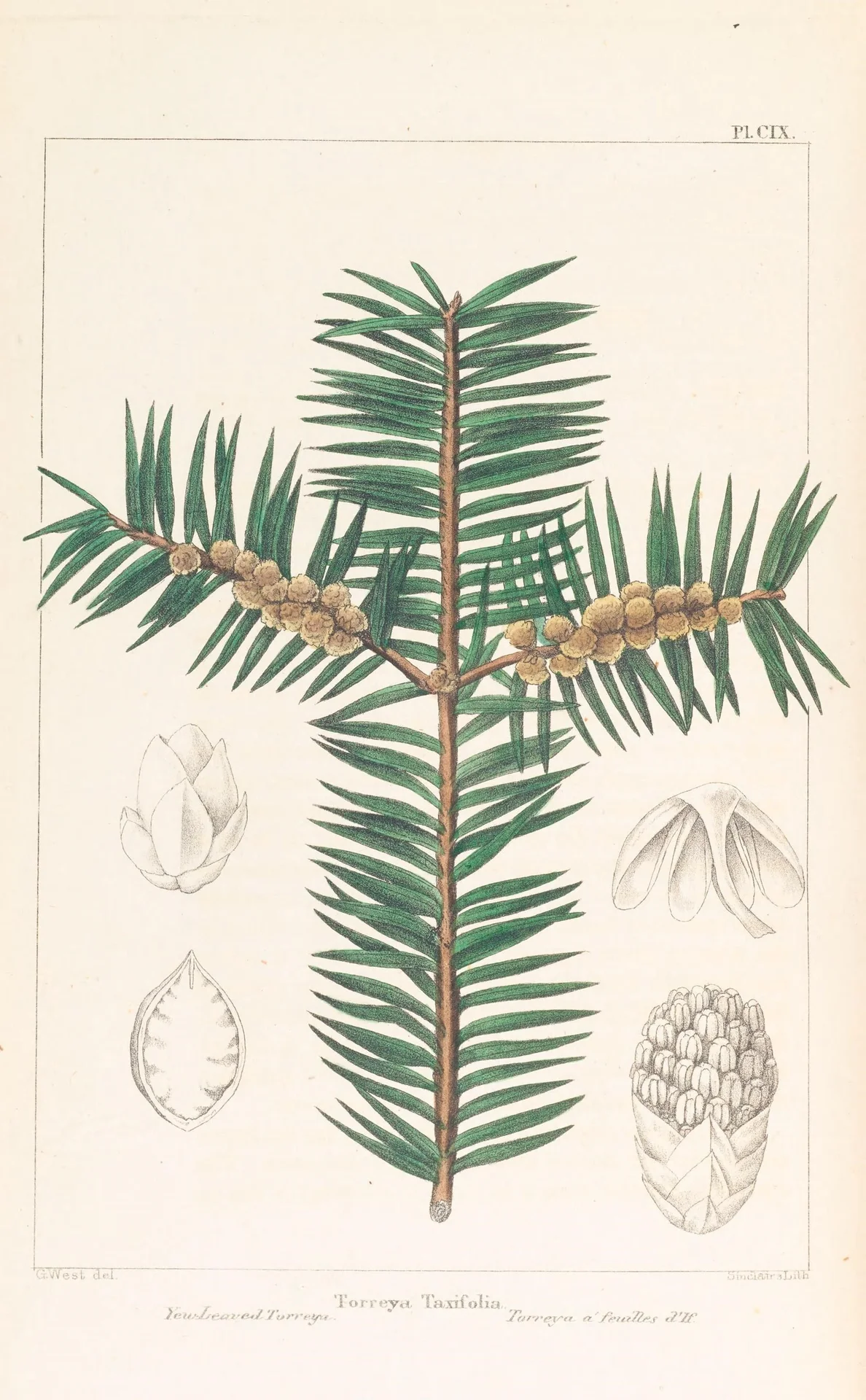
The stiff, needle-like leaves are arranged in two ranks along the twigs and measure 1.5 to 3.8 centimeters in length. They are glossy green above and lighter green below, marked by two narrow, grayish stomatal bands. When crushed, the foliage releases a sharp, highly pungent, and resinous odor, which gave rise to its common name, stinking-cedar.
This species is subdioecious, bearing male and female cones on separate plants or occasionally on different branches of the same tree. Pale yellow male pollen cones, measuring 5 to 7 millimeters, develop along the underside of year-old shoots. Solitary or small groups of female cones mature over 18 months into a drupe-like structure, consisting of a single large seed completely enclosed in a fleshy, dark green aril that becomes streaked with purple.
Flowering season
Pollen cones and female cones are produced in early spring, typically from March to April.
Jan
Feb
Mar
Apr
May
Jun
Jul
Aug
Sep
Oct
Name
Dec
Applications
Historically, the wood of Torreya taxifolia was highly valued for its exceptional durability and resistance to decay. Because the timber is long-lasting, it was commonly harvested for practical construction purposes before the species became endangered.
Construction Timber: Used to manufacture shingles, fence posts, and riverboats, particularly during the 19th and early 20th centuries.
Furniture Making: The light yellow, fine-grained wood was occasionally crafted into durable furniture pieces.
Holiday Decoration: Young wild trees were frequently harvested by locals to be used as traditional Christmas trees.
Conservation Horticulture: Today, the species is cultivated in botanical gardens and arboreta purely for genetic safeguarding and scientific research.
Interesting facts
Torreya taxifolia is considered a classic example of a glacial relict and a paleoendemic species. Fossil evidence shows that the genus was widely distributed across the Northern Hemisphere during the Jurassic and Tertiary periods before being pushed south by advancing glaciers.
The discovery of the species is tied to a tragic historical event. In 1833, Hardy Bryan Croom, a North Carolina lawyer and passionate botanist, discovered the tree along the Apalachicola River, but he and his family perished in a shipwreck in 1837 before its formal description was published by George Arnott Walker-Arnott in 1838.
Local residents historically referred to the tree as gopherwood, linking it to the wood used to build Noah's Ark in biblical stories. The common name stinking-cedar refers to the unpleasant, skunk-like odor released when the wood is cut or the leaves are bruised.
The citizen-led group called the Torreya Guardians has bypassed traditional government channels to perform assisted migration. Since 2005, they have illegally or semi-legally distributed and planted seeds hundreds of miles north in the Appalachian Mountains, arguing that northern Florida is merely a temporary glacial refuge and not the plant's true climatic home.
In October 2018, Category 5 Hurricane Michael directly struck the native habitat of the species, destroying 80% to 90% of the surrounding forest canopy and severely damaging the remaining wild population.