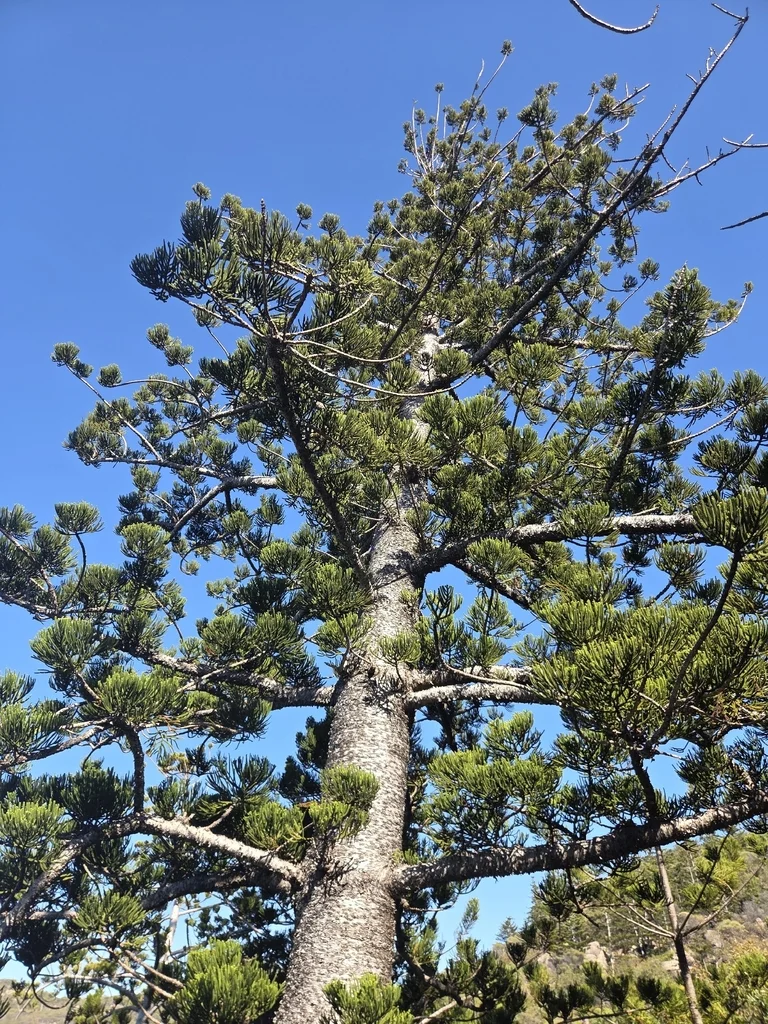
Towering majestically above the subtropical rainforest canopies of eastern Australia and New Guinea, Araucaria cunninghamii is a living testament to ancient botanical lineages. Often living for more than 450 years, this colossal conifer can reach staggering heights of up to 60 meters, dominating the skyline of its native habitats. The tree was introduced to European science by the explorer Allan Cunningham, who collected the first specimens in the 1820s.
Commonly known as the hoop pine due to the distinctive horizontal bands of its peeling bark, this species is the only member of the Eutacta section native to continental mainland areas. It thrives in dry rainforest environments, from coastal plains up to mountainous elevations of 2,700 meters in New Guinea. Its impressive stature and unique architectural form make it a striking feature of both wild landscapes and historical timber plantations.
Taxonomy
∟царствоPlantae
∟divisionTracheophytes(Vascular Plants)
∟subdivisionSpermatophytes(Seed plants)
∟superclassGymnospermae(Gymnosperms)
∟divisionPinophyta(Conifers)
∟subclassCupressidae
∟orderAraucariales(Southern pines and monkey-puzzles)
The structural development of Araucaria cunninghamii reveals a fascinating transition from juvenile to mature foliage. Young trees bear loosely arranged, awl-shaped leaves that are intensely sharp, measuring 1 to 2 centimeters in length. As the tree matures and reaches the canopy, the foliage transforms into scale-like, incurved leaves that densely overlap along the ascending branches.
This species is monoecious, with both male and female cones occurring on the same tree, though cone production may only begin after decades of growth. The cylindrical male pollen cones grow at the tips of branches, reaching 2 to 3 centimeters in length. The female seed cones are massive and ovoid, measuring up to 10 centimeters long and 8 centimeters wide, taking approximately 18 months to fully mature.
Upon reaching maturity, the heavy female cones shatter directly on the branches. This disintegration releases numerous nut-like, winged seeds that are easily dispersed by the wind. The bark of the trunk is highly resinous, copper-colored in its youth, and becomes dark grey and deeply furrowed with age, characteristically peeling off in thin, horizontal, hoop-like bands.
Applications
The high-quality timber of Araucaria cunninghamii has made it a cornerstone of the forestry industry in both Australia and Papua New Guinea. Its pale yellow-brown, fine-grained wood is exceptionally versatile and highly prized. Historically and in modern times, it is extensively used for manufacturing plywood, fine furniture, veneers, flooring, and even in boat construction.
Long before European settlement, Indigenous Australians recognized the valuable properties of this towering conifer. They traditionally harvested the thick, natural resin that exudes from the bark, utilizing it as a potent, natural cement for toolmaking and other practical applications. Today, due to the historical depletion of natural stands through intensive logging, the commercial timber supply is predominantly sourced from managed plantations.
Interesting facts
The ecological interactions of Araucaria cunninghamii in plantation settings present unique challenges and fascinating biological dynamics.
In Queensland plantations, the trees often fall victim to the native rat species, Rattus tunneyi, which burrows down to consume the roots of semi-mature trees, ultimately killing them.
To combat significant pest problems caused by mealybugs and scale insects, forestry managers successfully employ a natural predator: the ladybird beetle Cryptolaemus montrouzieri.
The species is divided into two distinct geographical varieties: Araucaria cunninghamii var. cunninghamii in Australia and Araucaria cunninghamii var. papuana, which grows at much higher altitudes in the mountains of New Guinea.
Despite heavy historical logging, magnificent ancient specimens continue to thrive in protected areas like Lamington National Park, where a popular walking track is named in honor of the hoop pine.
Araucaria cunninghamii var. glauca is a striking evergreen conifer recognized for its silvery-blue glaucous foliage and symmetrical, pyramidal growth. This …