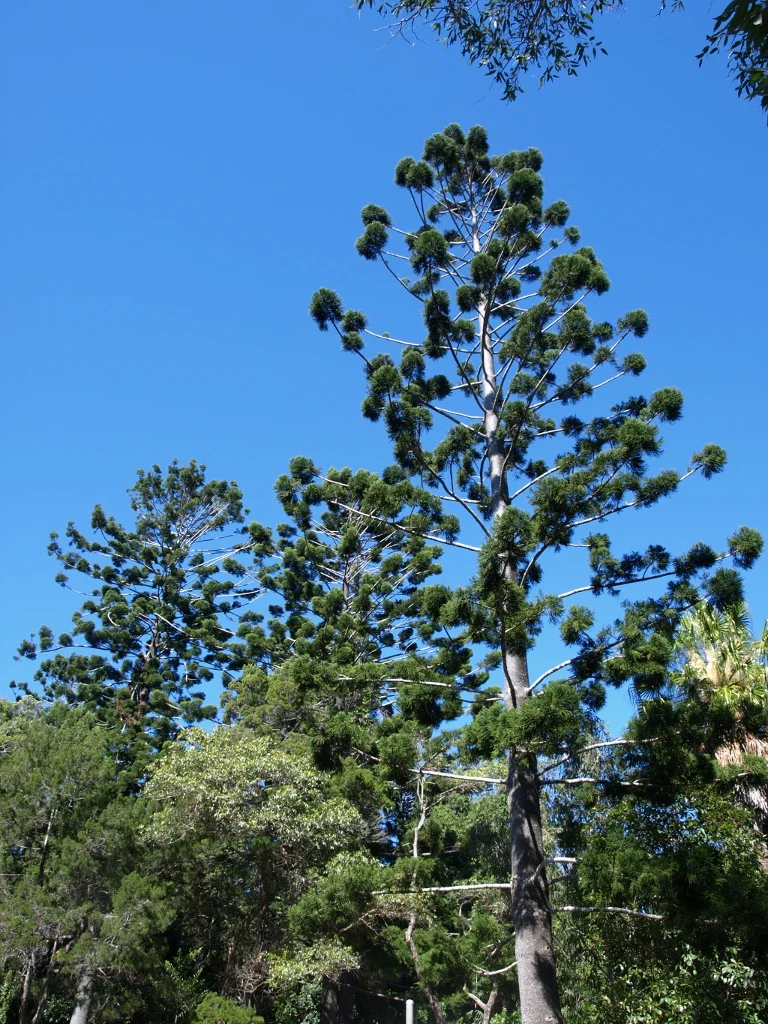
Typical hoop pine
(Araucaria cunninghamii var. cunninghamii)
Australian Hoop Araucaria
Hoop Pine
Moreton Bay Pine
Colonial Pine
IUCN: Least Concern
#5499E3
#406480
#5A6345
#1B291C
#272E19
Plant palette
Araucaria cunninghamii var. cunninghamii: Australian Hoop Pine
Thriving in the subtropical rainforests and coastal environments of Oceania, Araucaria cunninghamii var. cunninghamii shapes the canopy with its magnificent evergreen presence. This nominate variety of the Hoop Pine forms an integral part of the native flora across eastern Australia and New Guinea. It boasts an imposing stature and holds significant ecological and economic value throughout its native range.
The tree derives its distinctive common name from its unusual bark, which forms prominent horizontal bands or hoops that persist long after the tree has died. It traces its evolutionary lineage back to the Mesozoic era, standing as a living testament to prehistoric forests within the Araucariaceae family.
Taxonomy
∟царствоPlantae
∟divisionTracheophytes(Vascular Plants)
∟subdivisionSpermatophytes(Seed plants)
∟superclassGymnospermae(Gymnosperms)
∟divisionPinophyta(Conifers)
∟subclassCupressidae
∟orderAraucariales(Southern pines and monkey-puzzles)
This colossal conifer features a straight, cylindrical trunk and a symmetrical, pyramidal crown that gradually becomes more open and irregular with advancing age. The dark brown to blackish bark continually peels in distinct horizontal strips. Foliage on this species displays dramatic dimorphism, altering its physical structure as the plant matures.
Juvenile leaves appear awl-shaped, sharply pointed, and arrange themselves spirally around the young branchlets. In sharp contrast, adult leaves grow shorter, scale-like, and tightly imbricate, overlapping each other along the mature stems. As a monoecious species, a single tree produces both slender male pollen cones and massive, ovoid female seed cones.
Applications
This variety ranks among the most critical native plantation timber species in the Australian forestry sector. Its pale, fine-grained wood works effortlessly, making it highly desirable for fine furniture making, cabinetry, premium plywood, and solid flooring. Urban planners and landscape architects also frequently plant it as a striking ornamental specimen in large civic spaces.
Interesting facts
Botanists named the species in honor of Allan Cunningham, a prominent 19th-century botanical explorer and collector.
The unique horizontal hoops of bark resist decay and often remain completely intact on the forest floor after the inner wood rots away.
Once fully established, these towering trees exhibit remarkable drought tolerance and adapt to diverse soil conditions.
Major taxonomic databases list several historical synonyms for this variety, including Araucaria glauca and Araucaria cunninghamii subsp. tahitiensis.