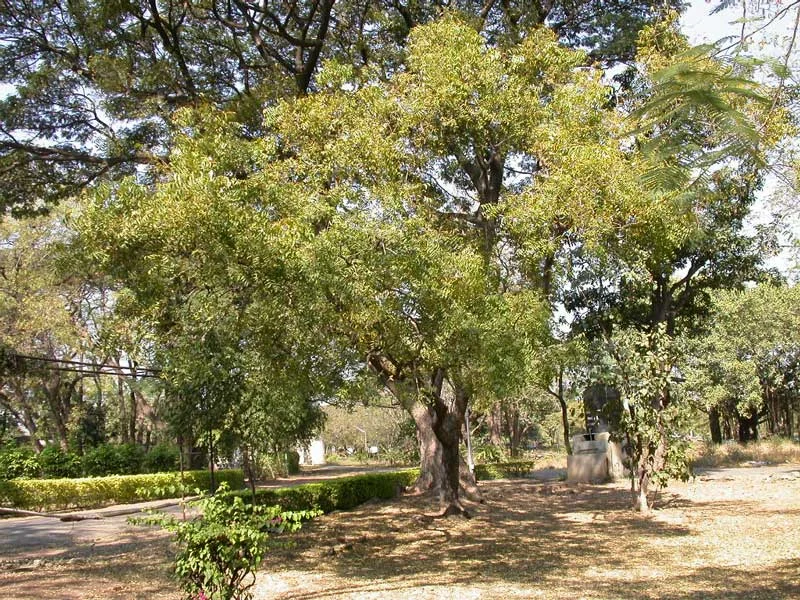
Azadirachta: Botanical Overview, Uses and Ecological Importance
Native to the Indomalayan realm, the trees of the genus Azadirachta play a vital role in both traditional agriculture and medicine. These evergreen trees are highly valued for their resilient nature and ability to thrive in arid environments. They are widely recognized for producing complex chemical compounds that act as natural pest deterrents.
Throughout their native range, the plants have been integrated into agroforestry and ecological restoration projects. Their fast growth and dense canopy provide shade and wind protection in dry tropical regions.
Members of this genus typically develop as large, evergreen trees with a short, robust trunk and deeply furrowed brown bark. The leaves are alternately arranged along the branches and are pinnately compound. Each leaflet features a strongly asymmetrical base and a coarsely serrate margin.
The flowers are arranged in large, axillary panicles and are predominantly bisexual. They consist of five free white petals and a cylindrical staminal tube containing ten stamens. The resulting fruit is an ellipsoid drupe that turns yellow when ripe, enclosing one or two seeds.
Flowering season
Spring to Summer
Jan
Feb
Mar
Apr
May
Jun
Jul
Aug
Sep
Oct
Name
Dec
Applications
The most significant commercial application of these plants is the extraction of neem oil from the seeds. This oil contains azadirachtin, a potent and environmentally friendly organic insecticide. It is widely used in organic farming to control a broad spectrum of agricultural pests.
In addition to pest control, the timber is highly valued for construction due to its natural resistance to termites. Various parts of the tree, including the leaves and bark, are also utilized in traditional medicine and cosmetics.
Interesting facts
The name of the genus is derived from the Persian words meaning "noble tree" or "free tree."
Extracts from these trees contain compound azadirachtin, which disrupts the growth cycle of insects without harming beneficial organisms.
In many tropical regions, these trees are planted for reforestation and to prevent soil erosion because of their deep root systems.
Azadirachta indica, commonly known as neem, is a fast-growing tropical evergreen tree famous for its medicinal properties, natural insecticide qualities, …
Discover how organic neem cake powder enriches garden soil, feeds foliage, and repels root pests. Complete guide to using neem cake fertilizer for plants.
Unlock lush foliage and subterranean pest protection with neem seed meal. Discover proven application ratios, soil blending methods, and organic growth tips.
Comparing margosa oil vs neem oil from Azadirachta indica? Discover differences in azadirachtin potency, processing methods, and practical application tips.
Discover how neem coated urea suppresses soil denitrification, reduces nitrogen leaching, and elevates crop yields through targeted agronomic application protocols.
Discover if margosa and neem are the same tree. Explore the botanical facts of Indian lilac or margosa, active compounds, oil extraction, and garden benefits.