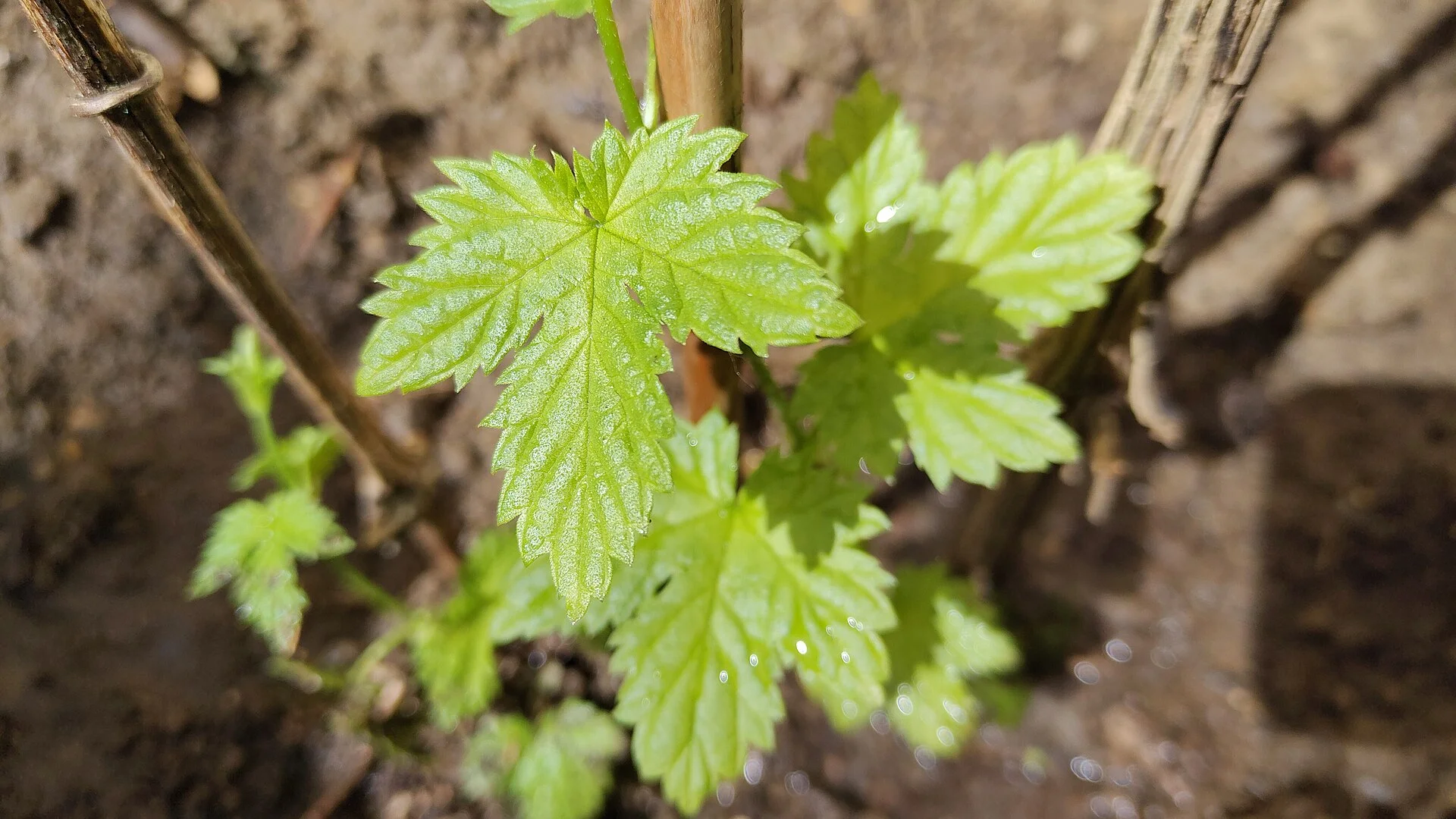
Unknown plant
(Humulus lupulus var. neomexicanus 'Yucca')
Yucca Hop
Yucca
Neomexicanus Yucca Hop
#726444
#AAA86E
#382A19
#C0D479
#929A49
Plant palette
Humulus lupulus var. neomexicanus 'Yucca' Hop Profile
Discovered in the arid mountain canyons of the American Southwest, Humulus lupulus var. neomexicanus subvar. 'Yucca' exhibits unique adaptations to drought and heat. This subvariety belongs to the neomexicanus botanical variety, which has evolved independently from European hops for thousands of years.
The 'Yucca' selection is prized by craft brewers and growers for its distinctive aromatic profile and resilience in low-water environments. It represents a growing interest in native North American hop genetics.
The morphology of Humulus lupulus var. neomexicanus subvar. 'Yucca' reflects its adaptation to drier climates. It grows as a herbaceous climbing vine, producing multiple vigorously growing bines from a hardy rootstock each spring.
The leaves are deeply lobed, often showing 5 to 7 sharp divisions, and are generally smaller and more dissected than those of European hop varieties. The leaves have a rough surface and serrated edges, and the stems are equipped with climbing hairs.
The female plants produce cone-like strobiles that are slightly more open and elongated than standard agricultural hops. These cones contain yellow lupulin glands that produce essential oils and bittering acids.
Flowering season
Late summer
Jan
Feb
Mar
Apr
May
Jun
Jul
Aug
Sep
Oct
Name
Dec
Applications
In the brewing industry, Humulus lupulus var. neomexicanus subvar. 'Yucca' is utilized as a flavoring and bittering agent for specialty craft beers. It imparts unique aromas of stone fruit, citrus, and native desert flora to the brew.
Because of its drought tolerance, it is also studied for sustainable agriculture in regions with limited water resources, where traditional European hop varieties struggle to survive.
Interesting facts
Unlike European hops that require high amounts of water, this subvariety has evolved to survive in arid southwestern climates.
It is named after the Yucca region or the characteristic desert plants where these wild hops are found.
Its genetic lineage is completely distinct from the classic noble hops of Europe, offering entirely new flavors to craft brewing.