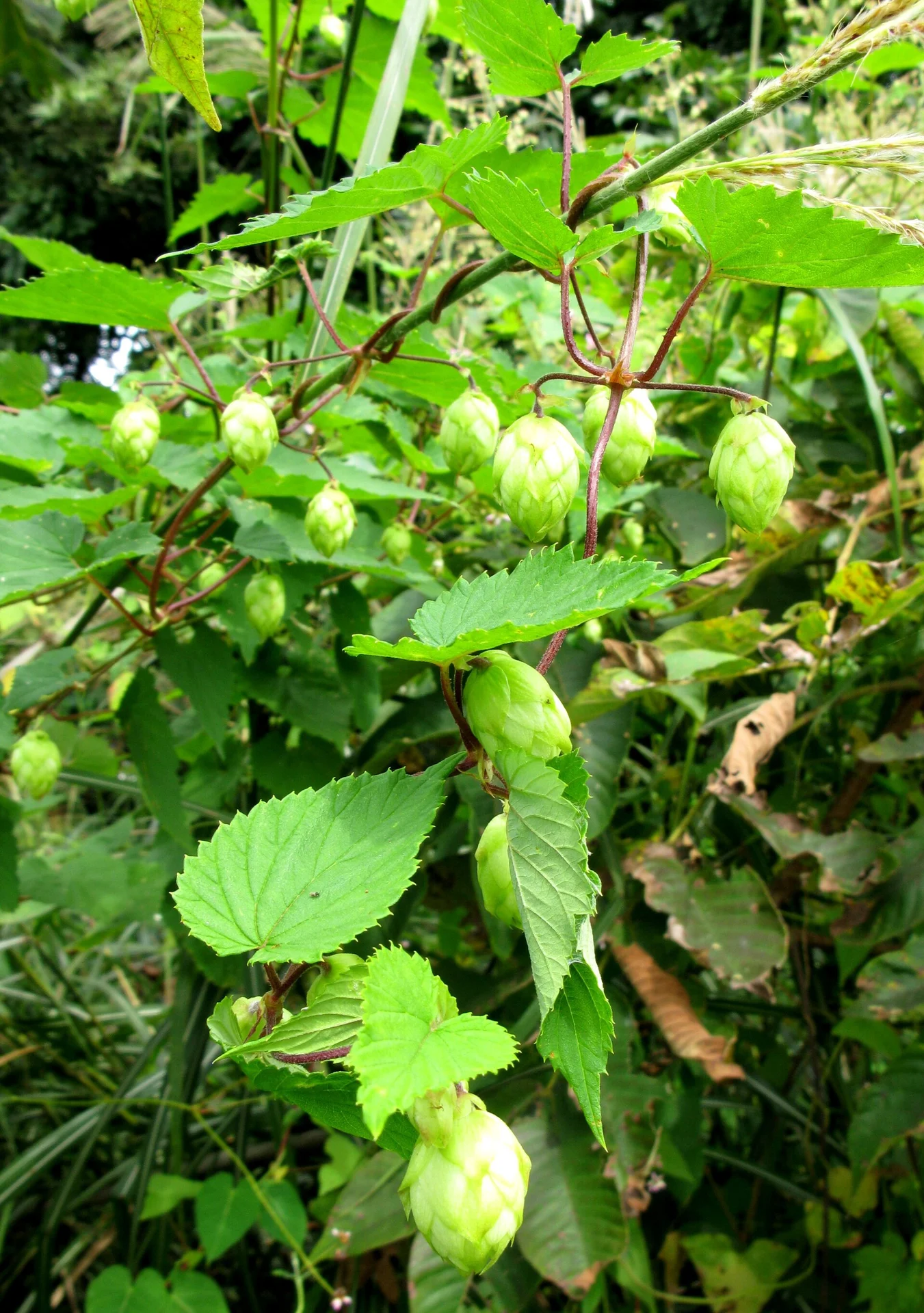
Heart-leaved common hop
(Humulus lupulus var. cordifolius)
Karahanasou
Yamahoppu
Mountain hop
Heartleaf hop
#112C06
#7CAE2B
#5E772B
#233106
#49782C
Plant palette
Humulus lupulus var. cordifolius (Karahanasou) - Botanical Profile
Native to the mountainous regions of East Asia, Humulus lupulus var. cordifolius grows as a climbing perennial herb in sunny fields and forest edges. Commonly known in Japan as Karahanasou or Yamahoppu (mountain hop), this wild relative of the commercial hop is valued both for its ecological role and culinary uses.
The variety is widely distributed across Hokkaido, northern Honshu, and northern China. It is easily distinguished from agricultural hop varieties by its specific growth habits and geographical range.
The morphology of Humulus lupulus var. cordifolius features twining stems that climb by clinging to neighboring vegetation. The stems and leaves are covered in hooked prickles that can cause minor pain and irritation upon contact.
The leaves are opposite, long-petioled, and broadly ovate, typically split into three distinct lobes with coarsely serrated margins. They measure about 10 to 15 centimeters in length.
This variety is dioecious, with separate male and female plants blooming from August to September:
Male Flowers: Produced in large, upright or drooping panicles consisting of small, greenish flowers.
Female Flowers: Form pinecone-like, ovoid strobiles (hops) measuring 2 to 3 centimeters, which hang from short stalks.
Root System: Composed of long stolons and thin, fibrous roots, occasionally developing small, fleshy tubers.
Flowering season
August to September
Jan
Feb
Mar
Apr
May
Jun
Jul
Aug
Sep
Oct
Name
Dec
Applications
The primary use of Humulus lupulus var. cordifolius is culinary, particularly in Japanese mountain vegetable cuisine (sansai). The young female strobiles are harvested in late summer or autumn and eaten as tempura.
Strobiles growing in shaded forest interiors tend to be larger, whiter, more aromatic, and less bitter than those in full sun. The seeds and cones also contain bitter compounds similar to commercial hops, showing potential for local flavoring applications.
Interesting facts
Locals refer to it as "mountain hop" (Yamahoppu) to differentiate it from cultivated brewing hops.
It can naturally hybridize with cultivated hop plants due to their close genetic relationship.
Its stems use specialized hook-like structures to climb, rather than wrapping tendrils like grapes.