Deep in the swampy rain forests of Southeast Asia and across the riverine basins of tropical Africa, a group of majestic canopy trees silently shapes the local ethnobotanical landscape. The genus Mitragyna, named for its peculiar stigma resembling a bishop's mitre, has long captured the attention of both traditional healers and modern pharmacologists.
These resilient trees thrive in hot, humid environments, often anchoring themselves in wetlands where few other woody species can persist. Over centuries, communities have integrated their leaves into daily rituals and medicinal practices, making them a cornerstone of regional folklore.
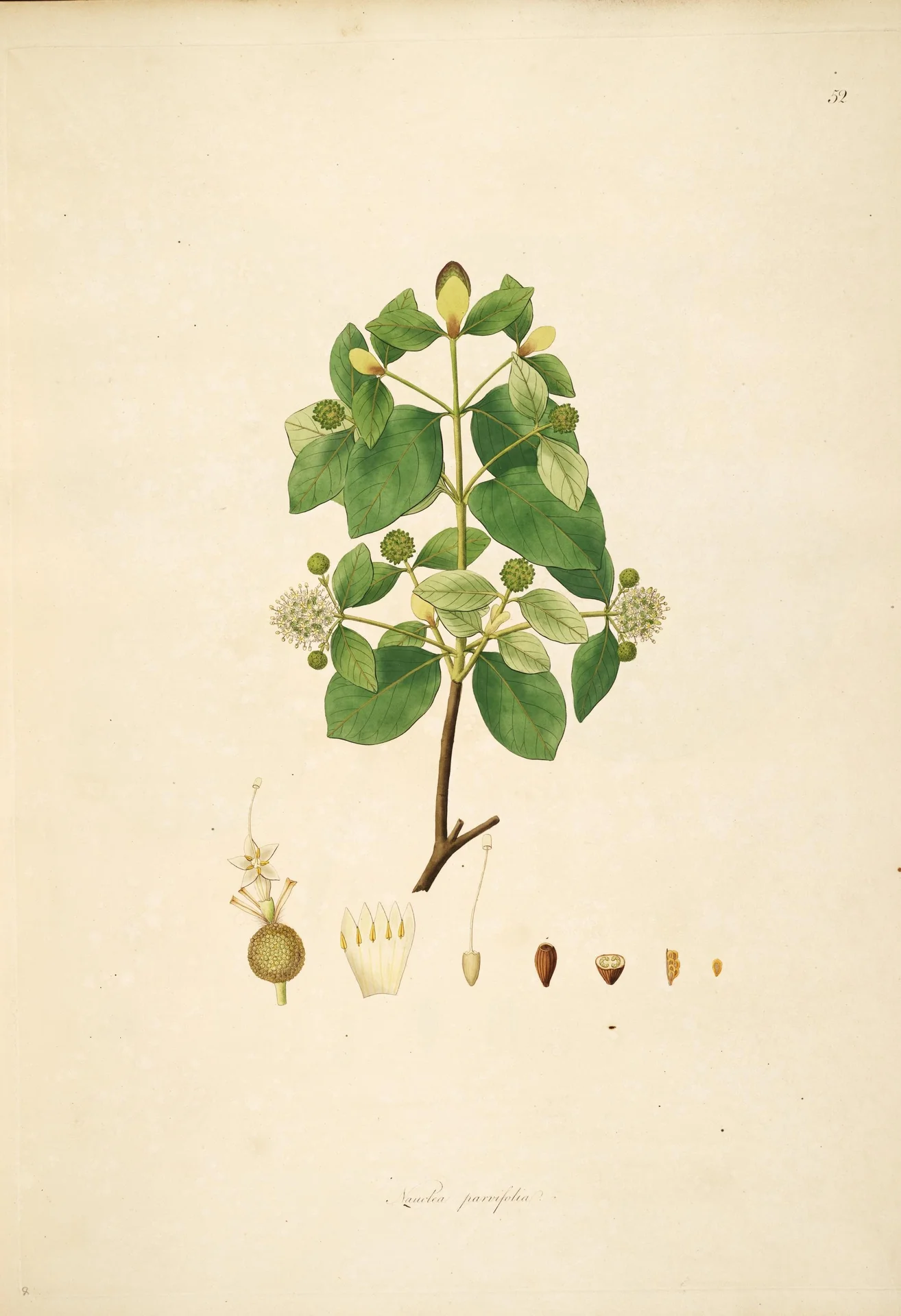
Botanical illustration
Фото: BioDivLibrary / Лицензия: Public Domain Mark
Morphology
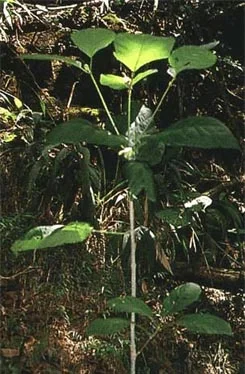
Members of the Mitragyna genus grow as small to large deciduous or evergreen trees, characterized by opposite, simple leaves with prominent, often reddish-purple midribs. The young foliage is protected by large, erect, and deciduous interpetiolar stipules that press closely together over the flattened apical buds.
The inflorescences are dense, spherical heads clustered in terminal cymes or umbels, adorned with spathulate bracteoles. Each small, zygomorphic flower features a cream-colored or yellowish-green funnel-shaped corolla with five lobes and five fertile stamens inserted near the throat.
The inferior ovary consists of two compartments, each containing numerous ovules attached to a pendulous placenta. Upon maturation, the flowers give way to spherical fruiting heads composed of woody capsule fruits that release small, flattened, winged seeds.
Applications
Several Mitragyna species hold significant commercial value for their durable, uniform timber. The wood of species like M. parvifolia and M. diversifolia is utilized in construction, furniture making, and delicate wood carvings, while African species like M. ledermannii supply high-quality plywood.
In traditional medicine, these plants are renowned for their active indole alkaloids, such as mitragynine and mitraphylline. While M. speciosa is famous for its dual stimulating and analgesic properties, the bark and leaves of African representatives like M. inermis serve as local remedies for fevers and dysentery.
Interesting facts
Bishop's Mitre Connection: The botanical name is derived from the Greek words mitra (headband or mitre) and gyne (woman), referencing the unique shape of the flower's stigma which resembles a bishop's mitre.
The Naming Dispute: In 1837, the genus was first described as Mamboga, but because the description was poorly defined, taxonomists officially preserved the later name Mitragyna to maintain nomenclature stability.
Alkaloid Diversity: These trees produce a wide range of specialized alkaloids, including mitrinermine, which has been shown to exhibit local anesthetic activity and affect blood pressure.
African Synonyms: The African species were once split into the separate genera Hallea and later Fleroya, but modern genetic analysis has firmly reunited them under the single genus.