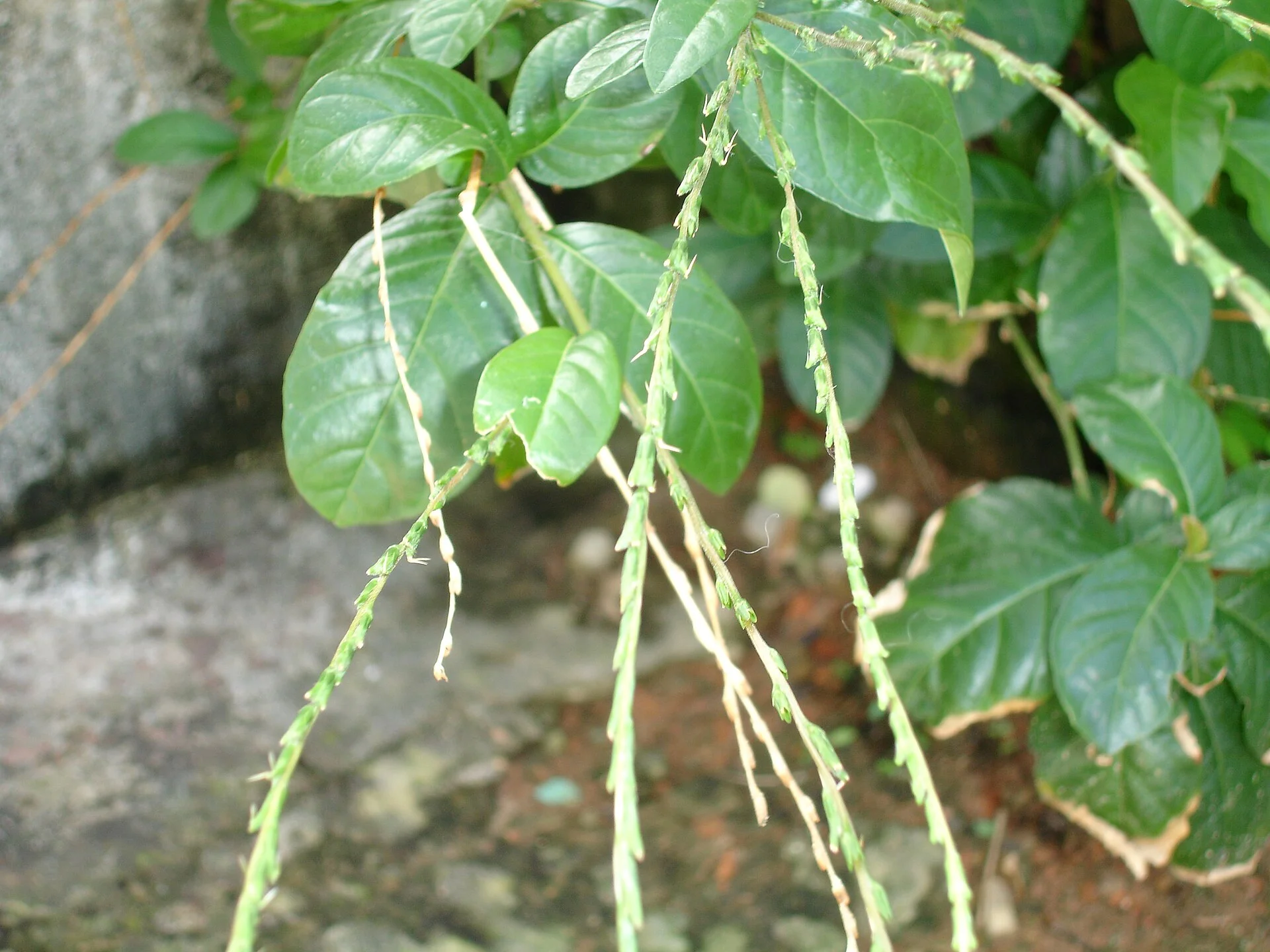
Crushing the foliage of Petiveria alliacea releases a remarkably pungent scent, a stark reminder of the volatile sulfur compounds that have made this tropical herb both a revered traditional remedy and a nuisance to cattle ranchers. Found thriving in clearings, forests, and thickets from Florida to South America, this deeply rooted perennial holds a prominent place in indigenous medicine and folklore. Its unassuming greenish-white flowers belie a potent chemical profile that continues to attract significant scientific and cultural interest.
Often known as Guinea henweed or anamú, the plant flourishes in a variety of disturbed and natural habitats. It adapts easily to different environments, forming dense patches that are easily identifiable by their distinct, lingering odor.
Petiveria alliacea grows as an herbaceous perennial or subshrub, typically reaching heights between 30 and 200 centimeters. It develops a robust taproot and erect stems that can become somewhat woody at the base, ranging from finely pubescent to completely glabrous.
The alternate, simple leaves are slightly leathery and emit a powerful garlic-like aroma when bruised. The leaf blades measure up to 20 centimeters in length and 7 centimeters in width, featuring an elliptic to obovate shape, a cuneate base, and an acute to acuminate apex.
Its inflorescences consist of slender, often drooping racemes that measure between 8 and 40 centimeters in length. The small flowers lack true petals, instead exhibiting four petaloid sepals that may be white, greenish, or pale pink. The distinctive fruit is a striated achene, 7 to 10 millimeters long, topped with one to three recurved hooks or spines that facilitate seed dispersal by attaching to animal fur.
Flowering season
Flowering occurs year-round in tropical regions, and from spring to autumn in the northernmost parts of its range.
Jan
Feb
Mar
Apr
May
Jun
Jul
Aug
Sep
Oct
Name
Dec
Applications
The entire plant, particularly the leaves and roots, is extensively utilized in traditional medicine systems across Central and South America. Decoctions and infusions are commonly prepared to address gastrointestinal discomfort, respiratory conditions such as asthma and bronchitis, and various nervous system ailments.
Topical treatments: Crushed fresh leaves and poultices are applied directly to the skin to treat infections, ulcers, and muscular pain.
Respiratory relief: The strong-smelling leaves are frequently crushed and inhaled to alleviate headaches and sinusitis.
Pest control: Extracts and macerations are widely used as natural insecticides to repel mosquitoes, ticks, and lice.
Modern pharmacological research has identified numerous active metabolites in the plant, particularly polysulfides like dibenzyl trisulfide, which demonstrate notable antimicrobial and potential antitumoral properties.
Interesting facts
The pungent nature of Petiveria alliacea has a tangible impact on local agriculture, as livestock grazing on the plant produce milk and meat tainted with a distinct garlic flavor. Furthermore, it is known to induce abortions in grazing animals, making it a problematic weed in pasturelands.
Spiritual significance: In various Afro-Brazilian and Caribbean traditions, such as Candomblé and Umbanda, the plant is highly regarded for its spiritual properties and is used in rituals to ward off negative energies and evil spirits.
Chemical defense: The roots contain unique cysteine sulfoxide derivatives, structurally related to those found in garlic and onions, which serve as potent defense mechanisms against herbivores.
Lachrymatory agent: The plant produces a tear-inducing compound similar to the lachrymatory factor of onions, though it is synthesized through an entirely different enzymatic pathway.