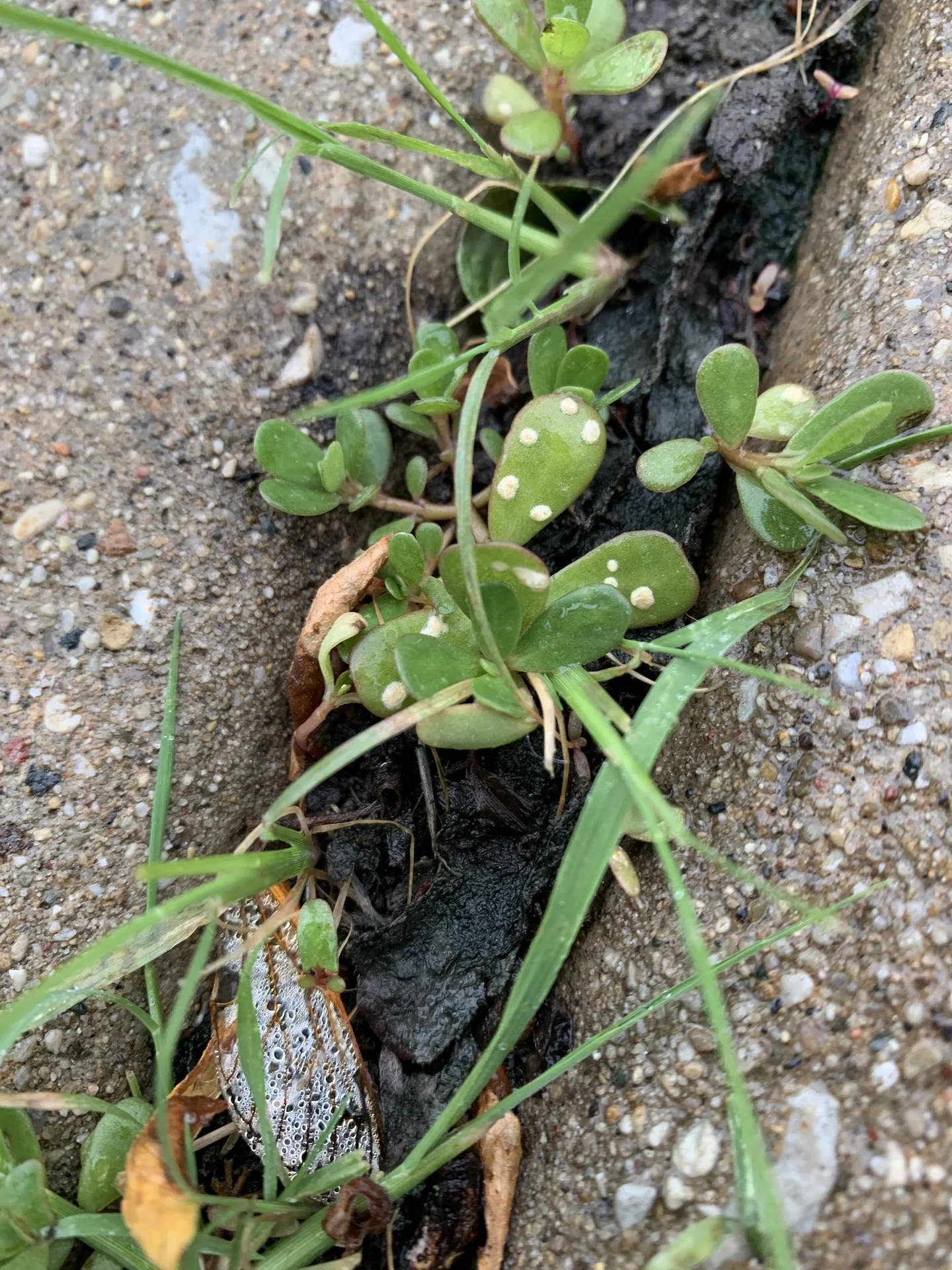
Typical Common Purslane
(Portulaca oleracea subsp. oleracea)
Baldroega
Beldroega
Beldroega-de-comer
Common purslane
Portulaca oleracea subsp. oleracea: The Common Purslane
Formally documented by Carl Linnaeus in his foundational 1753 work Species Plantarum, Portulaca oleracea subsp. oleracea serves as the autonymic subspecies of the widely distributed common purslane.
This herbaceous succulent grows natively in continental Portugal and the Madeira archipelago, while botanical records indicate it was historically introduced to the Azores.
The plant exhibits a sprawling, prostrate growth habit with smooth, reddish-purple succulent stems radiating from a central taproot.
Its leaves are distinctively fleshy, flat, and spatulate or obovate, clustering near the stem tips and nodes. Small, five-petaled yellow flowers emerge from the leaf axils, opening strictly during warm, sunny mornings.
Following pollination, the plant produces an oval capsule that splits open around the middle to release numerous tiny, glossy black seeds.
Flowering season
Summer
Jan
Feb
Mar
Apr
May
Jun
Jul
Aug
Sep
Oct
Name
Dec
Applications
This subspecies is historically recognized as an edible plant, a fact reflected in common Portuguese names like beldroega-de-comer.
The succulent leaves and stems are occasionally consumed raw in salads or cooked as a leafy vegetable, offering a distinctive, slightly tart culinary experience.
Interesting facts
It serves as the type subspecies of the Portulaca oleracea aggregate, establishing the baseline morphological characteristics for the entire group.
The plant utilizes Crassulacean acid metabolism (CAM) photosynthesis under drought stress, which accounts for its sour flavor in the morning.
A single plant can produce tens of thousands of seeds, contributing to its success as a pioneering species in disturbed soils.
Geography of distribution
Portugal (Continental, Azores, Madeira)
Sources
Linnaeus, C. (1753). Species Plantarum. 1: 445.
Sequeira M, Espírito-Santo D, Aguiar C, Capelo J & Honrado J (Coord.) (2010). Checklist da Flora de Portugal (Continental, Açores e Madeira).
Global Biodiversity Information Facility (GBIF) - Portulaca oleracea subsp. oleracea.