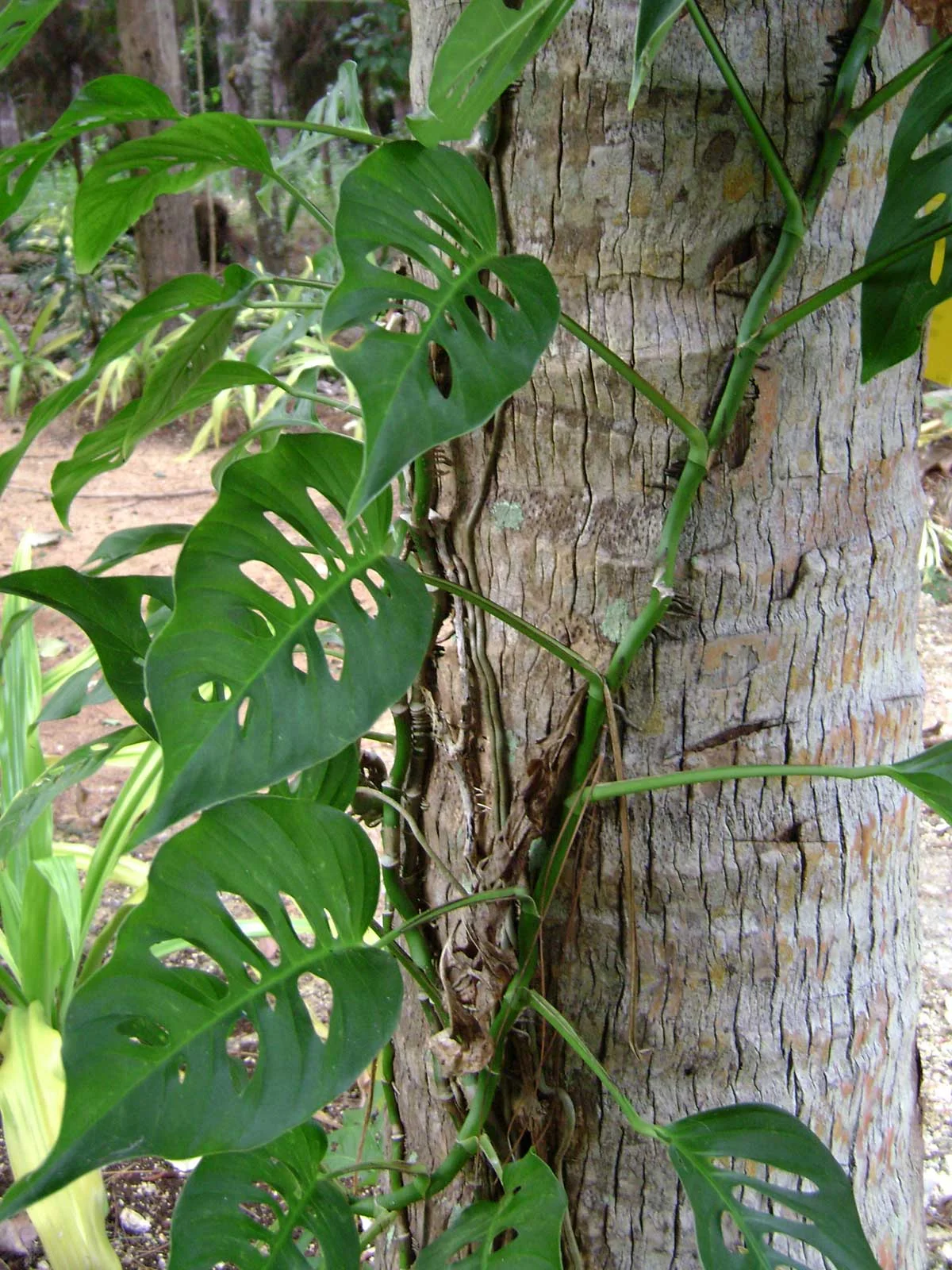
Scaling the towering trunks of wet tropical rainforests from Southeast Asia to Australia, these relentless climbers use specialized roots to reach for the canopy. Epipremnum species thrive in the humid shade of the forest floor, utilizing skototropism to seek out darkness and locate host trees.
In their juvenile stage, these evergreens are highly sought-after indoor plants due to their heart-shaped, beautifully variegated leaves. However, in their native wild habitats, mature vines can grow to enormous sizes, drastically transforming their leaf structure to adapt to the bright sunlight of the upper forest layers.
The growth form of Epipremnum is characterized by a high-climbing hemiepiphytic habit, supported by two distinct types of adventive roots. Clinging roots emerge from the stem nodes to anchor the vine to host trees, while longer feeding roots descend from internodes to draw nutrients from the soil.
A striking morphological feature is the leaf dimorphism between growth stages. Juvenile plants possess small, entire, heart-shaped leaves, whereas mature specimens develop giant leaves up to 60 centimeters long that often become pinnately lobed or develop natural perforations near the midrib.
The inflorescence consists of a dense, cylindrical spadix enclosed by a canoe-shaped spathe, which opens flat during the flowering phase. Individual flowers are bisexual and lack a perianth, eventually producing small berries filled with sticky pulp and curved seeds.
Applications
Traditional medicine systems across the Pacific and Asia utilize various parts of these vines. In Vanuatu, women consume the tips of the aerial roots of Epipremnum pinnatum to facilitate childbirth, while Chinese traditional practices apply the plant to treat fractures, burns, and skin ulcers.
Modern pharmacological studies have revealed that these plants contain compounds with significant anti-inflammatory, analgesic, and potential anticancer properties. Additionally, they are highly valued in interior design for their exceptional ability to purify indoor air by filtering toxic compounds such as formaldehyde and carbon monoxide.
Beyond medicinal uses, the durable stems of certain species are traditionally woven into ceremonial baskets in Tonga. Historically, the toxic sap from the fruits and spathes of these vines was also used by indigenous groups to prepare arrow poisons.
Interesting facts
The scientific name Epipremnum directly reflects the plants' lifestyle, originating from the Greek words meaning 'upon a tree stump'. This refers to the characteristic way the vines scale host trees in their native tropical environments.
Although currently restricted to tropical and subtropical regions, fossilized seeds of the extinct species Epipremnum crassum discovered in Denmark and Western Siberia reveal that the genus once flourished in Europe during the Miocene and Oligocene epochs.
To locate host trees in the dense jungle understory, young seedlings exhibit a rare growth response called skototropism. Instead of growing towards the light, they grow towards the darkest shadows, which typically indicate the presence of a solid tree trunk.
In the Solomon Islands, these climbing plants play a crucial ecological role as a primary food source. The endemic prehensile-tailed skink feeds extensively on the young leaves and inflorescences of the local wild vines.